

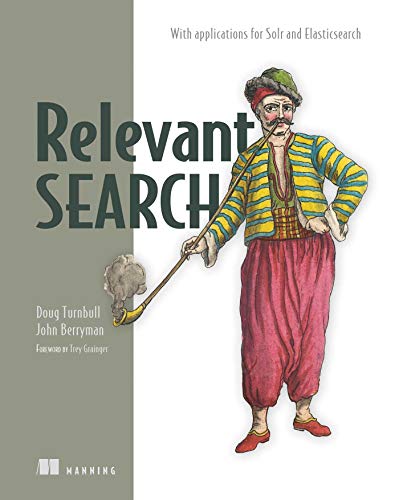
Ebook Info
- Published: 2016
- Number of pages: 360 pages
- Format: PDF
- File Size: 10.80 MB
- Authors: Doug Turnbull
Description
SummaryRelevant Search demystifies relevance work. Using Elasticsearch, it teaches you how to return engaging search results to your users, helping you understand and leverage the internals of Lucene-based search engines.Purchase of the print book includes a free eBook in PDF, Kindle, and ePub formats from Manning Publications.About the TechnologyUsers are accustomed to and expect instant, relevant search results. To achieve this, you must master the search engine. Yet for many developers, relevance ranking is mysterious or confusing. About the BookRelevant Search demystifies the subject and shows you that a search engine is a programmable relevance framework. You’ll learn how to apply Elasticsearch or Solr to your business’s unique ranking problems. The book demonstrates how to program relevance and how to incorporate secondary data sources, taxonomies, text analytics, and personalization. In practice, a relevance framework requires softer skills as well, such as collaborating with stakeholders to discover the right relevance requirements for your business. By the end, you’ll be able to achieve a virtuous cycle of provable, measurable relevance improvements over a search product’s lifetime. What’s InsideTechniques for debugging relevance?Applying search engine features to real problems?Using the user interface to guide searchers?A systematic approach to relevance?A business culture focused on improving searchAbout the ReaderFor developers trying to build smarter search with Elasticsearch or Solr.About the AuthorsDoug Turnbull is lead relevance consultant at OpenSource Connections, where he frequently speaks and blogs. John Berryman is a data engineer at Eventbrite, where he specializes in recommendations and search.Foreword author, Trey Grainger, is a director of engineering at CareerBuilder and author of Solr in Action.Table of ContentsThe search relevance problem Search under the hood Debugging your first relevance problem Taming tokens Basic multifield search Term-centric search Shaping the relevance function Providing relevance feedback Designing a relevance-focused search applicationThe relevance-centered enterprise Semantic and personalized search
User’s Reviews
Editorial Reviews: About the Author Doug Turnbull is Staff Relevance Engineer at Spotify and is the former Chief Technical Officer at OpenSource Connections. He is the co-author of the book Relevant Search, and contributed chapters 10-12 on “Learning to Rank”, “Automated Learning to Rank with Click Models”, and “Overcoming Bias in Learned Relevance Models”.John Berryman is a data scientist at EventBrite where he specializes in recommendations and search. He is interested in the potential of integrating semantic understanding into search and discovery applications.
Reviews from Amazon users which were colected at the time this book was published on the website:
⭐Although the book does create and environment abundant of useful knowledge pertaining to relevance problems within the search domain, it falls short in the majority of chapters by focusing too much on the organizational benefits of focusing on search relevance rather than on the applied problems that it tries to solve. I feel like the book would have been a better read had it been condensed to a thoughtfully organized 5 chapters instead of the broad stroked attempt at encompassing all things related to relevance. A majority of the readers will choose this book in order to unlock the potential that Elasticsearch and Solr have for modeling relevance within a search application. To that endeavor, this book excels in many ways. Its description of signals within documents and the emphasis on correct tokenization and analysis before indexing are great lingo and concepts to have when taking on the role of a search engineer. The examples and explanations are great and the authors do a good job of highlighting the importance of debugging relevance problems with the features available in the technologies used. As far as the concepts presented regarding how to build queries that run against an index engineered with relevance in mind I was enthralled by the content presented. And although the book was at times verbose and riddled with fluff pieces meant to sound joking and entertaining, they were mostly passable and one could still enjoy the thoughtfulness of the examples and code presented. However, at the end of the book, the content became increasingly unrelated and unfocused. The last 3 chapters could all be condensed into one “putting it all together” chapter. Not only that but the mention of the iterative cycle of relevance and collaborative filtering feel completely out of place within the intended goal of the book. The mentions of machine learning are appropriate but feel incredibly “hand-wavy” and some of the writing feels like it lacks depth. The organization of the book could have benefited from a larger and deeper focus on “term-centric” vs “field-centric” queries and the features available in the search engine to support those types of searches. Although the book is a decent introduction to the field I feel like it loses its focus at times and the end of it is a total miscalculation on its target audience.
⭐I expected more technical depth in how to build complex queries and understand what Lucene is doing with those queries “under the hood”. This book barely touched on that, only briefly discussing indices, distributed computing and doc values, and not going into say how queries are compiled (are they even compiled? I don’t know after reading this book). I also expected some discussion on how to combine several different types of rankings. I didn’t really get that either, since the authors kind of stop after discussing how to combine 2 or 3 factors in simplistic ways. If you need to use lots of advanced function scores, scripted scores, and nested document types, this probably won’t be more helpful than stack overflow. As a basic primer, it is a bit better than the elasticsearch intro book, though that is free online.
⭐This book is a comprehensive entry level book to search engine. I helped me understand how search works.
⭐Very clear on the explanation and the analysis. Thank you!!
⭐An excellent book which weaves the process of building a great search application with the tools available to do so.
⭐Really well written
⭐Great book
⭐Very informative book about Search Technology !
⭐Search has different dimensions. There are great books about search technologies and even others about logs analytics or user experience. This is the first that deals with something that is usually overseen: relevancy doesn’t happen out of the box with a default “TF-IDF” algorithm. To create “intelligent behaviour” it needs a mix of user analysis, content preparation and search technologies. And this is a different kind of engineering.
Keywords
Free Download Relevant Search: With applications for Solr and Elasticsearch 1st Edition in PDF format
Relevant Search: With applications for Solr and Elasticsearch 1st Edition PDF Free Download
Download Relevant Search: With applications for Solr and Elasticsearch 1st Edition 2016 PDF Free
Relevant Search: With applications for Solr and Elasticsearch 1st Edition 2016 PDF Free Download
Download Relevant Search: With applications for Solr and Elasticsearch 1st Edition PDF
Free Download Ebook Relevant Search: With applications for Solr and Elasticsearch 1st Edition