Ebook Info
- Published: 2002
- Number of pages: 488 pages
- Format: PDF
- File Size: 32.47 MB
- Authors: Cristian S. Calude
Description
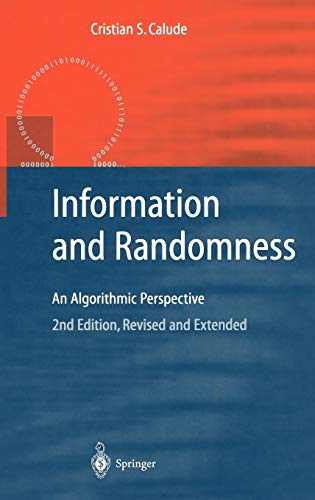
The first edition of the monograph Information and Randomness: An Algorithmic Perspective by Crist ian Calude was published in 1994. In my Foreword I said: “The research in algorithmic information theory is already some 30 years old. However, only the recent years have witnessed a really vigorous growth in this area. . . . The present book by Calude fits very well in our series. Much original research is presented. . . making the approach richer in consequences than the classical one. Remarkably, however, the text is so self-contained and coherent that the book may also serve as a textbook. All proofs are given in the book and, thus, it is not necessary to consult other sources for classroom instruction. ” The vigorous growth in the study of algorithmic information theory has continued during the past few years, which is clearly visible in the present second edition. Many new results, examples, exercises and open prob lems have been added. The additions include two entirely new chapters: “Computably Enumerable Random Reals” and “Randomness and Incom pleteness”. The really comprehensive new bibliography makes the book very valuable for a researcher. The new results about the characterization of computably enumerable random reals, as well as the fascinating Omega Numbers, should contribute much to the value of the book as a textbook. The author has been directly involved in these results that have appeared in the prestigious journals Nature, New Scientist and Pour la Science.
User’s Reviews
Editorial Reviews: Review From the reviews of the second edition:”This book, benefiting from the author’s research and teaching experience in Algorithmic Information Theory (AIT) should help to make the detailed mathematical techniques of AIT accessible to a much wider audience.” (PHINEWS, Vol. 2, October 2002) From the Back Cover The book presents in a mathematical clear way the fundamentals of algorithmic information theory and a few selected applications. This 2nd edition presents new and important results obtained in recent years: the characterization of computable enumerable random reals, the construction of an Omega Number for which ZFC cannot determine any digits, and the first successful attempt to compute the exact values of 64 bits of a specific Omega Number. Finally, the book contains a discussion of some interesting philosophical questions related to randomness and mathematical knowledge. “Professor Calude has produced a first-rate exposition of up-to-date work in information and randomness.” D.S. Bridges, Canterbury University, co-author, with Errett Bishop, of Constructive Analysis;”The second edition of this classic work is highly recommended to anyone interested in algorithmic information and randomness.” G.J. Chaitin, IBM Research Division, New York, author of Conversations with a Mathematician; “This book is a must for a comprehensive introduction to algorithmic information theory and for anyone interested in its applications in the natural sciences.” K. Svozil, Technical University of Vienna, author of Randomness & Undecidability in Physics
Reviews from Amazon users which were colected at the time this book was published on the website:
⭐I stumbled over this (lovely) book a little by accident. As I kept reading, my enthusiasm for the book gradually increased. While the book is addressed perhaps more to students in computation and in CS, it is very attractive also as a text to be used in mainstream mathematics, and in probability theory. It begins with a new look at the classical Kolmogorov construction of measures on infinite product spaces, and asks for explicit ways of labeling them with a class of certain concrete numerical functions. Then it moves onto noiseless coding theory (from communications science), but it stays rooted firmly in classical ideas from Shannon-Kolmogorov communication and information theory.It is indeed pleasing to see that God still plays dice, not only in quantum theory, but also in such classical areas of math as in number theory.From the foreword: “…putting Shannon’s information theory and Turing’s computability theory into a cocktail shaker, and shaking vigorously…”The book is a second edition 2002, with a number of attractive additions to the first edition from 1994. It will likely work equally well in a course, as for self-study.The main portion in the book focuses on classical and modern topics in computability, and its connections to randomness; covering concrete halting problems, chaos, cellular automata, algorithms, and their complexity.Palle Jorgensen, October 2004.
⭐”Information and Randomness: An Algorithmic Perspective” is an outstanding book on Algorithmic Information Theory that is accessible to students and useful to active researchers.Cristian Calude is a prolific researcher in this field.
Keywords
Free Download Information and Randomness: An Algorithmic Perspective (Texts in Theoretical Computer Science. An EATCS Series) 2nd Edition in PDF format
Information and Randomness: An Algorithmic Perspective (Texts in Theoretical Computer Science. An EATCS Series) 2nd Edition PDF Free Download
Download Information and Randomness: An Algorithmic Perspective (Texts in Theoretical Computer Science. An EATCS Series) 2nd Edition 2002 PDF Free
Information and Randomness: An Algorithmic Perspective (Texts in Theoretical Computer Science. An EATCS Series) 2nd Edition 2002 PDF Free Download
Download Information and Randomness: An Algorithmic Perspective (Texts in Theoretical Computer Science. An EATCS Series) 2nd Edition PDF
Free Download Ebook Information and Randomness: An Algorithmic Perspective (Texts in Theoretical Computer Science. An EATCS Series) 2nd Edition