

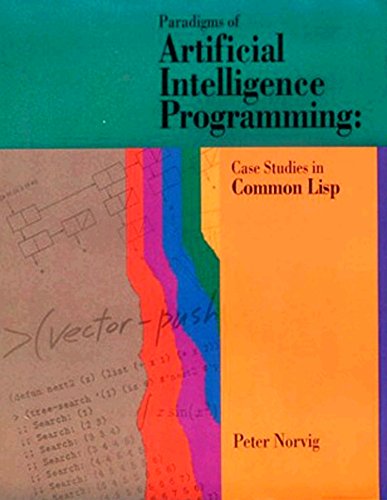
Ebook Info
- Published: 1991
- Number of pages: 976 pages
- Format: PDF
- File Size: 17.45 MB
- Authors: Peter Norvig
Description
Paradigms of AI Programming is the first text to teach advanced Common Lisp techniques in the context of building major AI systems. By reconstructing authentic, complex AI programs using state-of-the-art Common Lisp, the book teaches students and professionals how to build and debug robust practical programs, while demonstrating superior programming style and important AI concepts. The author strongly emphasizes the practical performance issues involved in writing real working programs of significant size. Chapters on troubleshooting and efficiency are included, along with a discussion of the fundamentals of object-oriented programming and a description of the main CLOS functions. This volume is an excellent text for a course on AI programming, a useful supplement for general AI courses and an indispensable reference for the professional programmer.
User’s Reviews
Editorial Reviews: Amazon.com Review This is an overview of classical artificial intelligence (AI) programming via actual implementation of landmark systems (case studies). For the student interested in AI, Paradigms of Artificial Intelligence Programming is an invaluable history lesson. Even the programmer who is relatively uninterested in AI will find value in the book’s basic introduction to Lisp and case studies written in Lisp. But perhaps the book’s best feature is its information on efficiency considerations in Lisp. Paradigms of Artificial Intelligence Programming is worth purchasing for these discussions alone, which provide a wealth of useful guidelines for optimizing your code. Review Paradigms of AI Programming teaches advanced Common Lisp techniques in the context of building major AI systems. By reconstructing authentic, complex AI programs using state-of-the-art Common Lisp, the book teaches students and professionals how to build and debug robust practical programs, while demonstrating superior programming style and important AI concepts. The author strongly emphasizes the practical, performance issues of writing real working programs of significant size, including chapters on troubleshooting and efficiency. A discussion of the fundamentals of object-oriented programming and a description of the main CLOS functions are included. This volume is an excellent text for a course on AI programming, a useful supplement for general AI courses and an indispensable reference for the professional programmer. — Book Description From the Back Cover Paradigms of AI Programming is the first text to teach advanced Common Lisp techniques in the context of building major AI systems. By reconstructing authentic, complex AI programs using state-of-the-art Common Lisp, the book teaches students and professionals how to build and debug robust practical programs, while demonstrating superior programming style and important AI concepts. The author strongly emphasizes the practical performance issues involved in writing real working programs of significant size. Chapters on troubleshooting and efficiency are included, along with a discussion of the fundamentals of object-oriented programming and a description of the main CLOS functions. This volume is an excellent text for a course on AI programming, a useful supplement for general AI courses and an indispensable reference for the professional programmer.|Paradigms of AI Programming is the first text to teach advanced Common Lisp techniques in the context of building major AI systems. By reconstructing authentic, complex AI programs using state-of-the-art Common Lisp, the book teaches students and professionals how to build and debug robust practical programs, while demonstrating superior programming style and important AI concepts. The author strongly emphasizes the practical performance issues involved in writing real working programs of significant size. Chapters on troubleshooting and efficiency are included, along with a discussion of the fundamentals of object-oriented programming and a description of the main CLOS functions. This volume is an excellent text for a course on AI programming, a useful supplement for general AI courses and an indispensable reference for the professional programmer. Read more
Reviews from Amazon users which were colected at the time this book was published on the website:
⭐Great book, bad Kindle version.I’m an undergrad. I bought this to learn Lisp, and it’s absolutely blown my mind with how good it is. I’ve learned more from this book than I ever will from my college classes. I’d say this has been a really good introduction to Lisp, and a really good introduction to AI. It’s easily becoming my favorite programming book. It’s covered more material than 3/4 of my programming classes combined.The kindle version is bad though. The syntax is all wonky, which is critical when you need to differentiate `s from ‘s and ,s from .s. There are tons of misspellings in the kindle version. The code formatting is very difficult to read. Thankfully I’ve been able to get the code from the Peter Norvig’s web page. If you can, get the paper edition. This is the second Common Lisp book I’ve read, so I’ve had enough experience that I can debug all of these problems myself.
⭐First, the good:This book is a great read, both the code and non-code sections. Peter Norvig is clearly passionate about AI, and it comes through in his examples. His writing is clear and fun to read. His code examples are fantastic. When he begins a chapter by describing a problem, you think “wow, that’s going to take ages to get through.” Then you flip the page, and he’s got all the code down on the next page. It’s a real joy to see clear, concise, well-written code like this. This is probably what musicians feel when they listen to a Beethoven sonata.The bad: the examples are historical (read: dated), and they don’t teach you a whole lot about either AI or Lisp. If you know depth first search and regular expressions, you can breeze through the first 250 pages of this book: it won’t show you anything besides some very well-written code (which, let me emphasize again, is really great to read). Unless you are using Lisp as your programming language (I’m using Haskell), section 3 (optimizing your Lisp code + Logic programming) will be hit and miss too.So, to sum up:If you want to learn Lisp, Norvig recommends Paul Graham’s book.If you want to learn AI, Norvig has written AI: A Modern Approach.I spent five bucks on a used copy of this book, and felt like I got my money’s worth. I would definitely not spend $80+ on it.
⭐The book is excellent. It provides a great source of information to learn Common Lisp and programming techniques. The exercises are nontrivial which makes the book great to use in my classes. I am using it to teach programming courses.Nevertheless, the kindle version has a lot of problems. The code blocks are images, so I can’t resize the fonts, show them in the projector during the class doesn’t work. There are a lot of small typos in the text. Some cross-references like “in page X” must be rewrite to links that better fit the electronic format. I am very frustrated with the current electronic version and I hope that Amazon improve it soon. It would be great to have some feedback from Amazon about my suggestions of improvement.
⭐As for AI part I must say that even though this book is somewhat old, its still very good for people new to the world of AI (such as myself). Since I only have another Norvig’s book (http://www.amazon.com/Artificial-Intelligence-Modern-Approach-Edition/dp/0137903952/ref=sr_1_3?ie=UTF8&qid=1359373092&sr=8-3&keywords=Norvig) to compare to I must say that this book takes a more practical approach, allowing one to understand ways in which implementation efficiency can be improved.For CL part – the best CL introduction and real world usage book in my opinion. Yes, I’ve read PCL, yet still this book digs a lot deeper when it comes to optimization patterns for Common Lisp. Motivation for almost every design choice is clear (overcoming Prolog’s drawbacks is one of my favorite parts).Also this book offers a variety of exercises and some of those are quite a time-killers.As for cons – some of the exercises are formulated a bit freely. And again, book is 20 years old, so some content is a bit outdated, especially techno-related.
⭐Intro into Common Lisp with overview of specific outdated use cases. This book does not cover high level difficulties in AI development, falling back to description of historically significant AI projects, that are not representative of the field anymore and are covered on a very basic level.
⭐If you are programming in Common Lisp, Lisp dialects or doing research on AI, this is the very book you need.However, when the book shipped to me, the box wrapping my book is so big and no extra proctection, so it hurt a bit when handled in my hands. I hope more proctection to my next international shipping. Thanks in advance.
⭐Classic book on both programming and AI. While the AI material is obviously dated, the programming examples are great for anyone who wants to learn Common Lisp.
⭐This is a excellent book for both the history of AI and a lot of program written very well in Common Lisp. Peter Norvig is actuallyvery enthusastic about AI and programming. From a glimpse of the book, I know it is valuable for learner both of AI and Common Lisp. So I decided to buy one for myself.
⭐OK, the title makes it appear as if this is an AI book. It is, but it’s also accidentally the best introduction to programming and structured thinking that money can buy. It introduces data oriented programming by working through classic AI examples, building from Eliza to the game of Othello. The code is in Lisp, but this is easily translated to your favourite variant (Scheme / Clojure).
⭐Nein, ernsthaft, mit dem Wälzer und seinem Nachfolger “Künstliche Intelligenz” kann man morden :)*Spaßmodus aus*Das Buch vermittelt äußerst anschaulich Common Lisp auf dem Level der zweiten Ausgaben von GLS, dem großen Quux, wobei es ein viel besserer Lehrer ist, als CLtL2 … aber das war auch niemals die Ambition zweiterens. Das Buch geht sehr detailiert auf die einzelnen Themen ein, ohne zu langeweilen, die enthaltenen Quellcode sind fehlerfrei – dennoch muß man gelegentlich Hand anlegen, um sie mit einem modernen Common Lisp zur 100% Funktion zu bringen. Das Buch selber ist wie gesagt, nicht viel wert, wenn man nicht auch B sagt und sich Künstliche Intelligenz in der 3., aktualisierten Auflage gönnt, wahlweise auch auf Englisch, aber die deutsche Fassung ist phantastisch!Als Programme im Buch werden besprochen ein genereller Problemlöser besprochen, eine Eliza-Dialogmachine und schließlich auch Student, ein englischsprachiger Löser für Algebra-Wort-Probleme. Und das alles gerade mal im ersten Viertel des Buches, bevor es wirklich hinab in die Tiefen geht.Norvig beläßt es nicht einfach dabei zu vermitteln, wie man diese Programme unter Common Lisp programmiert, er versucht wirklich die Techniken und Gedanken dahinter zu vermitteln – und geht dann erneut auf Common Lisp ein, erklärt wie man besser damit programmiert, effizienter – etwas, was in keinem anderen Buch zu finden ist.In späteren Teilen des Buches wird man dann auch noch an Prolog und Scheme herangeführt – und auch an die Verarbeitung englischer Sprache (“Does Kim like Lee?”, “Is he a doctor?”).Wer es ernst meint, man verbringt einige Monate damit, die mehr als 900 Seiten gewissenhaft durchzuarbeiten – und es fällt nicht immer ganz leicht, den Groschen auch zum Fallen zu bringen, jedoch ist dies nicht dem Autoren anzulasten, der wirklich meisterhaftes mit diesem Werk vollbringt.Kleiner Tip zum Schluß: Wem Common Lisp gefällt, der sollte sich mal an Racket heranwagen, denn dieses wird im Gegensatz zu Common Lisp noch aktiv weiterentwickelt – und die Grundzüge hat man nach dem Durcharbeiten dieses Buches bereits verstanden, als Übersetzter hilft hier der Hyperpolyglot […] weiter.Racket zeigt einem dann, was der wahre Geist von Lisp war und ist – und wie man es auch heutzutage nutzbringend einsetzen kann. Und die Erstellung eigener ausführbarer Dateien ist mit Racket ein Kinderspiel. Bei Common Lisp gibt es dafür keinen Mechanismus – hier ist man auf Zusatzfunktionen des jeweiligen Compiler-Bauers angewiesen.This book offers two things at once: a textbook on Lisp and a textbook on the history of AI. You will learn Lisp by coding the classical AI problems and learn the classical AI problems by coding them in Lisp 🙂 This feedback between the form (Lisp language) and the contents (the AI problems) make the narrative of the book incredibly exciting.Yes, you will learn Lisp from zero with this book. Yes, you will understand the solutions of the AI puzzles from this book.
⭐My book was a print on demand, listed as “new” by Amazon. It’s above the usual quality, although the cover was torn. But for this money, I could’ve printed a copy myself. Kinda sad.Other than that, the content is fantastic, and it’s a great practical lisp book.
⭐Very good to pick up lisp as well as AI. Code seems to have some minor incompatibility with modern implementations like SBCL. But too early to say it definitely
Keywords
Free Download Paradigms of Artificial Intelligence Programming: Case Studies in Common Lisp 1st Edition in PDF format
Paradigms of Artificial Intelligence Programming: Case Studies in Common Lisp 1st Edition PDF Free Download
Download Paradigms of Artificial Intelligence Programming: Case Studies in Common Lisp 1st Edition 1991 PDF Free
Paradigms of Artificial Intelligence Programming: Case Studies in Common Lisp 1st Edition 1991 PDF Free Download
Download Paradigms of Artificial Intelligence Programming: Case Studies in Common Lisp 1st Edition PDF
Free Download Ebook Paradigms of Artificial Intelligence Programming: Case Studies in Common Lisp 1st Edition