

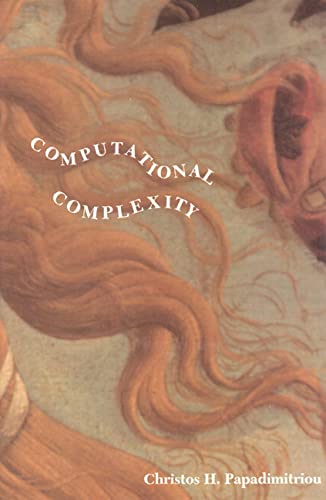
Ebook Info
- Published: 2015
- Number of pages: 523 pages
- Format: PDF
- File Size: 27.08 MB
- Authors: Christos Papadimitriou
Description
This text offers a comprehensive and accessible treatment of the theory of algorithms and complexity – the elegant body of concepts and methods developed by computer scientists over the past 30 years for studying the performance and limitations of computer algorithms. Among topics covered are: reductions and NP-completeness, cryptography and protocols, randomized algorithms, and approximability of optimization problems, circuit complexity, the “structural” aspects of the P=NP question, parallel computation, the polynomial hierarchy, and many others. Several sophisticated and recent results are presented in a rather simple way, while many more are developed in the form of extensive notes, problems, and hints. The book is surprisingly self-contained, in that it develops all necessary mathematical prerequisites from such diverse fields as computability, logic, number theory, combinatorics and probability.
User’s Reviews
Editorial Reviews: From the Back Cover This new text offers a comprehensive and accessible treatment of the theory of algorithms and complexity – the elegant body of concepts and methods developed by computer scientists over the past 30 years for studying the performance and limitations of computer algorithms. Among topics covered are: reductions and NP-completeness, cryptography and protocols, randomized algorithms, and approximability of optimization problems, circuit complexity, the “structural” aspects of the P=NP question, parallel computation, the polynomial hierarchy, and many others.Several sophisticated and recent results are presented in a rather simple way, while many more are developed in the form of extensive notes, problems, and hints. The book is surprisingly self-contained, in that it develops all necessary mathematical prerequisites from such diverse field as computability, logic, number theory, combinatorics, and probability.FeaturesFirst unified introduction to computational complexity.Integrates computation, applications, and logic throughout.Provides an accessible introduction to logic, including Boolean logic, first-order logic, and second-order logic.Includes extensive exercises including historical notes, references, and challeging problems. 0201530821B04062001
Reviews from Amazon users which were colected at the time this book was published on the website:
⭐why put barcode stickers directly on the cover? disrespectful treatment to own books..
⭐This is a good introductory book of computational theory for students in computer science, good juniors, seniors and first year graduates. The book is well presented, fit for self studies, and covered most contents of computability and complexity. The book is slightly old, some of the latest result are not included, e.g., a P-algorithm of solving “prime problem” was found in 2001. This book is not good for advanced researchers in theoretical computer science, it is way to shallow. Compared with Martin Davis’s book, this is easier to understand, equally well presented. Be sure not to get the $8-9 version, that is not the book, although under the same title.I am a research in theoretical algorithms.
⭐This book is excellent. However, you need strong training in the kind of reasoning used in math and CS theory before you can read it. The subject gets very abstract, and may be hard to follow (and that’s not Papadimitriou’s fault).I would recommend it for people who have already read Sipser’s book (working on the exercises), for example.
⭐explains the concepts well
⭐This is a great book on complexity theory at a graduate school level.I would recommend this book to anyone interested in the field of complexity theory.
⭐I used this book for a reading course in Complexity Theory. In going through the text, I found that though most topics were introduced in a fairly thorough manner, with enough axamples to make them understabdable, sometimes Papadimitriou would make some fairly simple mistakes. Of course, hese mistakes may be seen as typos in many places, but the sheer volume of them is difficult to attribute to typos alone. The readability of a proof, or a solution to an example is greatly reduced with the presence of inconsistent notations, and plain mathematical garbage.The set of references and notes listed at the conclusion of most chapters was excellent, but the reader is to beware that some of the references listed are wrong (Cook’s Theorem is from the 3rd ACM Symp. on Found. of Comp.Sci., not the 3rd IEEE Symp. on Found. of Comp. Sci., for instance).These problems make it difficult for the comitted learner to get all the information he/she wants, and greatly detracted from my enjoyment of the text.Unfortunately, I am unable to direct people to a more consistent text in Complexity Theory suitable for the senior undergrad through graduate levels.
⭐We used this book for one semester when I was in the graduate school. This is one of the computer science related books that actually have enough substance to have some intellectual value.I found this volume entertaining years after leaving graduate school and working in the industry as an engineer. The topics addressed in this book is actually quite intriguing–the best time to reduce programming complexity is before one actually programs. I believe any serious programmer should be able to estimate the complexity, both space and time, on the algorithm he is designing.In the real world, one does not encounter nontrivial algorithms very often, and from a practical perspective, this books is not quite useful.However, when you really get bored, this is something that could entertain your brain a little.
⭐[2016 review] Given the rapidity of technological development, the CS beginner may be surprised to learn that older textbooks contain much that is valuable: as with the rise of functional programming languages that derive their inspiration from Lisp, one of the first programming languages, there’s a fair amount of “going back to the future”. Christos Papadimitriou’s *Computational Complexity* is a good illustration of this principle. Complexity theory is one of the most “scientific” parts of computer science, and with a $1 million prize (still) on offer for a solution to the P and NP problem there’s no lack of attention to its basic concepts; recursive functions are well and good but if we want to do it on a computer, even a modern umpteen-core wonder, we need to be able to do it “fast”. What budding computer scientists may lack is the logical background necessary to make sense of the complexity classes and what they mean for programming practice.Papadimitriou is professor of logic at UC-Berkeley and a gifted expositor of logical concepts: he recently wrote the text for *Logicomix*, a graphic novel about the founding of modern logic in the early 20th century. What you will find in this decades-old text is the logic you need to understand computer science and the computer science you need to understand logic: not only the dedicated CS student, but philosophers and other people with “theoretical” interests in computational paradigms will benefit immensely from reading this (most “theory of computation” texts are designed to slingshot students into compiler construction and reinforce the principles of algorithms, so they leave out the negative result of the *Entscheidungsproblem* for first-order logic, the reason modern computation exists in the first place). The layout of the different complexity classes, beginning with the “tractable” P and going on into the well-named “complexity zoo”, is explained in readable prose and understandable diagrams.You need not be a genius to learn complexity from this book, only willing to be reflective about the principles of practices you know more “intuitively”. Still relevant.
⭐I received the book on time. The book is very expensive. However the pages of the book are too old. It should be reprinted.
Keywords
Free Download Computational Complexity 1st Edition in PDF format
Computational Complexity 1st Edition PDF Free Download
Download Computational Complexity 1st Edition 2015 PDF Free
Computational Complexity 1st Edition 2015 PDF Free Download
Download Computational Complexity 1st Edition PDF
Free Download Ebook Computational Complexity 1st Edition