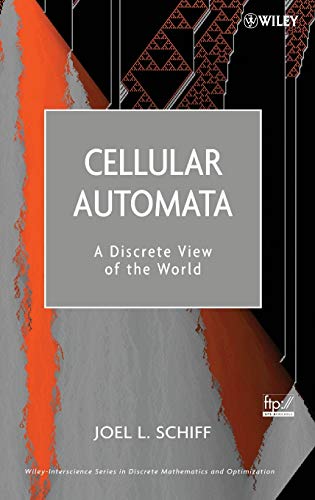
Ebook Info
- Published: 2008
- Number of pages: 280 pages
- Format: PDF
- File Size: 18.85 MB
- Authors: Joel L. Schiff
Description
Cellular Automata: A Discrete View of the World
User’s Reviews
Editorial Reviews: Review “An interesting read and worth browsing by somebody interested in getting a general background on CA. The examples are many and varied, and the numerous citations–both to electronic and printed media–are very helpful.” (Computing Reviews, Nov 2008) “Schiff suppresses most mathematical details, rendering his book highly accessible, informative, and entertaining, but leaving open niches for a textbook treatment with exercises or an advanced monograph with proofs.” (CHOICE, October 2008) “This book serves as a valuable resource for undergraduate and graduate students in the physical, biological, and social sciences and may also be of interest to any reader with a scientific or basic mathematical ground.” (Mathematical Reviews, 2008m)I have finished reading the preliminary MS, and I honestly think it is the best math related book I have ever read. It is easy to read, good pace, explains all and leaves nothing out. — Dror Speiser, Tel Aviv, IsraelThe preliminary manuscript was the fourth book that I have read on the subject, but also the most coherent. With all due respect to Wolfram, this really surpassed his New Kind of Science in both content and style. While he clearly deserves a place in the pantheon, in the long run, this book should stand with his in the popular academic literature. — Marc Ratkovic — graduate student, University of Wisconsin From the Publisher This book is an overview of the subject, written at the level of Scientific American. In fact, the first worldwide exposure of the subject of CA was in Scientific American, in Martin Gardner’s columns on the “Game of Life”. The book also includes interesting discussions on the nature of consciousness, swarm intelligence, emergence, and of course, self-organization, as these form an integral part of the CA milieu. Some of the commentary on these topics comes from overlooked historical sources as well as from the very latest scientific thinking. Additionally, explicit rules are given for each CA model so that anyone with a modicum of programming skill can delve right in and explore them further. The text should allow anyone with a basic scientific understanding, be they in biology, chemistry, physics, mathematics, computer science, economics etc., to apply the discrete modeling techniques of CA to their own scientific endeavors. Much of life on Earth, from seashell patterns to neural activity in the brain, to the formation of bacterial colonies, becomes amenable to investigation with this essentially elementary technique. The fundamental premise of CA is that complex behavior arises out of simple rules governing local behavior, and this is a useful paradigm for the way in which much of the world works. The virtue of CA is that they are much easier to deal with than the usual partial differential equations and often allow greater insight into the underlying processes at play. From the Author Having taught at the university level for the past 35 years, one of the techniques I have tried to invoke is teaching a particular topic from multiple points of view. This has a very positive effect on increasing the depth of learning and understanding. It is this approach that is adopted in the book, and some topics will be approached by two, three, and even five different points of view. From the Inside Flap An accessible and multidisciplinaryintroduction to cellular automataAs the applicability of cellular automata broadens and technology advances, there is a need for a concise, yet thorough, resource that lays the foundation of key cellularautomata rules and applications. In recent years, Stephen Wolfram’s A New Kind of Science has brought the modeling power that lies in cellular automata to the attentionof the scientific world, and now, Cellular Automata: A Discrete View of the World presents all the depth, analysis, and applicability of the classic Wolfram text in a straightforward, introductory manner. This book offers an introduction to cellular automata as a constructive method for modeling complex systems where patterns of self-organization arising from simple rules are revealed in phenomena that exist across a wide array of subject areas, including mathematics, physics, economics, and the social sciences.The book begins with a preliminary introduction to cellular automata, including a brief history of the topic along with coverage of sub-topics such as randomness, dimension, information, entropy, and fractals. The author then provides a complete discussion of dynamical systems and chaos due to their close connection with cellular automata and includes chapters that focus exclusively on one- and two-dimensional cellular automata. The next and most fascinating area of discussion is the application of these types of cellular automata in order to understand the complex behavior that occurs in natural phenomena. Finally, the continually evolving topic of complexity is discussed with a focus on how to properly define, identify, and marvel at its manifestations in various environments.The author’s focus on the most important principles of cellular automata, combined with his ability to present complex material in an easy-to-follow style, makes this book a very approachable and inclusive source for understanding the concepts and applications of cellular automata. The highly visual nature of the subject is accented with over 200 illustrations, including an eight-page color insert, which provide vivid representations of the cellular automata under discussion. Readers also have the opportunity to follow and understand the models depicted throughout the text and create their own cellular automata using Java applets and simple computer code, which are available via the book’s FTP site. This book serves as a valuable resource for undergraduate and graduate students in the physical, biological, and social sciences and may also be of interest to any reader with a scientific or basic mathematical background. From the Back Cover An accessible and multidisciplinaryintroduction to cellular automataAs the applicability of cellular automata broadens and technology advances, there is a need for a concise, yet thorough, resource that lays the foundation of key cellularautomata rules and applications. In recent years, Stephen Wolfram’s A New Kind of Science has brought the modeling power that lies in cellular automata to the attentionof the scientific world, and now, Cellular Automata: A Discrete View of the World presents all the depth, analysis, and applicability of the classic Wolfram text in a straightforward, introductory manner. This book offers an introduction to cellular automata as a constructive method for modeling complex systems where patterns of self-organization arising from simple rules are revealed in phenomena that exist across a wide array of subject areas, including mathematics, physics, economics, and the social sciences.The book begins with a preliminary introduction to cellular automata, including a brief history of the topic along with coverage of sub-topics such as randomness, dimension, information, entropy, and fractals. The author then provides a complete discussion of dynamical systems and chaos due to their close connection with cellular automata and includes chapters that focus exclusively on one- and two-dimensional cellular automata. The next and most fascinating area of discussion is the application of these types of cellular automata in order to understand the complex behavior that occurs in natural phenomena. Finally, the continually evolving topic of complexity is discussed with a focus on how to properly define, identify, and marvel at its manifestations in various environments.The author’s focus on the most important principles of cellular automata, combined with his ability to present complex material in an easy-to-follow style, makes this book a very approachable and inclusive source for understanding the concepts and applications of cellular automata. The highly visual nature of the subject is accented with over 200 illustrations, including an eight-page color insert, which provide vivid representations of the cellular automata under discussion. Readers also have the opportunity to follow and understand the models depicted throughout the text and create their own cellular automata using Java applets and simple computer code, which are available via the book’s FTP site. This book serves as a valuable resource for undergraduate and graduate students in the physical, biological, and social sciences and may also be of interest to any reader with a scientific or basic mathematical background. About the Author Joel L. Schiff, PhD, is Senior Lecturer in the Department of Mathematics at The University of Auckland, New Zealand. Dr. Schiff received his PhD from the University of California-Los Angelesand has published numerous articles and two books on his research specialties, which include complex function theory, potential theory, cellular automata, and the arithmetic Fourier transform. Read more
Reviews from Amazon users which were colected at the time this book was published on the website:
⭐Although I have been nebulously aware of the term “Cellular Automata” for about 25 years, it was not until I read the book Cellular Automata that I really understood what it entails. As a result, I have become enamored with the field and its mathematical elegance. It is unfortunate for this fascinating field of study, that it is called Cellular Automata — a marketing disaster if you ask me.Though Cellular Automata probably has a strict definition, you can think of it as how simple rules governing a cell (or a neuron or an ant or whatever) through time can give rise to complex ordered systems. People often think that there’s some intelligent design behind the complexity we see in nature, but as this book demonstrates, all it takes is a few simple rules about what happens in a local neighborhood to give rise to systems that order themselves into amazing complexity.The book is a comprehensive survey of the history and current state of Cellular Automata. I wish I had the time to follow through on the amazing panoply of interesting paths, papers, web sites and ideas presented to the reader, but this could easily require a lifetime of study (and computer time).In spite of having no background in Cellular Automata, I found this book to be extremely accessible and clearly written with many illustrative examples. I read the book cover-to-cover and understood it all, which for a textbook is really saying something. For the layman, it helps to have a strong mathematical background as well as a keen interest in number theory, but none of this is necessary. One of the nice things about this book is that if for some reason you don’t understand a topic such as say, the Sierpinski Triangle, the rest of the book is not predicated upon it, even if it is called back on occasion.The only possible issue I had with the text is that complex theoretical concepts were on rare occasion difficult to follow. Such concepts were introduced in order to give readers a complete primer on the current state of CA research, but the reader has to trust that the results are as stated in the book, and that an army of Grad Students carried out all the dirty work. Step-by-step implementation is (and should be) beyond the scope of the text, although for math weenies like myself, it may have clarified certain concepts.Highly recommended.
⭐This is perhaps how Martin Gardner would have written a science textbook, had he done so in his lifetime. Joel Schiff’s gentle introduction to Cellular Automata reads like a bestseller novel, and I raced through its pages, finishing it within two weeks–at which time I was sorry that the book had ended.The topics covered include one- and two-dimensional CAs, Wolfram’s CA classification scheme, dynamical systems, the Game of Life, self-replicating CAs, autonomous agents, and applications to diffusion, crystal formation, steady-state heat flow, and the Traveling Salesman problem. Fairly standard, perhaps, but treated in such an engaging and clear manner that makes the book a truly memorable and engrossing read–and certainly one to reread. The book requires math up to the university level for science majors, but is intended for the non-specialist.It’s a pity that the price is rather steep on this one, as it deserves to be more widely accessible. I read the digital version, but plan to eventually cough up the more than $150 for the hardcover.
⭐This book provides an excellent overview of the field of cellular automata. It brings together a broad range of concepts and ideas which have been percolating over the past 70 years. In many ways the field of cellular automata and its offshoots remind me of the principles and ideas expounded on in Thomas Kuhn’s book `The Structure of Scientific Revolutions’. For this field is truly revolutionary in its ability to easily show the power of emergent properties from simple rules.The flow of the book is easy to understand and the documentation and references are excellent. The prose is well written and the author’s ability to clarify basic ideas is exceptional.I highly recommend this book. The first chapter `Preliminaries’ clearly shows the author has brought a rich scope to the presentation of the material.
Keywords
Free Download Cellular Automata: A Discrete View of the World 1st Edition in PDF format
Cellular Automata: A Discrete View of the World 1st Edition PDF Free Download
Download Cellular Automata: A Discrete View of the World 1st Edition 2008 PDF Free
Cellular Automata: A Discrete View of the World 1st Edition 2008 PDF Free Download
Download Cellular Automata: A Discrete View of the World 1st Edition PDF
Free Download Ebook Cellular Automata: A Discrete View of the World 1st Edition