

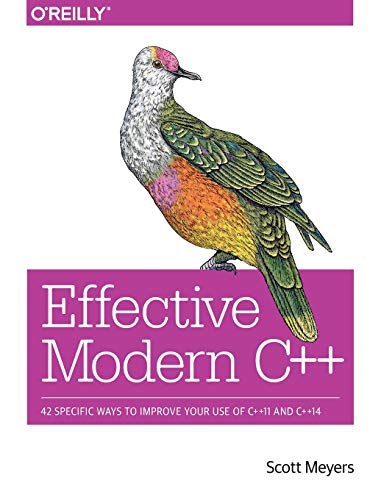
Ebook Info
- Published: 2014
- Number of pages: 334 pages
- Format: PDF
- File Size: 4.49 MB
- Authors: Scott Meyers
Description
Coming to grips with C++11 and C++14 is more than a matter of familiarizing yourself with the features they introduce (e.g., auto type declarations, move semantics, lambda expressions, and concurrency support). The challenge is learning to use those features effectively—so that your software is correct, efficient, maintainable, and portable. That’s where this practical book comes in. It describes how to write truly great software using C++11 and C++14—i.e. using modern C++. Topics include: The pros and cons of braced initialization, noexcept specifications, perfect forwarding, and smart pointer make functions The relationships among std::move, std::forward, rvalue references, and universal references Techniques for writing clear, correct, effective lambda expressions How std::atomic differs from volatile, how each should be used, and how they relate to C++’s concurrency API How best practices in “old” C++ programming (i.e., C++98) require revision for software development in modern C++ Effective Modern C++ follows the proven guideline-based, example-driven format of Scott Meyers’ earlier books, but covers entirely new material. “After I learned the C++ basics, I then learned how to use C++ in production code from Meyer’s series of Effective C++ books. Effective Modern C++ is the most important how-to book for advice on key guidelines, styles, and idioms to use modern C++ effectively and well. Don’t own it yet? Buy this one. Now”. — Herb Sutter, Chair of ISO C++ Standards Committee and C++ Software Architect at Microsoft
User’s Reviews
Editorial Reviews: About the Author For more than 20 years, Scott Meyers’ Effective C++ books (Effective C++, More Effective C++, and Effective STL) have set the bar for C++ programming guidance. His clear, engaging explanations of complex technical material have earned him a worldwide following, and they keep him in demand as a trainer, consultant, and conference presenter. Winner of the 2009 Dr. Dobb’s Excellence in Programming Award, he has a Ph.D. in Computer Science from Brown University.
Reviews from Amazon users which were colected at the time this book was published on the website:
⭐This is not an introduction or an exhaustive enumeration of all the features of modern C++. It is assumed that the reader has already an exposure to them. Along the same lines of his previous books, the author focuses on what had been really interesting for him to analyze and experiment with, before letting the audience know about it. The items presented are valuable, not only because of the technical clarifications given, but also because of the general adaptation of the author’s items, which might have been established as best practices.
⭐The C++ world lost a world class teacher when Scott Meyers decided to retire from explicating the dusty corners of the language for the rest of us poor benighted developers.This book is a grand “Hurrah!” for the series. My only regret is that he won’t be explaining C++23. But if you want to get your head around the minutiae of changes introduced in C++11 and C++14, this is the book for you!
⭐Having been stuck using C++03 for a very long time, I finally was able to use C++11/14 at work. I started working in the updated language using all the old tricks and feeling like my knowledge was stagnant. Picking up this book enlightened me to all the modern availabilities of the language, and explained a lot of information I had previously heard from coworkers/blogs, but never understood fully. This book alone made me a better C++ developer in a short span of time, and I still use it as a reference today. Get this book and read it.
⭐In the terms of Fred Brooks, The Mythical Man Month, or, perhaps, Thomas S. Kuhn, The Structure of Scientific Revolutions, this impressive and exceptional work by Scott Meyers shows how a systems language designed to allow even device driver development is degenerating by committee-submission-creep towards a Java like applications language …Effective Modern C++ does give excellent advice on how to cope. Together with Scott Meyers’ other three well known works, the programmer working on a low level programming effort systems or device driver or games performance would be able to navigate the shallows and avoid the rocks and riptides … But, woe betide the high level applications programmer who, frankly, is using the wrong tool for the job …Take the C++ 14 general cleanup of types. This was probably needed anyway. But, together with a comprehensive new typeset to make smart pointers usable, and a concurrency API, this low level approach to these matters may make thread safety possible in non kernel operating system executive mode executables built therefrom. However, the question I wish to raise is whether threads really need any more than absolutely minimal use outside application level code … Scott’s treatment of types and pointers with a view to thread safety is comprehensive and well written … This essential advice will save many an in-betweenst project halfway really not a systems project but really not an applications one either …One reason I bought this book was to find out the detail of what lambdas were. Oh God! Remembering Clipper 5.01 from 1993, whose Clipper code-blocks were this half-way house between DEC’s PDP-11 TECO macros, which had the awful possibility of self modification, and proper compiled to p-code small functions a la many Pascals, I suspect these lambdas share the problem that Clipper code-blocks had: one could embed a value inside the code-block a single internal state value that the code-block carried around. This idea undermined the whole conception of good code. Expressibility. Efficient. Maintainable. Obvious. Comprehensible. Top-Down.If one wants to send impenetrablely obscure messages from deep inside one module to deep inside another, not using the call chain, nor the data heap, use explicit operating system semaphores, not such side effects!! Therefore use lambdas with caution, and preferably not at all.Nevertheless another classic work by the author, noted for his writings on C++!!
⭐this book really hit the pain points and explained very well. require little bit experience with the language before all started to make sense.
⭐Honesty about C++ and the things that can really help you and those things you should manage carefully is what I like most about this book. The author did an exception job helping the reader navigate through C++ to understand the essence of those things that can benefit or most imperil them when using the language. You do need to have a general understanding of C++ before reading the book. Particularly, recent publications from Bjarne Stroustrup would be very helpful. Some knowledge of the STL could be helpful but not entirely necessary. You do not need to be fully versed in OOP or other programming paradigms. The book is paradigm agnostic. It focuses strictly on C++ programming language capabilities and a few standards approved capabilities represented through C++.Sometimes a good approach to knowledge involves the long way. It seems best to avoid certain shortcuts since good insights may be absent or unavailable when needed. However, there are shorter paths to understanding that are indeed productive. This book is one of those. Rather than spend months or years contending with many of missteps possible without the knowledge presented here, the author makes your use of C++ far more productive and reliable.Optimal ways to use capabilities in C++ are discussed and demonstrated. You can also read the book and get the impression that some parts of C++11 and C++14 are screwed up. That would be an incorrect view. I am referring to the parts of the book that show that some features of C++ are not what they seem on the surface. A great example are lambdas and their relationship to memory leaks if used improperly. What I see is that certain features or not designed wrong but they are not designed to be used all the time. C++ is like the computer language equivalent of Lego blocks. Not all pieces are designed to be used everywhere and in every case. It also means that when you use C++, you don’t really straight code in it like you might in a managed language, but you use it thoughtfully every step of the way. This book shows you some of those considerations that can reduce technical design problems and improve software programs.
⭐Very detailed analysis, much like in Meyers’ earlier Effective C++ and More Effective C++. If you can internalise the depth of content in here you’ll be very well set to write high quality C++. Just don’t expect everyone else to be able to keep up.Having said that, even the easier bits of the book are very valuable and provide an in depth understanding of those newer elements of C++ that you are more likely to encounter and use frequently.
⭐Coming from C++ 98 I found the book really clearly laid out, and is easy to dip in and out of as needed when finding new “things” in the modern C++ codebase I’m working on now. Concepts are really well explained and good examples for every point. Seems to be THE guide to modern C++.
⭐It’s an indictment on the state of the language that we need books like this to use it. Or perhaps I’m just too old and stupid now. Either way, this is a great book, if a little verbose for my tastes at times.
⭐This was an excellent write up on modern C++ idioms that gave me a great understanding of the new features introduced in C++ 11 and C++14. The style of the author is witty, and light, while at the same time it conveys the educational material in an easy to follow manner. Experience with C++ is recommended before buying this book, as this is a book which focuses more on the how-to, rather than the what-is. As in, this book doesn’t tell you what features are in C++ (well it does, but it assumes you know what they do), but it focuses more on how to use those features in an efficient manner.
⭐This is a must-have for any c++ developer. I have been developing in c++ for now than a decade, and still learned so much from this book. I now ask all my PhD students to read it.
Keywords
Free Download Effective Modern C++: 42 Specific Ways to Improve Your Use of C++11 and C++14 1st Edition in PDF format
Effective Modern C++: 42 Specific Ways to Improve Your Use of C++11 and C++14 1st Edition PDF Free Download
Download Effective Modern C++: 42 Specific Ways to Improve Your Use of C++11 and C++14 1st Edition 2014 PDF Free
Effective Modern C++: 42 Specific Ways to Improve Your Use of C++11 and C++14 1st Edition 2014 PDF Free Download
Download Effective Modern C++: 42 Specific Ways to Improve Your Use of C++11 and C++14 1st Edition PDF
Free Download Ebook Effective Modern C++: 42 Specific Ways to Improve Your Use of C++11 and C++14 1st Edition