

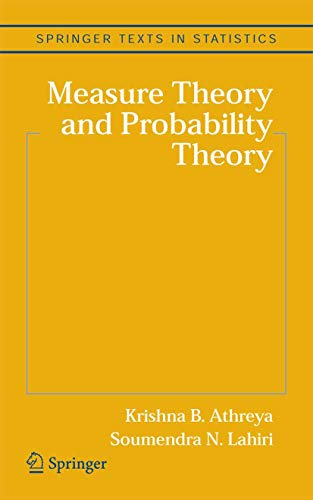
Ebook Info
- Published: 2006
- Number of pages: 637 pages
- Format: PDF
- File Size: 4.59 MB
- Authors: Krishna B. Athreya
Description
This is a graduate level textbook on measure theory and probability theory. It presents the main concepts and results in measure theory and probability theory in a simple and easy-to-understand way. It further provides heuristic explanations behind the theory to help students see the big picture. The book can be used as a text for a two semester sequence of courses in measure theory and probability theory, with an option to include supplemental material on stochastic processes and special topics. Prerequisites are kept to the minimal level and the book is intended primarily for first year Ph.D. students in mathematics and statistics.
User’s Reviews
Reviews from Amazon users which were colected at the time this book was published on the website:
⭐This is a good book. And the authors try to summary the measure theory and probability theory into one book. Benefit of doing this is easy to see relationship between the two theories more clearly than reading one for each topic. However, I should say that no book trying to do this job is successful, including this one. To my experience, better understand of real analysis is necessary. If you do not, I think this book is not suitable for you. If you do, you can start the book from chapter 6 and treat the 1-5 chapter as a good reference.Moreover, the statements in this book are quite concise and I like this style. However, this is a quite new one. There are pretty much typos in the book. I expect that the second edition will be much better than this one.
⭐This text is used for a course I am currently taking, and reflects a 2-3 semester sequence at the school where it is used. As a result each chapter is full of many questions of varying difficulty that help students learn, and each chapter contains a variety of examples that break up the traditional theorem-proof structure of some of the other measure and probability theory texts I’ve looked at.My main gripe is that for a few people in my course the binding came off along the interior edge.
⭐This is an excellent graduate level book on Measure and Probability Theory! The book to me seems student friendly! Of course measure theory is not an easy subject and you will never find an easy book on the subject. Some how I find myself flipping through the pages of this book many times during my times of boredom. I don’t know how to do all the problems in the book, but I would love to learn how to. This book is one of the best books in my eyes on Advanced Probability. I recommend it to any professor to use for their courses in measure theoretic probability.
⭐Very well written. The intuition about measure and integration is noted at first. I’m not a mathematician and this book makes a good job as a introduction to the field and probability theory. With respect to the quality of the material I have a complaint. Poor quality and not worth $81.25.Anyway, I recomend this book except for material that is very poor.
⭐I’ve completed courses on real analysis and mathematical writing (i.e. strategies for mathematical proofs). I have a solid math background and I am reading this book for self study. Still, I recommend reading parts of the Appendices before starting chapter 1. As of today, I am on chapter 3 and I’m planning to study through chapter 10. For me, the key to getting through the material is to keep it interesting! Don’t feel you have to learn everything in every chapter. At first, try to focus on the main objectives of each chapter. As time goes on, you can go back to previous chapters and learn the material as it becomes relevant; that’s what I’m doing and its working so far. The author, Krishna Athreya, makes it possible to do just that and, combined with the fact that there’s a high level of detail to proofs and examples, I would strongly recommend this book.Summary points:1. You might want to read a book on real analysis before reading this one, (like Advanced Calculus by Avner Friedman)2. Be a smart reader; (i.e., don’t try to learn everything right away,)3. Amazing appendices that include exercises, (like a reference book on real analysis)4. Detailed proofs and lots of examples
⭐There are many choices to make when studying graduate probability theory. There are the classics such as Billingsley, Shiryaev, and Dudley which belong in everyone’s library. However, this recently renewed volume by Athreya and Lahiri can be a very useful alternative.Measure, Integration, Product Spaces, Limit Laws, and so on are all covered in the early chapters. However, Characteristic Functions are covered particularly well, and many useful results can be found here. Discrete parameter Martingales are particularly well done, and well crafted proofs of results such as the Vitali theorem are available for reference.Some of the advanced topics include the Markov Chain Monte Carlo for simulation enthusiasts, a chapter on Brownian motion ending with option pricing is included for those in finance, and a chapter on the bootstrap is also included for further reference. Surprisingly, the Galton-Watson branching process is actually the last topic in the book, but it is treated in the context of martingales.This is another excellent Springer Statistics Text, by two leading probability theorists. I recommend it to all. Please note that as of 2010 this volume is only available in paperback.
⭐This a great book. Very systematic introduction
⭐V good
⭐Nice book
Keywords
Free Download Measure Theory and Probability Theory (Springer Texts in Statistics) 2006th Edition in PDF format
Measure Theory and Probability Theory (Springer Texts in Statistics) 2006th Edition PDF Free Download
Download Measure Theory and Probability Theory (Springer Texts in Statistics) 2006th Edition 2006 PDF Free
Measure Theory and Probability Theory (Springer Texts in Statistics) 2006th Edition 2006 PDF Free Download
Download Measure Theory and Probability Theory (Springer Texts in Statistics) 2006th Edition PDF
Free Download Ebook Measure Theory and Probability Theory (Springer Texts in Statistics) 2006th Edition