

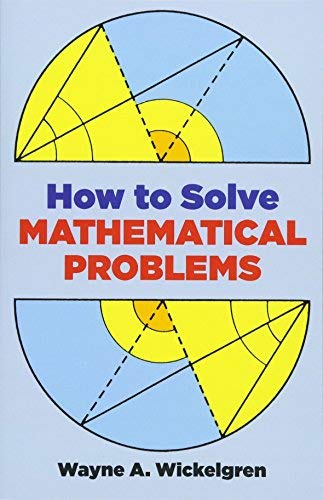
Ebook Info
- Published:
- Number of pages:
- Format: PDF
- File Size: 13.06 MB
- Authors:
Description
User’s Reviews
Reviews from Amazon users which were colected at the time this book was published on the website:
⭐February 03, 2013:The only problem is that if you can understand this book, then you probably do not need this book. In other words, this is one of the books which will be helpful for a good problem solver to review his skills but is not good for a novice. For example if you buy Polya’s books which are really useful in giving the right guidance for aspiring problem solvers, you will find that it is really interesting and you will find the reason as to why they say that he is such a genius; however, it won’t help. To understand exactly as to why this is, you must read Alan Schoenfeld’s “Mathematical Problem Solving”. My recommendation is that you must stick to Paul Zeitz’s book because that is THE ONLY book which talks about psychological strategies to solve problems. This book does that as well but not to the extent it is needed. Once you become a good problem solver, this book gives you lot more insight into various aspects of problem solving.October 16, 2013:This book has a lot of useful information. There is the “Getting out of loops” sub-section which is a very good one. Though short, he has given very useful suggestions. There are lot of good examples too; however, Paul Zeitz’s book is lot better because he has a specific goal of training kids for IMO and he also deals with a much wider mathematical topics. Wickelgren’s book tells you the points from a philosophical standpoint as to what all a student can do to get better at problem solving and also the typical problems that a problem solver encounters while solving tough problems; however, even to understand what he is talking about, you must have had very good experience in problem solving. Else I do not think that this book will be very useful.
⭐At first sight, this might seem like a book to solve math party puzzles. Indeed it can be used for that. But it also lets you understand strategies that may be applied in any context that a maths problem can arise. For instance, there is the idea of systematic trial and error. And a discussion of how to analyse what methods you have been using to tackle a problem. Very useful, because it might suggest other methods, simply by having you explicitly recap your previous methods.As the book says, think about what you did, rather than about the problem. As an inventor, this is just what I do. Plus, the book recommends “incubation”, where if you are making no headway, you put aside the problem for some time. Hours or days. Then, just maybe, your subconscious might operate on it during this downtime. So that when you later explicitly return to the problem, a solution emerges. This method is sometimes commonly known as “sleep on it”.Wickelgren cautions that this idea of your subconscious working on a problem might be bunk. He gives plausible alternatives. Like simply being less fatigued, physically and mentally, when you return to the problem after a hiatus.
⭐This book analyzes several problems, mostly in recreational mathematics, in fine detail. One feature worthy of emulation is that the book will present a problem, ask the reader to try to solve it, provide some analysis, ask the reader to again try to solve it and repeat this procedure for several iterations.That said, the global organization of the book leaves much to be desired. It opens by showing several example problems similar to others that are solved in the book. However, some of these initial examples are not later solved. There was one problem in particular, a chess problem, that I spent some time on unsuccessfully trying to solve, whose answer would have been appreciated.Wicklegren uses an artificial intelligence paradigm in the organization of the book. While AI techniques are useful for computers, there are better pattern matching techniques more suitable for use by humans. Hill climbing, for example, which is given as a basic technique, is good for use by a computer when no better method can be found. However, it is not well suited for hand calculation. Wicklegren tries to cover over this by saying that any technique that solves a problem by simplifying it, is an example of hill climbing even if there is no associated metric. There are several other places where the book tries unsuccessfully to shoehorn solution strategies into the few general techniques around which the book is organized. For example, the use of restraints is given as an example of proof by contradiction. Recursion and induction are lumped into a chapter on the use of subgoals.By training the author is a psychologist who apparently took a lot of courses in math. This is a good background for studying problem solving and someday someone with a similar background may write a worthwhile book on the subject. In this book, it is painfully obvious that the author’s math skills are a bit rusty and that the manuscript was not reviewed by anyone whose math skills are more current. For example, one of the solutions given is incorrect. This is due to a mental lapse where playing cards with numbers 2 to 8 are treated as if there are 8 cards instead of 7. In the last chapter, which departs from recreational mathematics, there are a few mathematical examples whose solutions are overly complicated. The most flagrant example of this is a problem that asks to determine the height of a triangle given the length b of the base and the two base angles of A and B. The straightforward solution to this is to consider the two segments that the altitude divides the base into to get the equation b = h*cot A + h*cot B. Instead, the book uses Heron’s formula for the area of a triangle. The book presents an algebraic proof of Pascal’s Identity without labeling it as such and without reference to the much more intuitive combinatorial proof.Overall, I would barely recommend this book because of the way that the details are presented, but I would advise the reader to ignore the surrounding contextual presentation.
Keywords
Free Download How to Solve Mathematical Problems (Dover Books on Mathematics) by Wayne A. Wickelgren (2003-03-28) in PDF format
How to Solve Mathematical Problems (Dover Books on Mathematics) by Wayne A. Wickelgren (2003-03-28) PDF Free Download
Download How to Solve Mathematical Problems (Dover Books on Mathematics) by Wayne A. Wickelgren (2003-03-28) PDF Free
How to Solve Mathematical Problems (Dover Books on Mathematics) by Wayne A. Wickelgren (2003-03-28) PDF Free Download
Download How to Solve Mathematical Problems (Dover Books on Mathematics) by Wayne A. Wickelgren (2003-03-28) PDF
Free Download Ebook How to Solve Mathematical Problems (Dover Books on Mathematics) by Wayne A. Wickelgren (2003-03-28)