

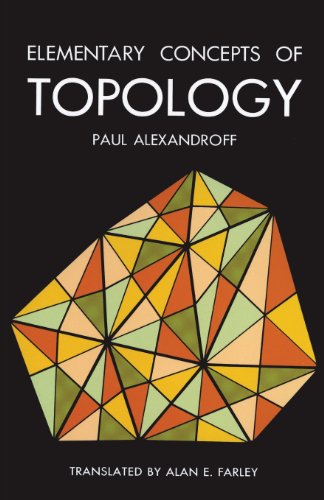
Ebook Info
- Published: 1961
- Number of pages: 64 pages
- Format: PDF
- File Size: 2.61 MB
- Authors: Paul Alexandroff
Description
Alexandroff’s beautiful and elegant introduction to topology was originally published in 1932 as an extension of certain aspects of Hilbert’s Anschauliche Geometrie. The text has long been recognized as one of the finest presentations of the fundamental concepts, vital for mathematicians who haven’t time for extensive study and for beginning investigators.The book is not a substitute for a systematic text, but an unusually useful intuitive approach to the basic concepts. Its aim is to present these concepts in a clear, elementary fashion without sacrificing their profundity or exactness and to give some indication of how they are useful in increasingly more areas of mathematics. The author proceeds from the basics of set-theoretic topology, through those topological theorems and questions which are based upon the concept of the algebraic complex, to the concept of Betti groups which binds together central topological theories in a whole and upon which applications of topology largely rest.Wholly consistent with current investigations, in which a larger and larger part of topology is governed by the concept of homology, the book deals primarily with the concepts of complex, cycle, and homology. It points the way toward a systematic and entirely geometrically oriented theory of the most general structures of space.First English translation, prepared for Dover by Alan E. Farley. Preface by David Hilbert. Author’s Foreword. Index. 25 figures.
User’s Reviews
Reviews from Amazon users which were colected at the time this book was published on the website:
⭐A great book, born in a great moment of mathematics. Alexandroff explains, and shows in pictures, what topology is basically about and why “homology groups” are the way to do it.Anyone can follow this who has had multivariable calculus, plus seen the definition of a group (as in, say, arithmetic modulo 2). In 55 profusely illustrated yet rigorous pages Alexandroff shows how to define topological manifolds, cut them into “simplices”, and keep track of simplices algebraically. He proves the two founding theorems of topology: the dimension of manifolds, and their homology groups, are both preserved by topological isomorphisms.Alexandroff was a favorite student of Emmy Noether, and L.E.J. Brouwer, and followed Hilbert’s lectures. The greatest algebraist, the greatest topologist, and the greatest mathematician of the early 20th century all had direct input into this book. All believed the most important, deepest mathematics can be made the clearest. They were right.
⭐This book introduces the algebraic machinery of homology theory and uses it to prove the invariance of dimension and the invariance of Betti numbers. With this point of view, manifolds should be taken to be complexes, and their properties should be studied in terms of linear combinations of its simplexes. So, for instance, in an appropriately oriented tetrahedron the “sum” of the faces is zero since each edge is counted twice with opposite orientation. But if we try to do the same thing in the projective plane or on a Möbius strip we will find that the summation of all faces leaves a boundary, revealing the difference between orientable and nonorientable surfaces. The natural algebraic equivalence of cycles of edges in a complex (homology) is close enough to topological equivalence (homotopy) to make the notion useful; in particular, the connectivity of a surface determines the number of generators of the free part of its homology group (the Betti number), so invariance of Betti numbers does give us useful topological information. Of course, if it was only for surfaces, homology and Betti numbers would be plainly inferior to the fundamental group, and indeed Alexandroff plays down surface topology while offering little in return except unsubstantiated reassurance that “anybody who wants to study topology for the sake of its applications must begin with the Betti groups”.
⭐This book is perfect for the advanced undergraduate–if you’ve taken modern algebra (groups, rings, fields, etc.), real analysis, some point-set topology, and are curious about algebraic topology, then this little book is time and money well spent. In about 50 relatively easy-to-read pages, you’ll be able to sit down with your favorite topological spaces and actually do homological calculations. One of the book’s main appeals is that it was originally published in 1932–well before homological algebra (aka “diagram chasing”) obscured the beauty of algebraic topology.
⭐When a book is translated it is supposed to be in English… this book is in topology as a language of it’s own. For me with a library and long history of reading topology books, it is understandable. The author is recognized as a great mathematician, but I think he should have had his maiden aunt read his proofs for the book… he writes badly of topology and his references aren’t anywhere near clear enough. I suppose it is that I found that his treatment of the tetrahedron and projective plane really don’t work well when translated to numbers….
Keywords
Free Download Elementary Concepts of Topology (Dover Books on Mathematics) in PDF format
Elementary Concepts of Topology (Dover Books on Mathematics) PDF Free Download
Download Elementary Concepts of Topology (Dover Books on Mathematics) 1961 PDF Free
Elementary Concepts of Topology (Dover Books on Mathematics) 1961 PDF Free Download
Download Elementary Concepts of Topology (Dover Books on Mathematics) PDF
Free Download Ebook Elementary Concepts of Topology (Dover Books on Mathematics)