

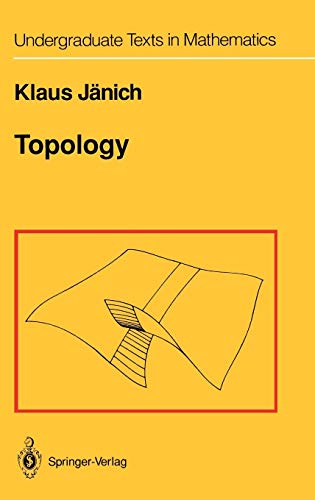
Ebook Info
- Published: 1984
- Number of pages: 202 pages
- Format: PDF
- File Size: 10.00 MB
- Authors: K. Jänich
Description
Contents: Introduction. – Fundamental Concepts. – Topological Vector Spaces.- The Quotient Topology. – Completion of Metric Spaces. – Homotopy. – The Two Countability Axioms. – CW-Complexes. – Construction of Continuous Functions on Topological Spaces. – Covering Spaces. – The Theorem of Tychonoff. – Set Theory (by T. Br|cker). – References. – Table of Symbols. -Index.
User’s Reviews
Reviews from Amazon users which were colected at the time this book was published on the website:
⭐If you want a real introduction to topology and algebraic topology or are about to take a topology course within a few months, read this book. It is no waste of time. Of course, this book does not prevent your topology professor or topology text from assigning you exercises from the outer limits. If this happens to you, do not despair, discuss, and NEVER give up. Topologists love to discuss. This text is to topology courses as tai chi is to martial arts instruction. Best wishes. Via con Dios.
⭐This is the most pleasurable text on general topology you are likely to find. Just for the sections on Urysohn’s Lemma, Tietze’s Extension, and Tychonoff’s Theorem alone this book is worth owning – it contains the nicest proofs of these theorems I have ever seen. The book is packed with revealing illustrations and motivations. Sometimes in mathematics it is difficult to see the forest for the trees. Whenever I feel that I am just grinding away at technical results, this is one of the books I return to for a little perspective.
⭐Wonderful book
⭐While I agree with the other reviewers here that Jaenich’s “Topology” is very well written, goes to great lengths to explain the “hows and whys” of topology, and includes many, many figures (about 1 per page on average), it is probably more popular with people who already know topology than with beginning students, even though it is an introductory text intended for undergraduates. This is due to both a frequent lack of precision or formality in proofs and definitions coupled with a tendency to discuss much more advanced material with which a student at this level wouldn’t be familiar. I believe that experienced mathematicians, who perhaps learned point-set topology from books such as those of Munkres, Kelley, or Bredon (or even an analysis book such as Royden), appreciate how this book focuses on motivating the concepts, explaining how the various objects are used elsewhere in mathematics – for that purpose this is one of the finest books I have seen. However, too much material is mentioned that is certainly over the heads of most students new to topology, such as the Pontrjagin-Thom construction, the spectrum of commutative Banach algebras, or Lie groups, often in a very cursory manner that would serve only to confuse beginners. Concepts are often used before they are defined, or are not defined precisely, which is liable to frustrate these students as well. Many topics are given such short attention it makes you wonder why the author even bothered – such as a page devoted to Frechet spaces followed by a section consisting of a single paragraph on locally convex topological vector spaces. Much of the material is not covered very deeply – only a definition and maybe a theorem, which half the time isn’t even proved but just cited.Certainly this book couldn’t be used as a textbook for an undergraduate course – for the reasons mentioned above and also because not enough material is actually covered, as well as the obvious deficiency in that it lacks exercises for the reader. Most of the proofs until the last chapters are of the 1- or 2-paragraph variety, with some pictures added, although as the book progresses the level becomes increasingly more sophisticated. The book also covers both point-set topology (topological spaces, compactness, connectedness, separation axioms, completeness, metric topology, TVS, quotient topology, countability, metrization, etc.) and elements of algebraic topology (homotopy, fundamental group, simplices, CW-complexes, covering spaces, but not really homology), but the presentation of the algebraic topology in particular is not liable to be helpful for the novice, except for the treatment of covering spaces, which is perhaps the highlight of the book. Half of the chapter on homotopy is actually concerned with categories and functors, probably not the best way to introduce the subject. In fact, here is direct quote from the index:”We talk about homology (and a number of other objects beyond the realm of point-set topology) several times in this book, but the definition is not given.”That, in a nutshell, explains the difficulty with this book.So why am I rating this 5 stars? For the wealth of examples (e.g., 4 sections on examples of quotient spaces) and explanations of how these concepts are used and why they are important. Just by looking at the contents one can see this, as there are sections titled:”What is point-set topology about?,” “What is algebraic topology?,” “Homotopy – what for?,” “The role of the countability axioms,” “Why CW-complexes are more flexible,” “Yes, but…?,” “The role of covering spaces in mathematics,” “What is it [Tychonoff’s theorem] good for?”The chapter on covering spaces, coming near the end of the book, is particularly good, with a proof of their classification given. This is definitely the most fleshed-out part; if only the rest of the book could go into this depth.This book would make an excellent supplement to a more formal textbook such as Munkres, but is not a substitute for it. But I would still consider this as a must-read for all those students who plan on studying mathematics in graduate school.
⭐It is not too often that a book about topology is written with the goal of actually explaining in detail what is going on behind the formalism. The author does a brilliant job of teaching the reader the essential concepts of point set topology, and the book is very fun to read. The reader will walk away with an appreciation of the idea that topology is just not abstract formalism, but has an underlying intuition that is rich in imagery. The author has a knack for allowing readers to “see into the future” of what kind of mathematics is waiting for them and how topology is indispensable in its study. At the end of chapter three, which deals with the quotient topology, the author writes the following paragraph: “If is often said against intuitive, spatial argumentation that it is not really argumentation but just so much gesticulation – just ‘handwaving’. Shall we then abandon all intuitive arguments? Certainly not. As long as it is backed by the gold standard of rigorous proofs, the paper money of gestures is an invaluable aid for quick communication and fast circulation of ideas. Long live handwaving!”. This has to rank as one of the best paragraphs that has every appeared in a mathematics book, for it nicely summarizes the need for developing a feel for the concepts behind mathematics before moving on to the rigorous proofs. Physicists in particular, who must assimilate mathematics very quickly in order to apply it to real problems must have a pictorial, “playful” understanding of the mathematical constructions. Thus the language that the author employs is informal, and a listing of the best discussions in the book would really entail a listing of every one in the book. There is not one part of the book that is not helpful or interesting, and the author delves into many different areas that involve the use of topology. If you are a beginning student in mathematics, BUY AND STUDY THIS BOOK…BUY AND STUDY THIS BOOK. You will take away so much for the price paid.
⭐No es un libro de demostraciones (que sí las tienes), es un libro que explica los conceptos y con muchas ilustraciones (casi una por página). Por supuesto que matemática formal no tiene porque verse ni tiene porque tener ejemplos o explicaciones que sean “dibujables”, pero creo que ayudan mucho para entender los conceptos y luego meterse en lo más abstracto. Muy buen libro como complemento para otros libros más formales e ideal para leerlo en cualquier lado porque es pequeño (200 páginas). Muy recomendable como libro complementario a libros más académicos y para “ver” a la topología.ok
Keywords
Free Download Topology (Undergraduate Texts in Mathematics) in PDF format
Topology (Undergraduate Texts in Mathematics) PDF Free Download
Download Topology (Undergraduate Texts in Mathematics) 1984 PDF Free
Topology (Undergraduate Texts in Mathematics) 1984 PDF Free Download
Download Topology (Undergraduate Texts in Mathematics) PDF
Free Download Ebook Topology (Undergraduate Texts in Mathematics)