Ebook Info
- Published: 1997
- Number of pages: 199 pages
- Format: PDF
- File Size: 30.60 MB
- Authors: Alan F. Beardon
Description
Intended as an undergraduate text on real analysis, this book includes all the standard material such as sequences, infinite series, continuity, differentiation, and integration, together with worked examples and exercises. By unifying and simplifying all the various notions of limit, the author has successfully presented a novel approach to the subject matter, which has not previously appeared in book form. The author defines the term limit once only, and all of the subsequent limiting processes are seen to be special cases of this one definition. Accordingly, the subject matter attains a unity and coherence that is not to be found in the traditional approach. Students will be able to fully appreciate and understand the common source of the topics they are studying while also realising that they are “variations on a theme”, rather than essentially different topics, and therefore, will gain a better understanding of the subject.
User’s Reviews
Editorial Reviews: Review “The author’s writing style is clear and crisp ; the book is self-contained and well organized.” — ZENTRALBLATT MATH
Reviews from Amazon users which were colected at the time this book was published on the website:
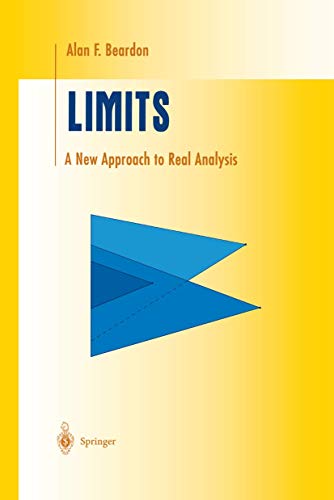
⭐An interesting, brief, introductory analysis text. Reading the preface: “the general definition of a limit is no more complicated than the definition of an equivalence relation–which is standard fare in almost all first-year university courses in mathematics.” That may be so, however, in my first three-years of undergraduate education, I was never introduced to ‘equivalence relations.’ (Certainly they were mentioned in passing, I contend that no time was spent elaborating upon equivalence relations). Thus, limits as they are introduced here–in terms of ordered, or directed–sets, might not be to everyone’s liking. I admit, it was my admiration for the real analysis text by McShane and Botts which compelled me to study Beardon (see their page 33, their second chapter, convergence). Beardon is an excellent precursor to that more advanced textbook, Real Analysis (McShane and Botts, 1959).The figure on the front cover of the present book is described on page 29. That figure (#3.22) illustrates the new point of view, that is, of directed sets. What else do we find ?(1) Chapter one and chapter two, these will be introductory and review. I dare say, finishing the exercises in these two chapters will cement needed background for all else to follow. Sets, ordered pairs, bounds: “we are not defining the least upper bound in the sense that we are applying the adjective ‘least’ to ‘upper bound,’ for we do not know that there is a smallest object of this type.” (page 14). Excellent pedagogy !(2) Third Chapter is foundation: Limits. As already mentioned, based upon the notion of “directed, or ordered. sets”(page 31). I highlight Section 3.6, Limits and Inequalities. Also, note Problem #11: “This example shows that the limit of a composition of functions may not be what you expect.” (page 40).(3) A brief chapter four introduces nested intervals, intermediate value theorem and Cauchy criterion. Next up,(4) Infinite Series. I highlight Section 5.2, unordered sums (pages 67-72). Each section has its own problem set.(5) Periodic Functions, next: exponentials, trigonometric, logarithm, in quick succession. Ten pages, pay attention. I enjoyed the proof of Theorem 6.5.2: “The function Log is a strictly increasing differentiable map onto R….”(6) Third Part of the book is entitled Analysis. The first two parts have prepared you for this final excursion. It is here where the learning curve steepens. Sequences to continuous functions to derivatives (culminating in power and Taylor series), then integration (exceptional clarity, culminating in integration and differentiation of series). (7) Final chapter introduces special numbers: ” pi, gamma, e.” Become adept at mathematical manipulations. Especially, work the exercises. I highlight proof of the Theorem that “the number pi is irrational.” (page 174).(8) There you have a brief tour of a brief book. The writing is lucid, examples provided. Exercises straightforward.After study of this (more elementary) text, secure a copy of McShane and Bott (more advanced) text. Now, one size does not fit all when perusing a suitable analysis text. But, Beardon is worthy of your consideration.
⭐I found this to be a very stimulating and interesting book.It shows how the concept of limits and convergence of sequencesand summation of series can all be very nicely andeconomically handled through the concept of directed sets.Written very well and lots of nice stuff.
⭐Excellent book & delivery.
Keywords
Free Download Limits: A New Approach to Real Analysis (Undergraduate Texts in Mathematics) 1997th Edition in PDF format
Limits: A New Approach to Real Analysis (Undergraduate Texts in Mathematics) 1997th Edition PDF Free Download
Download Limits: A New Approach to Real Analysis (Undergraduate Texts in Mathematics) 1997th Edition 1997 PDF Free
Limits: A New Approach to Real Analysis (Undergraduate Texts in Mathematics) 1997th Edition 1997 PDF Free Download
Download Limits: A New Approach to Real Analysis (Undergraduate Texts in Mathematics) 1997th Edition PDF
Free Download Ebook Limits: A New Approach to Real Analysis (Undergraduate Texts in Mathematics) 1997th Edition