

Ebook Info
- Published: 2003
- Number of pages: 344 pages
- Format: PDF
- File Size: 4.04 MB
- Authors: Mathew Penrose
Description
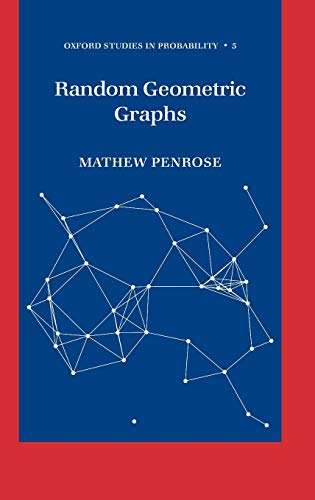
This monograph provides and explains the mathematics behind geometric graph theory, which studies the properties of a graph that consists of nodes placed in Euclidean space so that edges can be added to connect points that are close to one another. For example, a collection of trees scattered in a forest and the disease that is passed between them, a set of nests of animals or birds on a region and the communication between them or communication between communications stations or nerve cells. Aimed at graduate students and researchers in probability, statistics, combinatorics and graph theory including computer scientists, it covers topics such as: technical tools, edge and component counts, vertex degrees, clique and chromatic number, and connectivity. Applications of this theory are used in the study of neural networks, spread of disease, astrophysics and spatial statistics.
User’s Reviews
Editorial Reviews: About the Author Mathew Penrose is in the Department of Mathematical Sciences, Durham University.
Reviews from Amazon users which were colected at the time this book was published on the website:
⭐
⭐
Keywords
Free Download Random Geometric Graphs (Oxford Studies in Probability, 5) 1st Edition in PDF format
Random Geometric Graphs (Oxford Studies in Probability, 5) 1st Edition PDF Free Download
Download Random Geometric Graphs (Oxford Studies in Probability, 5) 1st Edition 2003 PDF Free
Random Geometric Graphs (Oxford Studies in Probability, 5) 1st Edition 2003 PDF Free Download
Download Random Geometric Graphs (Oxford Studies in Probability, 5) 1st Edition PDF
Free Download Ebook Random Geometric Graphs (Oxford Studies in Probability, 5) 1st Edition