

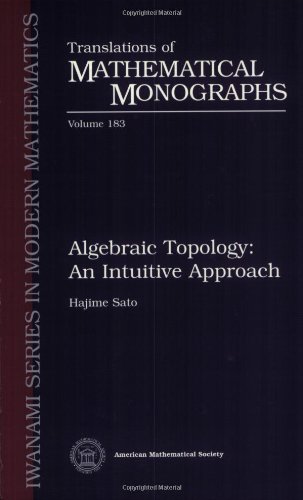
Ebook Info
- Published: 1999
- Number of pages: 118 pages
- Format: PDF
- File Size: 3.57 MB
- Authors: Hajime Sato
Description
The single most difficult thing one faces when one begins to learn a new branch of mathematics is to get a feel for the mathematical sense of the subject. The purpose of this book is to help the aspiring reader acquire this essential common sense about algebraic topology in a short period of time. To this end, Sato leads the reader through simple but meaningful examples in concrete terms. Moreover, results are not discussed in their greatest possible generality, but in terms of the simplest and most essential cases. In response to suggestions from readers of the original edition of this book, Sato has added an appendix of useful definitions and results on sets, general topology, groups and such. He has also provided references.Topics covered include fundamental notions such as homeomorphisms, homotopy equivalence, fundamental groups and higher homotopy groups, homology and cohomology, fiber bundles, spectral sequences and characteristic classes. Objects and examples considered in the text include the torus, the Mobius strip, the Klein bottle, closed surfaces, cell complexes and vector bundles.
User’s Reviews
Editorial Reviews: Review … Sato’s book is a gem, and I am happy to recommend it in very enthusiastic terms. –MAA ReviewsThis is an uncommon book with an interesting idea behind it, which is given in its title: to give an intuitive approach to algebraic topology. Instead of stating theorems in full generality or proving them rigorously with all technical details (or proving them at all), the author rather tries to make the reader familiar with “the idea” of the central notions of algebraic topology. –Zentralblatt MATHA nice supplement for a topology course. –American Mathematical Monthly
Reviews from Amazon users which were colected at the time this book was published on the website:
⭐When I chose this book, it was because I wanted to review algebraic topology. This kind of study is a valuable experience, since each of specialists has his own point of view on his subject. For example, if you climb a mountain and somebody who already climbed on the top of the mountain briefly tells you about what he has seen, it will be helpful to you. The best merit of the book is, first, it has only about 100 pages, and second, the author introduces algebraic topology from the basic definitions of algebraic topology to characteristic classes. In Preface, he emphasized that to read this book, you don’t need to have the experience to study topology. He seemed confident about this. But to me, that’s unrealistic. First of all, it has many typos, especially in basic definitions and examples. If readers have not studied algebraic topology before, it seems impossible to understand. I would give this book only three stars because typos abound, making many important places incomprehensible to readers who are naive of the subject. Anyway, I am content with the book, because I become more familiar with the concepts of fiber bundles, vector bundles, characteristic classes, spectral sequences, and I come to have my own image on these concepts.Overall, the book is very well-organized and the author chose a right path in making the book comprehensible to undergraduate students. If there were only a few and minor typos, I would have given this book five stars.
⭐In my opinion, this is a great little book to take with you to a park or on a trip to read before you start tackling a more serious book such as the one by Allen Hatcher. This book will give you a great over view of many major topics in Algebraic Topology; for a serious reader, you might want to read this book in parallel with Hatcher, Massey and Munkres (Topology, 2nd Edition). I find that these three books compliment one another very well if you are trying to learn this beautiful subject on your own. I use Sato’s book to read about general ideas; once I understand the surface of the concepts I then reference the latter two books to dive deeper into the machinery. It’s working well for me; however, do not be fooled, nothing replaces a great teacher!
⭐I was looking for a book on algebraic topology that would be a good introduction to the subject, giving some motivation and ideas about the most fundamental concepts. The title of this book and the first chapter seemed very promising, but the further I was, the bigger my confusion grew. First of all, some might disagree with me, but I wouldn’t call throwing a bunch of axioms with almost no comment as a very intuitive approach. We don’t see why stuff is defined the way it is, we just have to accept it. Also, it may be my bad, but I was looking for a book that might be read in a bus or cafe. This is definitely not a case here, I needed a pen, a sheet of paper, and a lot of intensive thinking to get through every page of this book, due to its very concise treatment (because of it, it’s very short, but in this case I wouldn’t call it an advantage).Every chapter ends with some exercises, but the answers are too terse to be useful if you don’t know how to solve a problem. For example, chapter 3 concludes with the exercises asking us to determine the fundamentals group of the projective plane and two-holed torus. The problem is, this chapter doesn’t give us any systematic way of establishing these structures and the answers yield just the final result.Finally, the book is full of errors, also in definitions and theorems, that makes it very hard to use. These mistakes are not only typos, but are sometimes much heavier. In the appendix it is stated that “A topological space X is connected if it is not a union of two open sets.”, which strongly lacks a key-word “non-empty”. Later, the author writes that “The quotient set G/~ of a group G with respect to an equivalence relation ~ inherits the group structure of G” – it’s not true in general! If there are mistakes in such a simple concepts, how can I be sure that there are no errors in the proper part of the book.Summing up, I can’t give this book a higher mark than 2 stars. It may be helpful for someone else, but definitely not for me. Definitely not a good choice for a first book on algebraic topology.
Keywords
Free Download Algebraic Topology: An Intuitive Approach (Translations of Mathematical Monographs, Vol. 183) 1st Edition in PDF format
Algebraic Topology: An Intuitive Approach (Translations of Mathematical Monographs, Vol. 183) 1st Edition PDF Free Download
Download Algebraic Topology: An Intuitive Approach (Translations of Mathematical Monographs, Vol. 183) 1st Edition 1999 PDF Free
Algebraic Topology: An Intuitive Approach (Translations of Mathematical Monographs, Vol. 183) 1st Edition 1999 PDF Free Download
Download Algebraic Topology: An Intuitive Approach (Translations of Mathematical Monographs, Vol. 183) 1st Edition PDF
Free Download Ebook Algebraic Topology: An Intuitive Approach (Translations of Mathematical Monographs, Vol. 183) 1st Edition