

Ebook Info
- Published: 2015
- Number of pages: 672 pages
- Format: PDF
- File Size: 5.42 MB
- Authors: Ronald Graham
Description
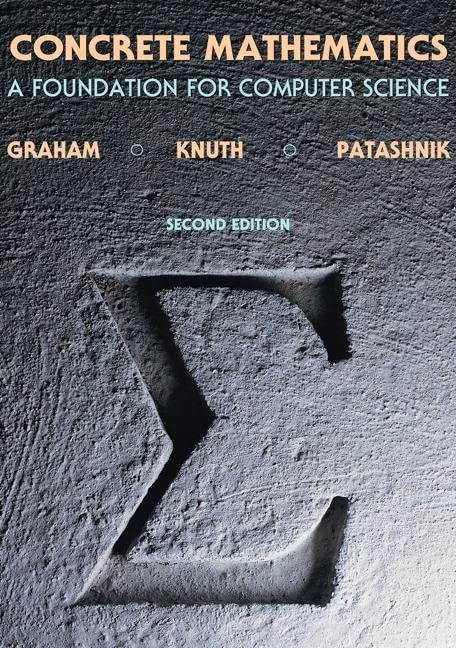
This book introduces the mathematics that supports advanced computer programming and the analysis of algorithms. The primary aim of its well-known authors is to provide a solid and relevant base of mathematical skills – the skills needed to solve complex problems, to evaluate horrendous sums, and to discover subtle patterns in data. It is an indispensable text and reference not only for computer scientists – the authors themselves rely heavily on it! – but for serious users of mathematics in virtually every discipline.Concrete Mathematics is a blending of CONtinuous and disCRETE mathematics. “More concretely,” the authors explain, “it is the controlled manipulation of mathematical formulas, using a collection of techniques for solving problems.” The subject matter is primarily an expansion of the Mathematical Preliminaries section in Knuth’s classic Art of Computer Programming, but the style of presentation is more leisurely, and individual topics are covered more deeply. Several new topics have been added, and the most significant ideas have been traced to their historical roots. The book includes more than 500 exercises, divided into six categories. Complete answers are provided for all exercises, except research problems, making the book particularly valuable for self-study.Major topics include:SumsRecurrencesInteger functionsElementary number theoryBinomial coefficientsGenerating functionsDiscrete probabilityAsymptotic methodsThis second edition includes important new material about mechanical summation. In response to the widespread use of the first edition as a reference book, the bibliography and index have also been expanded, and additional nontrivial improvements can be found on almost every page. Readers will appreciate the informal style of Concrete Mathematics. Particularly enjoyable are the marginal graffiti contributed by students who have taken courses based on this material. The authors want to convey not only the importance of the techniques presented, but some of the fun in learning and using them.
User’s Reviews
Editorial Reviews: From the Back Cover This book introduces the mathematics that supports advanced computer programming and the analysis of algorithms. The primary aim of its well-known authors is to provide a solid and relevant base of mathematical skills – the skills needed to solve complex problems, to evaluate horrendous sums, and to discover subtle patterns in data. It is an indispensable text and reference not only for computer scientists – the authors themselves rely heavily on it! – but for serious users of mathematics in virtually every discipline. Concrete Mathematics is a blending of CONtinuous and disCRETE mathematics. “More concretely,” the authors explain, “it is the controlled manipulation of mathematical formulas, using a collection of techniques for solving problems.” The subject matter is primarily an expansion of the Mathematical Preliminaries section in Knuth’s classic Art of Computer Programming, but the style of presentation is more leisurely, and individual topics are covered more deeply. Several new topics have been added, and the most significant ideas have been traced to their historical roots. The book includes more than 500 exercises, divided into six categories. Complete answers are provided for all exercises, except research problems, making the book particularly valuable for self-study. Major topics include:Sums Recurrences Integer functions Elementary number theory Binomial coefficients Generating functions Discrete probability Asymptotic methodsThis second edition includes important new material about mechanical summation. In response to the widespread use of the first edition as a reference book, the bibliography and index have also been expanded, and additional nontrivial improvements can be found on almost every page. Readers will appreciate the informal style of Concrete Mathematics. Particularly enjoyable are the marginal graffiti contributed by students who have taken courses based on this material. The authors want to convey not only the importance of the techniques presented, but some of the fun in learning and using them. About the Author Ronald L. Graham (1935–2020) was for many years the Chief Scientist at AT&T Labs Research. He was also a Professor of Computer and Information Science at the University of California, San Diego, and a former President of the American Mathematical Society and the Mathematical Association of America. He was the coauthor of seven other mathematics books. Donald E. Knuth is Professor Emeritus of The Art of Computer Programming at Stanford University. His prolific writings include four volumes on The Art of Computer Programming, and five books related to his TEX and METAFONT typesetting systems. Oren Patashnik is a member of the research staff at the Center for Communications Research, La Jolla, California. He is also the author of BibTEX, a widely used bibliography processor.
Reviews from Amazon users which were colected at the time this book was published on the website:
⭐One of my lovest books. Great written, great examples, great exercises. Perfect math book. Love it.
⭐I originally bought this book as a source of remedial study following the end of my US state school CS undergrad experience (I completed a BS Computer Science in 2013, > 3.5 GPA), and as preparation for V1 & V4 of TAOCP. I use the word remedial here in the sense that I felt that I was missing a critical foundation in the mathematical analysis and derivation of algorithms, even after the course-work of that degree. I’ve done 3 chapters of it in full, and I will mention a number of things that other reviews haven’t talked about. Due to the horrendous time commitment of this book, I strongly suspect this is because those reviewers haven’t actually worked through it, and have instead chosen to skim and allow Knuth fanboyism, along with the desire for mutual association, to cloud their opinions. I’m revoking a star simply to balance those reviews out, and so that graduates in similar situations have an actual informed critical opinion of this book to find among the reviews.Take-Aways (As of Ch 3):There are many aspects of summations, integer functions, and proofing that: I never saw covered in my CS degree, are unforgettable, and can be immediately applied to most algorithm research. Those alone make this book worth every penny. Further, the problems posed by this book are more than just repeated mechanics, as I have seen in books like those mentioned below. Each problem is carefully chosen, thorough, and exposes multiple aspects of each topic. They really do weed out many faults that I wasn’t really exposed to- as a small example: the importance of ensuring validity of n-1 and n-2 hypothesis & base cases during an induction proof.The Bad:Students educated through a contemporary CS track at most American uni’s, I believe, (e.g. Rosen Discrete Math, Cormen Algorithms) will find this book both terrifyingly terse and frustratingly paced. In many cases, examples are given without derivation. In many cases, important points are made without obvious connection to previous topics. This is not without a solution however, and getting through this book is often an acquired technique of paper noting things as-you-go, as well as a learned hyper-literacy. The terseness is also a double-edged sword, as sometimes I found it useful as an extra opportunity to practice the taught methods to see if I could come to the same result. Further, the reader should be prepared to go back and review propositional logic & university calculus theorems (atleast FTC, definite vs indefinite integrals). For example, the description of sum by parts in the section on finite calculus assumes _much_ from the reader, and being able to use university calc. as a point of reference to get through that is helpful.A lot of exercises are tersely explained in both problem and solution. Further, many solutions are totally left-field (having little to do with material in the book). This isn’t necessarily bad, as even taking the wrong path to a solution is very educational. However, at some point the reader has to make a judgment as to how long to commit to a certain problem. Many terse problems & left-field solutions instill the wrong judgment: quitting too early.Conclusion:Attention to detail & extra work is necessary to overcome the terseness of this particular beast, but it’s worth it. I recommend this book for developers confronted with algorithm optimization problems, as a well as for a different take on parts of discrete math, and definitely for students coming out of a US state school CS program, the last which this book complements very well. Having worked through some of V1 TAOCP, I would also say that the book is effective in expanding upon its math underpinnings (V1 at-least), and incidentally, does give one confidence to tackle Knuth’s other works.
⭐This book is classic Knuth: brilliant, comprehensive, inviting, and playful. Highly, highly recommended. This book is ideal for self-study.Material covered includes the basics of discrete math, plus some extras needed for analysis of algorithms. There is an explicit and polemical slant towards a concrete (Knuth calls it ‘Eulerian’) approach, but this basically just means the emphasis is on explicit calculation and motivating examples, rather than ‘elegant’ formality and abstraction.In terms of topics, the book starts with a chapter introducing recurrences, then guides the reader through developing familiarity and calculational skill with sums and sigma notation; floors and ceilings; modular arithmetic and a bit of number theory; binomial coefficients and special functions, finally culminating with generating functions, which provide a general framework for solving recurrences encountered in earlier chapters. There are also a couple of chapters on discrete probability and asymptotics, which round out the stated goal of the book: covering preparatory mathematical material needed for the analysis of algorithms in Knuth’s Art of Computer Programming.As with TAOCP, the problem sets are as enjoyable and carefully constructed as the exposition, and the solutions are included in the back of the book (about 500 pages of exposition, and about 100 pages of solutions). These problems could easily keep an interested person busy for a lifetime. They are each graded using Knuth’s customary scale, and range from the trivially easy to open research problems.
⭐This is a wonderful and desk reference, proving holistic coverage of all the math-oriented themes in CS study and practice. It is especially helpful if you already have a solid background in math, up to at least College Calculus I. If you need to write a proof of some algorithm, it has countless examples of proofs to draw inspiration from, and includes many examples of the (genius) author’s thinking when they work their way to proofs. I’m quite glad I own it as Concrete Mathematics is a monumental achievement and quite comprehensive.It gets 4 instead of 5 stars because despite having, as advertised, complete coverage of the mathematical topics needed for Computer Science, it is NOT a math book designed to teach you how to *conceptualize* the content it covers. It is heavy on examples and light on theory, and so is not particularly apt for developing one’s math schemas. Let me reiterate this point: “Concrete Mathematics” will NOT teach you Pre-Calculus, Discrete Mathematics, or Calculus concepts. If you don’t already have a robust mathematical repertoire, this book will not instill a sense of confidence that you’re doing things correctly when working on your own. In the Introduction, it says it was written based on an undergraduate class the authors routinely taught… but what seems missing from this book is the *teaching part* of their lecture series. One gets the impression reading it that students who took the course must have all been math aces prior to setting foot in the lecture hall, that they needed only to learn how to apply their considerable math talents to the Computer Science problem domain. I was fine reading and applying the content in this book, but I felt I should warn people looking for math instruction that they will need to supplement this volume with additional “pure math instruction” textbooks (Brief Applied Calculus, Discrete Math, etc.).
⭐I only started but I love the book, it has a great “applicable maths” feel to it. It really is a book for falling in love with the beauty of mathematics.But, my only minor complaint is some of the explanations are a little “sparse”. The authors draw conclusions that my mind does not see, but this can be seen as an opportunity to self research from other sources, or to give up.10/10Happy Reading!
⭐I’ll say now I’ve yet to read it all – and may never – but it certainly starts in a solid, informative fashion. I bought it as a companion volume to Knuth’s The Art of Computer Programming (TAOCP). There’s a significant overlap between the two works. My plan is to work through the TAOCP until I find my maths isn’t sufficient, then use Concrete Mathematics to fill in any Gaps. But this is a science degree level Mathematics course in a book and a good one.
⭐It is not an easy read – you have to work through it slowly to get the best from it, but the effort pays off in the long run.
⭐What a wonderful book.The marginal notes are wonderful.
⭐An excellent book.
Keywords
Free Download Concrete Mathematics: A Foundation for Computer Science (2nd Edition) 2nd Edition in PDF format
Concrete Mathematics: A Foundation for Computer Science (2nd Edition) 2nd Edition PDF Free Download
Download Concrete Mathematics: A Foundation for Computer Science (2nd Edition) 2nd Edition 2015 PDF Free
Concrete Mathematics: A Foundation for Computer Science (2nd Edition) 2nd Edition 2015 PDF Free Download
Download Concrete Mathematics: A Foundation for Computer Science (2nd Edition) 2nd Edition PDF
Free Download Ebook Concrete Mathematics: A Foundation for Computer Science (2nd Edition) 2nd Edition