

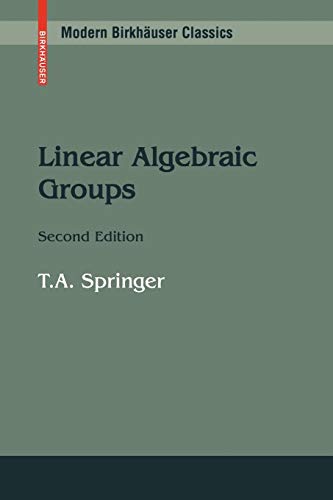
Ebook Info
- Published: 2008
- Number of pages: 346 pages
- Format: PDF
- File Size: 31.32 MB
- Authors: T.A. Springer
Description
The first edition of this book presented the theory of linear algebraic groups over an algebraically closed field. The second edition, thoroughly revised and expanded, extends the theory over arbitrary fields, which are not necessarily algebraically closed. It thus represents a higher aim. As in the first edition, the book includes a self-contained treatment of the prerequisites from algebraic geometry and commutative algebra, as well as basic results on reductive groups. As a result, the first part of the book can well serve as a text for an introductory graduate course on linear algebraic groups.
User’s Reviews
Editorial Reviews: Review From the reviews of the second edition:”[The first] ten chapters…are an efficient, accessible, and self-contained introduction to affine algebraic groups over an algebraically closed field. The author includes exercises and the book is certainly usable by graduate students as a text or for self-study…the author [has a] student-friendly style… [The following] seven chapters… would also be a good introduction to rationality issues for algebraic groups. A number of results from the literature…appear for the first time in a text.” –Mathematical Reviews (Review of the Second Edition)”This book is a completely new version of the first edition. The aim of the old book was to present the theory of linear algebraic groups over an algebraically closed field. Reading that book, many people entered the research field of linear algebraic groups. The present book has a wider scope. Its aim is to treat the theory of linear algebraic groups over arbitrary fields. Again, the author keeps the treatment of prerequisites self-contained. The material of the first ten chapters covers the contents of the old book, but the arrangement is somewhat different and there are additions, such as the basic facts about algebraic varieties and algebraic groups over a ground field, as well as an elementary treatment of Tannaka’s theorem. These chapters can serve as a text for an introductory course on linear algebraic groups. The last seven chapters are new. They deal with algebraic groups over arbitrary fields. Some of the material has not been dealt with before in other texts, such as Rosenlicht’s results about solvable groups in Chapter 14, the theorem of Borel and Tits on the conjugacy over the ground field of maximal split tori in an arbitrary linear algebraic group in Chapter 15, and the Tits classification of simple groups over a ground field in Chapter 17. The book includes many exercises and a subject index.” –Zentralblatt Math (Review of the Second Edition)”In Linear Algebraic Groups Springer aims at a self-contained treatment of the subject in the title and he certainly succeeds … . each chapter comes equipped with an endnote for a bit of history and context, as well as indications of where to go next. And all of it is done in a very clear style, making for a smooth and readable presentation. … a superb choice for any one wishing to learn the subject and go deeply into it quickly and effectively.” (Michael Berg, The Mathematical Association of America, March, 2009) From the Back Cover “[The first] ten chapters…are an efficient, accessible, and self-contained introduction to affine algebraic groups over an algebraically closed field. The author includes exercises and the book is certainly usable by graduate students as a text or for self-study…the author [has a] student-friendly style… [The following] seven chapters… would also be a good introduction to rationality issues for algebraic groups. A number of results from the literature…appear for the first time in a text.” –Mathematical Reviews (Review of the Second Edition)”This book is a completely new version of the first edition. The aim of the old book was to present the theory of linear algebraic groups over an algebraically closed field. Reading that book, many people entered the research field of linear algebraic groups. The present book has a wider scope. Its aim is to treat the theory of linear algebraic groups over arbitrary fields. Again, the author keeps the treatment of prerequisites self-contained. The material of the first ten chapters covers the contents of the old book, but the arrangement is somewhat different and there are additions, such as the basic facts about algebraic varieties and algebraic groups over a ground field, as well as an elementary treatment of Tannaka’s theorem. These chapters can serve as a text for an introductory course on linear algebraic groups. The last seven chapters are new. They deal with algebraic groups over arbitrary fields. Some of the material has not been dealt with before in other texts, such as Rosenlicht’s results about solvable groups in Chapter 14, the theorem of Borel and Tits on the conjugacy over the ground field of maximal split tori in an arbitrary linear algebraic group in Chapter 15, and the Tits classification of simple groups over a ground field in Chapter 17. The book includes many exercises and a subject index.” –Zentralblatt Math (Review of the Second Edition)
Reviews from Amazon users which were colected at the time this book was published on the website:
⭐It is an very good book. Moreover it is printed clearly.
⭐There is a lot of good and a lot of bad in this book. Some sections are organized beautifully, others are an absolute trainwreck. The first chapter is pretty horrible. It’s fine if you already know algebraic geometry, but if you don’t, you’re better off learning from Milne or somewhere else.The biggest problem with the book is how unfriendly it is. Springer leaves way too much to the reader to figure out on their own for the sake of brevity. If he claims something, and it isn’t immediately clear to you, there are three possibilities: (1) it is actually see to see (2) you will have to flip through the previous couple of chapters scouring for a result that can help you, which Springer could have just mentioned or (3) there is actually a lot of work to be done in establishing his claim. Seriously, when he says something without an explanation, and you endeavor to explain it yourself, you never know whether you’ll have two sentences or half a page. It’s like he has not really thought about the proofs of the theorems he is writing. It’s like if Serge Lang had an evil twin brother.Just as frustrating, is how averse Springer is to making the chapters of the book relatively independent. I get it, the material of linear algebraic groups is hard and everything is connected. But it’s one thing if you’re reading a theorem from Chapter 5 and Springer is citing Lemma 5 from Chapter 2. It’s another if he says “The proof of Lemma 5 in Chapter 2 shows that…” In other words, the only way to read a chapter and fully understand all the details is if you have read all the previous chapters and know all the previous details from them. As I mentioned in the last paragraph, the fact that Springer frequently omits details makes it all the more rage inducing.If you want to learn algebraic groups, you are better off reading Humphreys, or switching to Humphreys at the parts where Springer’s explanations are poor. The other choice is Borel, but if you don’t have a solid algebraic geometry background, you will find it harder than Springer.
Keywords
Free Download Linear Algebraic Groups (Modern Birkhäuser Classics) in PDF format
Linear Algebraic Groups (Modern Birkhäuser Classics) PDF Free Download
Download Linear Algebraic Groups (Modern Birkhäuser Classics) 2008 PDF Free
Linear Algebraic Groups (Modern Birkhäuser Classics) 2008 PDF Free Download
Download Linear Algebraic Groups (Modern Birkhäuser Classics) PDF
Free Download Ebook Linear Algebraic Groups (Modern Birkhäuser Classics)