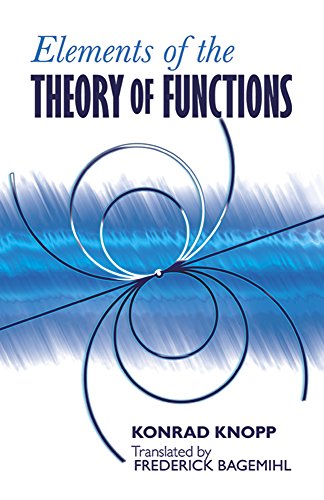
Ebook Info
- Published: 2016
- Number of pages: 160 pages
- Format: PDF
- File Size: 5.48 MB
- Authors: Konrad Knopp
Description
This well-known book provides a clear and concise review of general function theory via complex variables. Suitable for undergraduate math majors, the treatment explores only those topics that are simplest but are also most important for the development of the theory. Prerequisites include a knowledge of the foundations of real analysis and of the elements of analytic geometry.The text begins with an introduction to the system of complex numbers and their operations. Then the concept of sets of numbers, the limit concept, and closely related matters are extended to complex quantities. Final chapters examine the elementary functions, including rational and linear functions, exponential and trigonometric functions, and several others as well as their inverses, including the logarithm and the cyclometric functions. Numerous examples clarify the essential ideas, and proofs are expressed in a direct manner without sacrifice of completeness or rigor.
User’s Reviews
Editorial Reviews: About the Author German mathematician Konrad Knopp (1882–1957) taught at the University of Königsberg from 1915-26 and at Tübingen University from 1926 until his retirement in 1950. His other Dover books include Infinite Sequences and Series, Theory and Applications of Infinite Series, Theory of Functions, and Problem Book in the Theory of Functions.
Reviews from Amazon users which were colected at the time this book was published on the website:
⭐this is a small and well-written book which seems like it should be an introduction to the larger, two-volume work, “the theory of functions”, by knopp. but in my opinion, it is a smaller book, without problem sets, that emphasizes somewhat different topics. there are five sections. I. complex numbers and their geometric representation (41 pages). II. linear functions and circular transformations (23 pages). III. sets and sequences. power series (23 pages). IV. analytic functions and conformal mapping (17 pages). V. elementary functions (30 pages).volume 1 of “the theory of functions” alone has approximately the same number of pages (about 140), nearly ALL of which are devoted to analytic functions of complex variables. while one could argue about the “meaning” of a theory of functions, the main “applications” of such a theory appear to be in the area of analytic functions of a complex variable.the “elements” covers this material in 17 pages and without a problem set. so there are no questions, problems or demonstrations of the power of conformal mapping and cauchy’s integral theorem in solving problems involving, say, conservative fields in physics.so this little introductory book (with no problem sets) outlines a stimulating “theory of functions”, but it does not explore the breadth and power of analytic functions of complex variables. these are covered in much greater depthin knopp’s “theory of functions, vols. 1 & 2”, as well as in the accompanying problem book.
⭐Recently, I dug into my collection of “old-school” math books looking for a good review of general function theory via complex variables. I [somehow] recalled this author as having a very good approach to this area. This topic is so wide and deep as to allow for many approaches. The whole presentation of this author via his little series of math works follows a very clear and sharp path from complex variables to general function theory. It seems many authors delay starting at the start with complex numbers and variables — yet the “complex way” is a very streamlined way into general function theory and even infinite series — as this Mentor shows — starting with this very great little gem of an introduction. Even complex numbers can be approached from various angles — one of the best being that of “Elements of the Theory of Functions” by Konrad Knopp +++
⭐Read this book the summer before engineering grad school. I thought I knew a thing or 2 about applied math.Wrong. This little book changed everything. But it & read it.
⭐This book goes with the series of books written by this author:” Theory of Functions”. Together with the other parts it gives a good introduction to the theory of complex functional analysis. Although the language is in places outdated, the mathematics covered is solid and necessary. It is a starting point in study for subjects like chaos and fractals as well. One of the best points is that is a cheap Dover book!
⭐prompt delivery an correct description
Keywords
Free Download Elements of the Theory of Functions (Dover Books on Mathematics) in PDF format
Elements of the Theory of Functions (Dover Books on Mathematics) PDF Free Download
Download Elements of the Theory of Functions (Dover Books on Mathematics) 2016 PDF Free
Elements of the Theory of Functions (Dover Books on Mathematics) 2016 PDF Free Download
Download Elements of the Theory of Functions (Dover Books on Mathematics) PDF
Free Download Ebook Elements of the Theory of Functions (Dover Books on Mathematics)