

Ebook Info
- Published: 1999
- Number of pages: 616 pages
- Format: PDF
- File Size: 14.40 MB
- Authors: Tristan Needham
Description
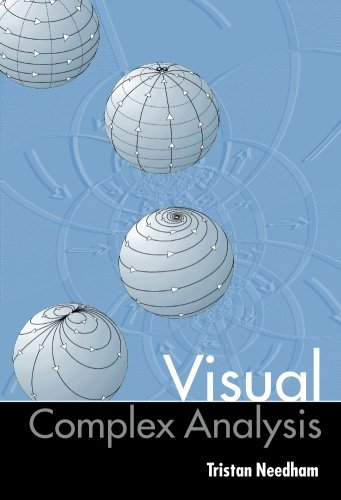
This radical first course on complex analysis brings a beautiful and powerful subject to life by consistently using geometry (not calculation) as the means of explanation. Aimed at undergraduate students in mathematics, physics, and engineering, the book’s intuitive explanations, lack of advanced prerequisites, and consciously user-friendly prose style will help students to master the subject more readily than was previously possible. The key to this is the book’s use of new geometric arguments in place of the standard calculational ones. These geometric arguments are communicated with the aid of hundreds of diagrams of a standard seldom encountered in mathematical works. A new approach to a classical topic, this work will be of interest to students in mathematics, physics, and engineering, as well as to professionals in these fields.
User’s Reviews
Editorial Reviews: Review “[Needham’s] highly praised massive book Visual Complex Analysis may still be resounding in the minds of those who have read it. The original approach and the numerous graphics must have left a lasting impression.” — Adhemar Bultheel, Mathematical Association of America Reviews”Visual Complex Analysis is a delight, and a book after my own heart. By his innovative and exclusive use of the geometrical perspective, Tristan Needham uncovers many surprising and largely unappreciated aspects of the beauty of complex analysis.” –Roger Penrose”Tristan Needham’s Visual Complex Analysis will show you the field of complex analysis in a way you almost certainly have not seen before. Drawing on historical sources and adding his own insights, Needham develops the subject from the ground up, drawing us attractive pictures at every step of the way. If you have time for a year course, full of fascinating detours, this is the perfect text; by picking and choosing, you could use it for a variety of shorter courses. I am tempted to hide the book from my own students, in order to appear more clever for popping up with crisp historical anecdotes, great exercises, and pictures that explain things like that mysterious 2*pi that crops up in integrals. Whether you use Visual Complex Analysis as a text, a resource, or entertaining summer reading, I highly recommend it for your bookshelf.”–American Mathematical Monthly”Delivers what its title promises, and more: an engaging, broad, thorough, and often deep, development of undergraduate complex analysis and related areas. . .A truly unusual and notably creative look at a classical subject.” –American Mathematical Monthly”One of the saddest developments in school mathematics has been the downgrading of the visual for the formal. I’m not lamenting the loss of traditional Euclidean geometry, despite its virtues, because it too emphasised stilted formalities. But to replace our rich visual intuition by silly games with 2 x 2 matrices has always seemed to me to be the height of folly. It is therefore a special pleasure to see Tristan Needham’s ‘Visual Complex Analysis’ with its elegantly illustrated visual approach. Yes, he has 2 x 2 matrices–but his are interesting.” –New Scientist”Committed to the exclusive use of geometrical arguments and content to pay the price of ‘an initial lack of rigour’, he has produced a radically new text. The author writes “as though [he] were explaining the ideas directly to a friend”. This informal style is excellently judged and works extremely well.”–Mathematical Review”This is a book in which the author has been willing to make himself available as our teacher. His own voice enters in a rather charming way….I recommend Visual Complex Analysis, as something to read and enjoy, to share with students, and perhaps to inspire other books in which the voice of the author is vividly present to teach and explain.”–American Mathematical Monthly About the Author Tristan Needham is Associate Professor of Mathematics at the University of San Francisco. For part of the work in this book, he was presented with the Carl B. Allendoerfer Award by the Mathematical Association of America.
Reviews from Amazon users which were colected at the time this book was published on the website:
⭐The book is well written with excellent illustrations. Reader should have had a course in Complex variables and advanced Calculus before conquering this text. But even if one does not have the math background, the book is worth wading through… it may get one interested in advanced math topics.When in the 8th grade [millions of years ago] I purchased advanced texts in Advanced Engineering, Vector Analysis and Complex Analysis and looked through the books. I was curious about the math symbols and how they worked. Several years later I had taken courses in these subjects. I would encourage others to browse as it may lead you to a career too.
⭐Complex analysis can challenge the intuition of the new student. This text is unique, among high quality textbooks, in giving a careful and thorough exploration of the geometric meaning underlying the usual algebra and calculus of complex numbers. The Cauchy-Riemann equations define what is meant by a holomorphic function. Restricting to these particularly pleasant and useful functions, the formalism of calculus looks very much like ordinary calculus. Too many students muddle through complex analysis with the notion that it looks like calculus, except some extra nice functions also hold. Such students commonly become competent, but they seldom actually get good at complex analysis. In particular, for many engineers, complex calculus remains an unpalatable mystery, even though they know how to do the calculations. That is the difficulty, and Needham corrects the whole of the difficulty perfectly.Ahlfors is a great classical text. Conway (two volumes) is thorough, clear, and modern. Carrier, Krook, and Pearson is especially concise and well oriented to the practical calculations of engineering and applied science. Berenstein/Gay is very modern and oriented to a very high quality undergraduate or beginning graduate who intends to continue in (very) pure mathematics. All these and more (e.g. Saff) are at least very good or perhaps excellent texts. Because there is a body of problems that beginners are expected to be able to work (mathematics is also a culture—there are expectations), it is probably necessary to pick one of these texts and to use Needham’s book as one of two texts for an excellent course. I know of no other book that gives the great intuitive and geometric understanding of complex analysis that Needham gives. I would, under no circumstances, teach any beginning course in complex analysis at any school anywhere at any time for any reason without using Needham as one of the texts. If I were feeling particularly self-satisfied, I might possibly use it as the only text. I myself seldom feel so confident. Perhaps you do. This text is used frequently at M.I.T. and at Oxford. That seems to me a great recommendation. The book is very well and clearly written. The prose flows. It is a great joy to read.
⭐I have held off on writing a review on this book for some time now. After having read it completely, and, more importantly, having worked with complex variables extensively, I am finally ready to deliver a verdict on it.I applaud the author’s effort to visually describe the complex plane: in particularly complex multiplication and integration. He also goes into great detail on Mobius transformations and other geometric concepts. However, I think that he missed the opportunity to describe complex differentials completely. While he speaks of analytic functions being “everywhere aplitwist,” he doesn’t describe the nature of differentials at analytic points: namely, the differential remains the same, regardless of which path we take from the point. This much more clearly explains the rigidity of analytic functions (along with theorems like FTC, maximum modulus, etc. which follow directly from this rigidity).I believe that he forsakes his own thesis in describing the argument principle in generic topological arguments. These arguments are far more involved than they need to be.More than anything, I dislike how he uses results that haven’t been proved. It is quite annoying to use Cauchy’s Theorem throughout the book, not proving it till very late.All that said, this is an overall great book that will get you thinking about the concepts. His writing style is very skillful, and, obviously, he provides a lot of figures to help get his point across. It is definitely worth adding to your library, but I think that you will need at least one other text to completely grasp the subject. (I personally recommend Gamelin’s book.)
⭐This is a great book that has earned my respect, but it is not for a beginner. It is intended for the crowd who already has some good mathematics background (at least the basic calculus levels and understanding of what imaginary numbers are).Other than that the book is enlightening and entertaining. I learn something new everyday with this book, it is a great book to have as a teaching suppliment or as light reading. It allows one focus on concepts that may be hard to grasp in literature, but now more easy to grasp due to the visual representations this book contains.I gave it 4 out 5 of because I wish to see more practical applications besides just theory (although the book is called complex analysis for a reason, it talks mostly about theory which i truely understand that was the intention). More practical and applied problems would be a benefit to those who are not just visual learners but also want to understand more about the importance of complex analysis.The book is good, get it.
⭐Everyone is different. I believe that I am a visual thinker and develop understanding faster and better with a visual model or visual interpretation of the maths. This book was written with this approach in mind, so, for me, is one of the best text books on maths that i have read. Many maths text books are dense with maths, formulae, equations etc leaving the insight to the reader to develop on their own. With these other text books, I can plough my way through the maths eventually, but often i am left wondering whether i have fully understood the maths being presented and its implications. I thought this book was different. It was a thoroughly enjoyable book to read and one that i am likely to be referring to again and again.
⭐If only this book had been available when I did my degree! I got a First, and A grades in all the papers, but two of which I had no proper understanding of: Galois Theory, and Complex Analysis. I am still searching for the book which can explain to me what made Galois set off in the direction he did. As for the latter, this work by Needham more than fulfills the comprehension I have been looking for ever since I finished my degree course, 33 years ago! Admittedly it has been a rather leisurely search. Some reviewers complain that it is not very accessible. I think it is plain right at the outset that it is not an attempt at popularising complex analysis. Nor is it intended to be a text book. The author clearly states on several occasions that sometimes he is only offering a geometric insight rather than a rigorous proof. This book is perfect in complementing a typical text on the subject, which may provide the rigour but possibly totally neglect the geometry. None of this is to suggest that the book is sloppy, or inaccurate in any way. The mathematics is not compromised at all. What was a true revelation for me was the magical world that slowly but surely unfolded with each chapter. When I did my degree, all the results of complex calculus were presented in the usual way, with rigorous proofs, which I could reproduce in exams, and knew that those results which gave complex analysis an advantage over real analysis derived from the definition of an analytic function. But I never understood why until now. People like Cauchy and Riemann clearly understood and saw in a way which is brought to life in CVA. Needham refers to Bach and Wagner in his preface. I think it is no exaggeration to say that exploring the magical world of complex analysis as presented here is just as sublime and beautiful as the music of those two giants.
⭐This is not just an excellent book, this book is exceptional. I can actually name just a couple of books of the same quality. This book is in the same division as Feyman’s lectures.First of all, it is a very good piece of writing. The book very easy to read (although the content is far from being easy!) and I can compare the reading of this book to reading a good classical literature. Besides that, all of the explanations in the book is very clear and visual.I knew a bit of complex analysis before, but I always felt that I miss some parts and I don’t have a whole image of this field in my head. But I was quite prepared. Surprisingly, even those things which I already knew this book presented in a different way, which was very interesting.I strongly recommend this book to everyone (even to those who is confident in his knowledge of Complex Analysis!) and personally I’ll follow this author and by his upcoming books.
⭐Hi,In a way you only see how good this book is when you read a number of other books on this topic? This is a book that works best when other books balance these two approaches, and by doing this it lets you see the whole ‘landscape’ of complex analysis.If other books are rich in detailed questions, you slog along and break them down in small steps often without the `big picture’ of where it fits in the wider scheme of things. With this book you see a vast sweeping panorama that allows the reader to gain insight with a geometrical approach in conceptualising areas. The book starts in elemental terms in reflections and translations and complex algebra. Also a common feature is the book has outstanding illustrations and has helpful text to explain in more depth. I found the approach helped my geometrical interpretation of the links between complex numbers projected onto ‘Riemann spheres’ using ‘Möbius transforms’ through into ‘Hyperbolic geometry’ and the Calculus and on further to consider the properties of 3 combinations of two curved mirrors (reflections and translations again) on a Euclidian plane. The book also carries on to cover more general-purpose ‘Laurent series’ and beyond and how they can be applied in Complex Analysis.* Updated 12/01/2021Reread this book cover – to – cover and it’s so clear. The bit on celestial mechanics is not very good, but the rest is beautifully explained and easily comprehended. During this lockdown, I reread math books I have previously read and re-watch a movie to break the silence.Summary: I.M.H.O. It’s a good buy as part of your bookshelf on this gripping topic. A Mathematics professor I knew once (who I will not name) -paraphrased-described the book to me as “the type of book you have at MSc level, without the intensive level of calculation. Its a lovely book to give you a `feel’ of the topic”.
⭐This is a well known and highly regarded text on Complex Analysis. I wouldn’t buy it if you are an undergraduate student, but if you are already familiar and confident with complex numbers to degree level then you will find this book to be well worth the investment.
Keywords
Free Download Visual Complex Analysis in PDF format
Visual Complex Analysis PDF Free Download
Download Visual Complex Analysis 1999 PDF Free
Visual Complex Analysis 1999 PDF Free Download
Download Visual Complex Analysis PDF
Free Download Ebook Visual Complex Analysis