

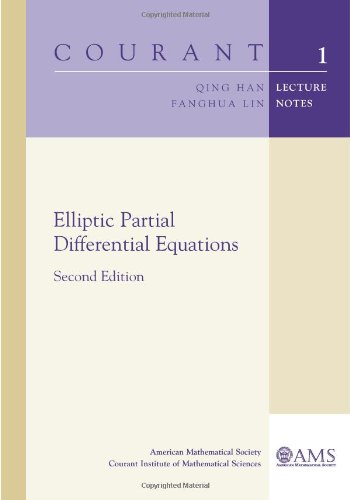
Ebook Info
- Published: 2011
- Number of pages: 147 pages
- Format: PDF
- File Size: 6.92 MB
- Authors: Qing Han
Description
Elliptic Partial Differential Equations by Qing Han and FangHua Lin is one of the best textbooks I know. It is the perfect introduction to PDE. In 150 pages or so it covers an amazing amount of wonderful and extraordinary useful material. I have used it as a textbook at both graduate and undergraduate levels which is possible since it only requires very little background material yet it covers an enormous amount of material. In my opinion it is a must read for all interested in analysis and geometry, and for all of my own PhD students it is indeed just that. I cannot say enough good things about it–it is a wonderful book. –Tobias Colding This volume is based on PDE courses given by the authors at the Courant Institute and at the University of Notre Dame, Indiana. Presented are basic methods for obtaining various a priori estimates for second-order equations of elliptic type with particular emphasis on maximal principles, Harnack inequalities, and their applications. The equations considered in the book are linear; however, the presented methods also apply to nonlinear problems. This second edition has been thoroughly revised and in a new chapter the authors discuss several methods for proving the existence of solutions of primarily the Dirichlet problem for various types of elliptic equations. Titles in this series are co-published with the Courant Institute of Mathematical Sciences at New York University.
User’s Reviews
Reviews from Amazon users which were colected at the time this book was published on the website:
⭐Excellent printing! Fast delivery! The book itself is great as well!
⭐A well-known book.
⭐This book is a great introduction to elliptic PDEs. My main interest are geometric analysis, and this book covers essential topics for application to PDEs appearing in geometry. Examples of such topics which are ubiquitous in geometric analysis include maximum principles, Moser iteration, Harnack inequalities, Schauder estimates and the continuity method.The prerequisites are a graduate course in analysis, and knowledge of Sobolev spaces equivalent to chapter 5 in Evans’ book “Partial Differential Equations”.Although the topics are fascinating, this text leaves rather large gaps for the reader to fill in. This can be seen as a good thing, since it forces the reader to get his hands dirty and dig deeper into the material. However, I was sometimes unable to fill the gap and had to ask a professor or consult other sources on the internet. This happened for example when the end of a proof was left to a “standard covering argument”, which in my opinion was tricky to complete if one hadn’t seen such a kind of argument before. Since many of the gaps are much more than a straight-forward calculation, this makes the textbook extremely frustrating for the beginner.With the occasional help of someone who already knows the material, struggling through this textbook is a rewarding experience for the beginner of elliptic PDEs. As an added bonus, the book is relatively short, and cheap!
⭐
Keywords
Free Download Elliptic Partial Differential Equations: Second Edition (Courant Lecture Notes) 2nd Edition in PDF format
Elliptic Partial Differential Equations: Second Edition (Courant Lecture Notes) 2nd Edition PDF Free Download
Download Elliptic Partial Differential Equations: Second Edition (Courant Lecture Notes) 2nd Edition 2011 PDF Free
Elliptic Partial Differential Equations: Second Edition (Courant Lecture Notes) 2nd Edition 2011 PDF Free Download
Download Elliptic Partial Differential Equations: Second Edition (Courant Lecture Notes) 2nd Edition PDF
Free Download Ebook Elliptic Partial Differential Equations: Second Edition (Courant Lecture Notes) 2nd Edition