Ebook Info
- Published: 2013
- Number of pages:
- Format: PDF
- File Size: 5.44 MB
- Authors: James R. Munkres
Description
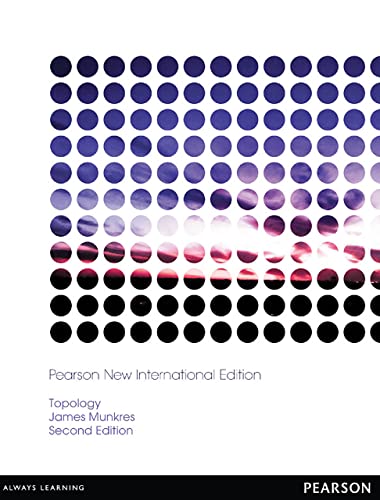
For a senior undergraduate or first year graduate-level course in Introduction to Topology. Appropriate for a one-semester course on both general and algebraic topology or separate courses treating each topic separately.This text is designed to provide instructors with a convenient single text resource for bridging between general and algebraic topology courses. Two separate, distinct sections (one on general, point set topology, the other on algebraic topology) are each suitable for a one-semester course and are based around the same set of basic, core topics. Optional, independent topics and applications can be studied and developed in depth depending on course needs and preferences.FROM THE BACK COVERThis introduction to topology provides separate, in-depth coverage of both general topology and algebraic topology. Includes many examples and figures. GENERAL TOPOLOGY. Set Theory and Logic. Topological Spaces and Continuous Functions. Connectedness and Compactness. Countability and Separation Axioms. The Tychonoff Theorem. Metrization Theorems and paracompactness. Complete Metric Spaces and Function Spaces. Baire Spaces and Dimension Theory. ALGEBRAIC TOPOLOGY. The Fundamental Group. Separation Theorems. The Seifert-van Kampen Theorem. Classification of Surfaces. Classification of Covering Spaces. Applications to Group Theory. For anyone needing a basic, thorough, introduction to general and algebraic topology and its applications.
User’s Reviews
Reviews from Amazon users which were colected at the time this book was published on the website:
⭐I’ve gone through most of this book and did many of the problems. The sections I skipped are the section on nets, the “review section” in chapter 4, the existence of a continuous nowhere-differentiable function, Dimension Theory, and all of Chapter 10 (Separation Theorems in the Plane), the Classification Theorem, and Constructing Compact Surfaces.This is definitely my favorite math book. The two other books I’ve read this semester (Conway’s Complex Analysis, and Rudin’s Real and Complex Analysis) simply don’t compare. In fact I’m afraid I’ll always find fault with every other math book, after reading this one. There’s alot of good expository prose, many examples and diagrams, and if you pay attention to details, and struggle to supply missing ones, you won’t miss a beat and will succeed (unlike sometimes in Rudin’s text). The problems are appropriate; very few are mindless, most do require a little thought, but a motivated student could solve most or all of them in a reasonable amount of time. There are no sudden breaks in proofs or in the text that are relegated as exercises (unless it’s a repeat of a previous proof), and although results from previous exercises are sometimes used, he always states the necessary hypotheses. The book is self-contained – he begins with 70+ pages of naive set theory, for instance (not a prerequisite for the rest of the book).I feel that reading this book and working its problems has given me a solid and comprehensive grounding in basic topology, and this book does go beyond what’s usually taught in a first topology course, and the second half of the book is all algebraic topology. Here I found the review of abelian groups, free products and free groups to be extremely helpful, though I did still have to contemplate these alot on my own afterwards. The Seifert-Van Kampen theorem was also well-presented; he presents it as a pushout diagram. In the last chapter, as a nice application, he proves using linear graphs that subgroups of free groups are free.I just simply love this book, but to be fair, I do have some minor qualms.(1) There are a few obvious typos, and I didn’t find more than six(2) I believe one step in the proof of Lemma 68.9 is incorrect; this arises from a definitional issue of the subgroup generated by a subset. earlier, he assumed the subset was itself a subgroup, but now he’s assuming it’s arbitrary. the correct definition is on the next page, and the method of proof, with this definition, does give the right result; almost nothing changes in the proof(3) In Theorem 68.4, the monomorphism and generating assumptions aren’t necessary(4) Problem #2 on page 438: I think the X_i should be path-connected, and Wikipedia is in agreement with this. I tried passing to path-components, which solved one problem but gave me others. On the other hand, if you assume path-connectedness, the proof is is the right level of difficulty.(5) He gives an exercise regarding absolute retracts and adjunction spaces. I think he should’ve elaborated more on adjunction spaces, as it does involve new notions (e.g. free/topological union). Also his definition of adjunction space is incomplete, as compared to other definitions I found(6) The book binding is horrible (it’s the same with his other book, “Analysis on Manifolds”). If you’re paying 100+ dollars for a book, you should expect to receive something very pretty, but the typesetting of this book is quite dull, and the book falls apart easily (mine is in many pieces).In conclusion I highly recommend this book for self-study, and for seeing how math books can and should be written. I hope Munkres writes more textbooks, I’d read every single one of them.
⭐I used to own the first (1975) edition of this title since the late 1990s, but eventually purchased the new edition as well, and donated the old book to our campus library. Despite having very close similarity to the text by Stephen Willard (1970, Dover issue 2004) which points to the fact that both authors must have used the same source articles, Munkres’s book stands out as one of the best rigorous introductions for a beginning graduate student. It covers all the standard material for a first course in general topology starting with a full chapter on set theory, and now in the second edition includes a rather extensive treatment of elementary algebraic topology. The style of writing is student-friendly, the topics are nicely motivated, (counter-)examples are given where they were needed, many diagrams provided, the chapter exercises relevant with the correct degree of difficulty, and there are virtually no typos. The 2nd edition fine-tunes the exposition throughout, including a better paragraph formatting of the material and also greatly expands on the treatment of algebraic topology, making up for 14 total chapters as opposed to eight in the first edition. I particularly found useful the discussion of the separation axioms and metrization theorems in the first part, and the classification of surfaces and covering spaces in the second part.In my opinion, after going through the discussion of algebraic topology in Munkres, the students should be ready to move forward to a (now standard) text such as Hatcher, for further coverage of homotopy, homology and cohomology theories of spaces. Eventhough a few contending general topology texts – such as a recent title published in the Walter Rudin Series – have started to hit the academic markets, Munkres will no doubt remain as the classic, tried-and-trusted source of learning and reference for generations of mathematics students. This is despite the fairly high price tag which could stop some students from buying their own copies, hence encouraging instructors to choose some of the cheaper topology paperbacks readily available through the Dover publications. Also the majority of Munkres’s readers would have wished to see more hints and answers provided at the back so as to make the text more helpful for self-study. (I remember suffering from and being lost with my Munkres topology homework exercises in 1998-1999, during my first year of graduate school.) It later became evident to me that those who are newcomers to the topic or are merely testing the waters, should try Fred H. Croom’s 1989 topology text, since the latter is a more accessible title similar in the exposition and selection of topics on Munkres (and Willard for that matter), thus nicely serving as a prerequisite for either of the more advanced books.A couple of ending remarks: A reviewer has correctly mentioned here that Dr. Munkres does not include differential topology in his presentation. This is because of the length consideration, given that he has already written a separate monograph on the topic. In fact it’s also necessary to first get a handle on a fair amount of algebraic topology such as the notions of homotopy, fundamental groups, and covering spaces for a full-fledged treatment of the differential aspect. In any case, one high-level reference for a rigorous excursion into this area is the Springer-Verlag GTM title by Morris W. Hirsch which includes introductions to the Morse and cobordism theories. I’d also like to mention that another decent book on general topology, unfortunately out of print for quite some time, is a treatise by “James Dugundji” (Prentice Hall, 1965). The latter would complement Munkres, as for instance Dugundji discusses ultrafilters and some of the more analytical directions of the subject. It’s a pity that Dover in particular, has not yet published this gem in the form of one of their paperbacks.
⭐I learned general topology from the 1st edition red hardcover. I sold it back to the college bookstore thinking that Kelley which is only a little more demanding than Munkres would suffice. The most complicated theorem I reasoned I would ever have occasion to need was the Nagata-Smirnov Metrization Theorem which I understood in Munkres as well as in Kelley. Munkres also does the Smirnov Metrization Theorem which relies more on paracompactness. But Kelley does Moore-Smith convergence and nets-a way of doing topology with sequences, and only gives a reference for Smirnov. The Munkres text gave a brief introduction to homotopy and the fundamental group-Kelley none. Yet except for Smirnov Kelley seemed to have more point-set topology even proving the equivalence of the axiom of choice to Zorn’s Lemma in set theory. Well I got nostalgic for Smirnov and Munkres added in the 2nd edition more material on the fundamental group including even Seifert-Van Kampen, pretty much the equivalent of the famous Massey text. The price was right so I bought it.This text is excellent for self study assuming you’ve taken an analysis course and followed the proofs enough to do reasonably well in the exercises (when you screwed up-you figured out why.). General or point set topology is essentially math analysis distilled to its basic constructs and arguments (proof forms). Great theorems in analysis become great ideas in general topology. One theorem I’ve oft repeated is that a metric space is compact if and only if every infinite sequence (in it) has a limit point(in it)-or point of accumulation-this theorem is the prototype for the notion of sequential compactness. You’ll see arguments from analysis repeated or called upon throughout-same friends just different clothes on them.
⭐This is the Indian edition of this classic book. Everything is present from the original edition except for the preface and the comprehensive index. This edition does contain an index, but it’s pretty useless. Many essential elements are excluded from it. My workaround was to obtain the contents and index of a US edition (using ‘Look Inside’) and using that instead. So, only four stars because of this. On the positive side the version that I received was very cheap and so was very worthwhile. So, no regrets.
⭐Great book and great customer service when some delivery issues arose. Thanks!
⭐Book doesn’t need any introduction so have it as early as possible. It has two parts which covers algebraic and general topology in sufficient way. Highly useful for MA and MSc mathematics students.Physicists too will find the book interesting.Pearson has kept printing and binding good. They have only cut short index a little bit. It should be library of every maths lover. I suggest to have J.N.Sharma’s Topology book too , it is also really good and revised many times.
⭐Best book to understand spaces or all other topology cincepts. Generalised manner to explain things.Rhe good thing is it eoes not matter for how long you are out of touch with set theory, you need not to look for other books to start from scratch, you will get everything in this book even in a much better detailed manner.
⭐The quality of pages of book is really bad. The book doesn’t have contents. Index is useless in such a way that one can’t find topic from that. For example , there is nothing for ” Compact ” in the index. I suggest don’t buy this book. The older version is REALLY much better. See the picture that I’ve uploaded for better view of Index.
Keywords
Free Download Topology: Pearson New International Edition 2nd Edition in PDF format
Topology: Pearson New International Edition 2nd Edition PDF Free Download
Download Topology: Pearson New International Edition 2nd Edition 2013 PDF Free
Topology: Pearson New International Edition 2nd Edition 2013 PDF Free Download
Download Topology: Pearson New International Edition 2nd Edition PDF
Free Download Ebook Topology: Pearson New International Edition 2nd Edition