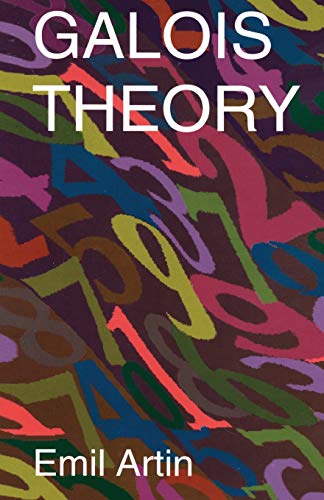
Ebook Info
- Published: 1997
- Number of pages: 96 pages
- Format: PDF
- File Size: 24.39 MB
- Authors: Emil Artin
Description
In the nineteenth century, French mathematician Evariste Galois developed the Galois theory of groups-one of the most penetrating concepts in modem mathematics. The elements of the theory are clearly presented in this second, revised edition of a volume of lectures delivered by noted mathematician Emil Artin. The book has been edited by Dr. Arthur N. Milgram, who has also supplemented the work with a Section on Applications.The first section deals with linear algebra, including fields, vector spaces, homogeneous linear equations, determinants, and other topics. A second section considers extension fields, polynomials, algebraic elements, splitting fields, group characters, normal extensions, roots of unity, Noether equations, Jummer’s fields, and more.Dr. Milgram’s section on applications discusses solvable groups, permutation groups, solution of equations by radicals, and other concepts.
User’s Reviews
Reviews from Amazon users which were colected at the time this book was published on the website:
⭐This is a cute little book that guides the reader into Galois theory starting all the way from the review of linear algebra and polynomial rings over fields and progressing all the way to the Fundamental theorem. There are moreover many nice sections on Finite fields, Noether equations, Kummer extensions and as a final chapter the application to solvability by radicals of a general polynomial and the ruler and compass constructions. So the book is pretty self-contained and contains lots of good stuff. Also, Artin has a knack of giving very down-to-earth proofs that could be characterized as computational (rather than conceptual). It depends on everyone’s preference whether they like this approach but for me it was very refreshing change of pace (compared to abstract and ofter almost magical proofs e.g. from commutative algebra).In any case, patient reader will walk away from this book with a feeling of having built the subject from the ground up.Nevertheless, I can’t give it 5 stars because the book is very lacking in exercises. There are some applications scattered here and there (e.g. on symmetric extensions of function fields and on symmetric functions) but this is hopelessly insufficient to solidify the knowledge gained from the theorems. To properly understand Galois theory one needs to get their hands dirty by investigating splitting fields and Galois groups of all kinds of polynomials and paying close attention to the interaction of roots and group actions. In this regard the book leaves the reader completely on their own and so should be complemented by some additional source of exercices.
⭐Galois Theory is in traditional mathematical format. The major elements of the book are definitions, lemmas, theorems, and proofs. The book introduces the major topics of Galois Theory. They are fields, extension fields, splitting fields, unique decomposition of polynomials into irreducible factors, solvable groups, permutation groups, and solution of equations by radical. The last part of the book contains the major results of Galois Theory with proofs using the theorems from the second part of the book. They are theorem 5: The polynomial f(x) is solvable by radicals if and only if its group is solvable; theorem 4: The symmetric group G on n letters is not solvable for n > 4; theorem 6: The group of the general equation of degree n is the symmetric group on n letters. The general equation of degree n is not solvable by radicals if n > 4. This is my second Galois Theory book. What impress me most is the involvement to prove the major results of Galois Theory such as theorem 5 and theorem 6. In order to prove the theorems, mathematicians invent many mathematical objects. They are root, group, symmetric group, solvable group, field, extension field, splitting field, Kummer field/extension, Abelian group, normal subgroup, normal extension, factor/quotient group, homomorph, fixed field, extension by radicals field, and more. Nowadays, we put all these objects under the domain of abstract algebra. The book is certainly not self-contained because one would need an abstract algebra textbook for reference to the mathematical objects.
⭐Evariste Galois was the Beethoven of mathematics because he was able to “see” mathematical ideas with his entire being. This volume delves deeply into his mathematics but it is presented in a way accessible to anyone willing to put in a little effort. The primary role of Galois theory in the proof of Tanyama-Shimura conjecture and, by implication, the proof of Fermat’s Last Theorem speaks volumes about this mathematician’s genius. This book is well worth the effort and acts as a springboard to other cutting edge mathematics like Elliptic Curves, Modular Forms, Langlands Program, and eventually Riemann Hypothesis. Galois had a passion for mathematics that reflected the Romanticism of the early nineteenth century. Definitely give this book the old college try.
⭐learning
⭐Any student (graduate or undergraduate) who is learning Galois theory will benefit greatly from reading this book. Artin has a very elegant style of writing and many parts of the book read like a novel. At its current price, there’s no reason to not buy this book; you may actually want to buy a few extra copies as they make great gifts and/or stocking stuffers.I would also recommend Artin’s Geometric Algebra.
⭐Not helpful to almost anyone who hasn’t already learned Galois theory. As the abstract algebra prereqs for the work would almost only be guilted in the context of a course or text that ended with coverage of Galois theory.Nor is the text focused on broad ideas or intuition.However. If you have seen Galois theory and would like to look at another take on it (as is valuable for subjects in general) then this is a reasonably concise text that one may find interesting.
⭐Self-instruction. Not for everyone. Replaces an older book in my library.
⭐Great book but the font size used is small. Too small and difficult to read. Dover should enlarge the pages by at least 25%.
⭐Fabulously good value, but the treatment if the subject (inc notation) seems to be a little out of date.
⭐Da neofita ho letto diverse presentazioni della teoria di Galois, ma nessuna ha la stessa chiarezza, oltre che compattezza della trattazione di Emil Artin. Credo che l’esposizione presentata in questo breve testo sia diventata la presentazione standard de facto della teoria di Galois nell’algebra del XX secolo. Come spesso accade la fonte risulta spesso più chiara delle riproposizioni successive. Il difetto che si riscontra in tanti altri testi successivi -incluso quello di Michael Artin, figlio di Emil- è la presenza di riferimenti ad altri risultati e proposizioni, mentre questo testo è pressoché autocontenuto. Un altro difetto che spesso si riscontra è non chiarire bene la natura degli enti matematici che sono oggetto delle proposizioni: capita spesso nell’algebra di partire da un campo F per definire un altro campo su altri enti, per esempio sull’insieme degli omomorfismi da F ad un altro campo F’. E’ la potenza (e la croce) dell’algebra, ma l’importante è che chi espone chiarisca al lettore il salto concettuale che sta compiendo senza dare nulla per scontato. Emile Artin si preoccupa di farlo. L’unico neo è la mancanza di esempi o esercizi.The book is more like a compilation of definitions and theorem. The concepts are not explained. Quality of paper is pathetic. Printing quality is equally bad so much so that the number ‘0’ is not distinguishable from the letter ‘o’.
⭐Ce livre d’un mathématicien reconnu a le mérite de présenter l’essentiel de la théorie de Galois d’une manière claire,abrégée et simple.Il s’adresse toutefois à un lecteur qui a déjà des notions de mathématiques (bac et bac+1).Dommage qu’il soit écrit en anglais et non en français.Il n’y a pas d’exercices dans ce livre.Il est petit et simple.Pourtant, il semble que son contenu est bon et complet.
⭐
Keywords
Free Download Galois Theory: Lectures Delivered at the University of Notre Dame by Emil Artin (Notre Dame Mathematical Lectures, Number 2) in PDF format
Galois Theory: Lectures Delivered at the University of Notre Dame by Emil Artin (Notre Dame Mathematical Lectures, Number 2) PDF Free Download
Download Galois Theory: Lectures Delivered at the University of Notre Dame by Emil Artin (Notre Dame Mathematical Lectures, Number 2) 1997 PDF Free
Galois Theory: Lectures Delivered at the University of Notre Dame by Emil Artin (Notre Dame Mathematical Lectures, Number 2) 1997 PDF Free Download
Download Galois Theory: Lectures Delivered at the University of Notre Dame by Emil Artin (Notre Dame Mathematical Lectures, Number 2) PDF
Free Download Ebook Galois Theory: Lectures Delivered at the University of Notre Dame by Emil Artin (Notre Dame Mathematical Lectures, Number 2)