

Ebook Info
- Published: 2003
- Number of pages: 159 pages
- Format: PDF
- File Size: 11.99 MB
- Authors: John Horton Conway
Description
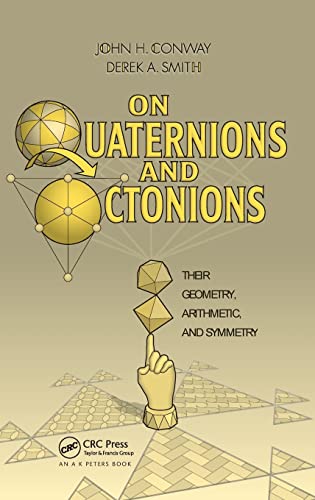
This book investigates the geometry of quaternion and octonion algebras. Following a comprehensive historical introduction, the book illuminates the special properties of 3- and 4-dimensional Euclidean spaces using quaternions, leading to enumerations of the corresponding finite groups of symmetries. The second half of the book discusses the less familiar octonion algebra, concentrating on its remarkable “triality symmetry” after an appropriate study of Moufang loops. The authors also describe the arithmetics of the quaternions and octonions. The book concludes with a new theory of octonion factorization. Topics covered include the geometry of complex numbers, quaternions and 3-dimensional groups, quaternions and 4-dimensional groups, Hurwitz integral quaternions, composition algebras, Moufang loops, octonions and 8-dimensional geometry, integral octonions, and the octonion projective plane.
User’s Reviews
Editorial Reviews: Review “Conway and Smith’s book is a wonderful introduction to the normed division algebras … They develop these number systems from scratch, explore their connections to geometry, and even study number theory in quaternionic and octonionic versions of the integers. … a lucid and elegant introduction. … remarkably self-contained. It assumes no knowledge of number theory, string theory, Lie theory, or lower-case Gothic letters.”―John C. Baez, Bulletin of the American Mathematical Society, January 2005″A resonant spike above background noise in one parameter as another parameter is varied is a frequent indicator…”―Geoffrey Dixon, Mathematical Intelligencer, May 2004″Those readers who are fascinated by the links between geometry and groups will find that this book gives them new insights.”―Hugh Williams, The Mathematical Gazette, July 2004″This is a beautiful and fascinating book on the geometry and arithmetic of the quaternion algebra and the octonion algebra. … most intriguing to read: it is an excellent exposition of very attractive topics, and it contains several new and significant results.”―Theo Grundhöfer, Mathematical Reviews, 2003 About the Author John H. Conway, Derek A. Smith
Reviews from Amazon users which were colected at the time this book was published on the website:
⭐I really enjoyed much of the book. I liked the discussion of primes, units, and unique factorization for the natural integers, the Gaussian integers, and the Eisenstein and Kleinian numbers. I also liked the discussion of spherical geometry. The discussion of symmetry groups is rather terse.If you are just interested in what octonions are and how they multiply and are already familiar with quaternions, it suffices to read just the first three pages of chapter 6, pages 67 to 69). Starting from just the composition law (the norm of a product of two elements in the algebra is the product of their norms) , the linearity of multiplication, and the existence of an identity, but assuming neither commutivity nor associativity, the author derives relations for the inner products and using these discusses Dickson doubling. It is the Dickson doubling composition law that says how one goes from quaternions to octonions, shows how they multiply, and shows that the octonions form a non-associative algebra.This book does not discuss the complex quaternions. These do not form a normed division algebra. It is a group of these that can represent Lorentz boosts in the Minkowski four dimensional space-time of special relativity as well as spatial rotations in Euclidean three space (search Lorentz in sourceforge).My complaint is that much of the book is too dense with too much left out or not well explained. Nevertheless, I really enjoyed and learned from what I did understand. I think that the author assumes some prior familiarity with many of these topics. For instance, in the discussion of Hurwitz quaternions, it is not explicitly stated that the product of two Hurwitz quaternions is again a Hurwitz quaternion and that they form a ring (It is tacit in the proof of the factorization theorem though). Admittedly this is trivial to prove. The Hurwitz quaternions have coefficients that are either all whole integers or all half integers, have integer norms, and have Euclid division with a remainder having a smaller norm. Therefore any left (right) ideal is a left (right) principal ideal. Octonion multiplication is also distributive but is not associative, only alternative which is a weaker property than being associative. Octonions also form a normed division algebra with the norm of a product also equal to the product of the norms. The author extensively discusses factorization of octonion integers, which is a complicated subject. Octonions have a richer structure than quaternions. Like the Hurwitz quaternions, octonions having coefficients that are either all integers or all half integers form a ring, but there are also mixed sets that form rings. It’s easy to see for the octonion ring of the first form that it has Euclid division with a remainder having a smaller norm. The additional relations (Z z^-1) z = Z and (Q z^-1) z = Q are needed to modify the corresponding Hurwitz quaternion proof. The author derives many identities involving changing how multiplied factors are to be associated. Hurwitz’s theorem on composition algebras (algebras having the norm of a product equal to the product of the norms) is proved. This explains the existence of the complex numbers, the quaternions, and the octonions with the commutative and associative properties that they have and explains why there are no others. Some knowledge of abstract algebra, number theory, and symmetry and group theory is helpful. For those for whom some topics are new, more detailed explanations would make the going easier. I found helpful the Wikipedia articles “Octonion”, “Alternative algebras”, and “Cayley–Dickson construction” (“eyes-right” in the author’s Appendix 1 : On Dickson Doubling Rules in Chapter 6 The Composition Algebras). For quaternions, there is an Iowa State University course handout available online titled “Quaternions” by Yan-Bin Jia that gives an introductory treatment. All in all, not easy going but well worth the effort.
⭐While I quickly learned that quaternions are a special variant of complex numbers having one real end three imaginary parts (and octonions have one real end seven imaginary parts), the book then delved into many proofs about them (most of which I could not follow the notation). However no place in the book was I able to find any definition for arithmetic operations on them (which was really what I was looking for when I bought the book, so I could program a quaternion arithmetic library).
⭐A very beautiful little book with some interesting takes, especially the links to algebraic integers and groups. Some statements are quite elliptical and require a good background in mathematics to follow, but generally fascinating for those who like Conway’s work.
⭐I love it. There are many fascinating, deep and unique tidbits from John Conway himself.The style is simple and lucid, assuming you are a mathematician.
⭐The authors summarized and expanded upon their referents.therir work is an appreciable advance of the field.
⭐Candid review by one of the masters of the subject. The text is accessible to undergraduate students, very concise and clearly written.
⭐If you want a good laugh take a look at chapter sixin this hastily compiled piece of trash. No one whodoes not already understand the material on octonianswill be able to penetrate this unannotated formulary.The same goes for the entire second half of the book.[The first half is just a rehash of material so familiar that there is no need to see it in print for the N+1 st time. ]The only worthwhile entry here is the reference guidingreaders to John Baez’s article on octonians which:a) is available free online andb) actually explains in a reader friendly way the history, math, and applications involved.The authors (not to mention editors) should be ashamedat such a sloppy treatment of this rich and historicallyinteresting episode in mathematics.
⭐John Conway’s books are always well written, and this could serve as a model for other mathematics authors. I don’t need to know that much about quaternions and octonions, but I found myself working through most of the book and the beautiful mathematics it covers. The only thing that disappoints is the dreadful cover and the difficulty getting hold of a copy in a bookstore. But then I guess Amazon.com exists to help people get their hands on stuff they might never see in a bookstore.
⭐I found this book to have been a terrible exposition of the quaternions and the octonions (especially the quaternions). The notation is poor and many symbols are written without adequate and clear explanations. The book goes into virtually no detail at all about the algebraic properties of the quaternions, does not explicitly or formally define its terms (the terms “projectively”, “projective group”, “rotation”, and “reflection”, among others, are never defined in a clear and formal way). In a lot of passages, I found myself often trying to guess or read between the lines in order to understand what the authors meant by certain sentences. Moreover, the informal conversational writing style of this book just make it even more obscure and confusing.Overall, I cannot recommend this book anybody, especially for an introduction to the quaternions. It lacks rigour, it lacks formalism, it lacks clarity and it lacks structure. It is, I find, a disastrously poor presentation and the authors simply did not deliver at all.
⭐Another great bok by my favourite mathematician
⭐Wer eine Einführung zum Thema Quaternionen (und Oktonionen) sucht, wird mit diesem Buch nicht unbedingt glücklich. Es setzt eine gewisse Vertrautheit mit Quaternionen voraus (mit komplexen zahlen natürlich selbstverständlich sowieso).Ist dies gegeben und ist man darüberhinaus solide mathematisch vorgebildet, bietet das Buch eine umfassende EInführung in die algebraisch-gruppentheoretischen Eigenschaften und Anwendungen der Quaternionen und insbesondere auch der Oktonionen. Manches hier Dargestellte wird man kaum anderswo finden. Aber es ist nicht alles leicht lesbar, sondern wirklich nur für “Profis”.Da es ein recht schmales gebundenes Buch ist( rund 160 Seiten), von den Autoren in TeX gesetzt und nicht einmal fadengeheftet, finde ich den Preis, den A.K. Peters verlangt, allerdings unverschämt hoch.The book explains what quaternions are. Has proofs. No problem understanding it. It goes also into the symmetries, which explains why some operations disappear.
⭐*****
Keywords
Free Download On Quaternions and Octonions: Their Geometry, Arithmetic, and Symmetry 1st Edition in PDF format
On Quaternions and Octonions: Their Geometry, Arithmetic, and Symmetry 1st Edition PDF Free Download
Download On Quaternions and Octonions: Their Geometry, Arithmetic, and Symmetry 1st Edition 2003 PDF Free
On Quaternions and Octonions: Their Geometry, Arithmetic, and Symmetry 1st Edition 2003 PDF Free Download
Download On Quaternions and Octonions: Their Geometry, Arithmetic, and Symmetry 1st Edition PDF
Free Download Ebook On Quaternions and Octonions: Their Geometry, Arithmetic, and Symmetry 1st Edition