Ebook Info
- Published: 2012
- Number of pages: 400 pages
- Format: PDF
- File Size: 20.50 MB
- Authors: Oystein Ore
Description
Unusually clear, accessible introduction covers counting, properties of numbers, prime numbers, Aliquot parts, Diophantine problems, congruences, much more. Bibliography.
User’s Reviews
Reviews from Amazon users which were colected at the time this book was published on the website:
⭐Phenomenal read. One of my favorite math textbooks. Supposedly used at Yale in the 1940s. Powerful passages on mathematics history and numbering systems used by various cultures.A potential solution for Fermat’s Last Theorem might be derived from the primitive roots of the Pythagorean Theorem. The case for even roots is straight forward. Odd root require some extra work.This is the most plausible solution based upon what this textbook reports that Fermat was reading at the time that he scribbled his Famous Last in the border of the pages of a book.Powerful Text on Number Theory.
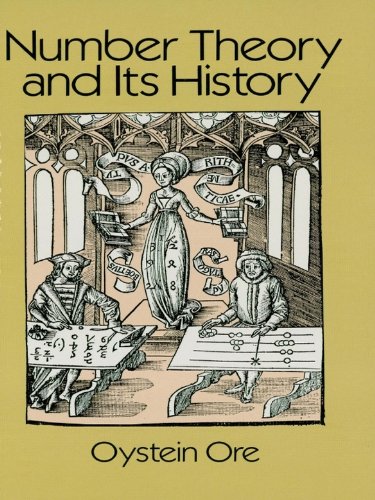
⭐I hope reviewing number theory will help me understand what is happening in current Algebraic Geometry.The paperback with its beautiful cover illustration arrived in perfect condition.
⭐Wonderful book about Number Theory. Begins at the beginning and doesn’t assume you already know what the writer is talking about. The complexity builds as the book moves through the subject but if you can read an understand Beckmann’s “A History of Pi” you should have no problem with this one.
⭐I read this book when I was a senior in high-school. It is a very well written history and exposition of elementary number theory.I found it fascinating. This book certainly contributed to my later decision to study mathematics and become a number theorist. Irecommend it with enthusiasm to any young man or woman with an interest in mathematics. However, beware, you might get hooked.
⭐I teach mathematics at the University. It was a “graduation gift” for a student. Its ok, but not great. I found the writing a bit turgid.
⭐I was hoping for more history of math thought and less actual math. Otherwise, a great book.
⭐The history of numbers. If you want to understand encryption, this is a great place to start. It is an awesome read.
⭐A agree with somebody that the history didn’t provide much in teaching number theory. John Stillwell’s “Elements of Number theory” is more succesfull.Oystein’s book partly tries to show the historical development; but, he’s always introducing concepts that only make sense or are proved in more advanced settings like the ‘trivial factors'(both the minus and positive versions of the same divisor). 4K+1 theorem is introduced. He mostly tries to only get into pre-Gaussian number theory, but ends up talking a lot about congruence number theory. In fact, compared to John Stillwell, I like this book for Oystein’s much more thourough introduction to congruence integers. Also compared to John Stillwell, Oystein goes through Fermat’s infinit descent method a lot better. And yet, Oystein mentions things like Leonard Euler’s zeta function and some other post-gaussian number theory. It’s a weird book like that.I also like Oystein’s treatment of Euclid’s algorith and the general solution of linear number theory equations over John Stillwell’s. All in all, it’s a good valuable book, but hardly historically accurate; or he mixes modern mathematics up with old to make the old easier to handle(as does John Stillwell). Oystein’s book is better for pre-gaussian number theory imo over John Stillwells. John Stillwell’s book is better for an easy introduction to post-gaussian number theory. For a better introduction to the issues of ancient number theory see Van Der Waerden’s almost anything, but generally “Science Awakening”, and Thomas Heath’s “A History of Greek Mathematics” volume 1 and 2 really for the Diophantine analyses. I havn’t read Andre Weil’s book which is probably the best overal technical history of number theory.Something that isn’t said by Oystein but if you have read ahead somewhere is that Dirichlet used Euclid’s algorith to make a clearer presentation of Frederick Gauss’s revolutionary work on number theory. This is the tool Oystein Ore uses to present number theory easily. Oystein’s historical origins of diophantine analyses is also actually kindof valuable. He hints at how some number theory problems are more like open ended spaces and others more like compact spaces and the idea of infinity. There’s pluses and minuses with just about every book, but the pluses may outweigh the minuses in all cases. It’s a little frustrating for someone trying to learn the real mathematics from some generic school text; but, they are worth it.
⭐interesting reading for a maths teacher or student
⭐No matter what else you’ve already got on number theory, or are planning to get, this book will put it all into perspective. Okay, it can’t help being way out of date on our modern computerised stuff – Mersenne and Fermat numbers, etcetera – but that’s only a small fraction of all the goodies in this book.
⭐EXCELLENT
Keywords
Free Download Number Theory and Its History (Dover Books on Mathematics) in PDF format
Number Theory and Its History (Dover Books on Mathematics) PDF Free Download
Download Number Theory and Its History (Dover Books on Mathematics) 2012 PDF Free
Number Theory and Its History (Dover Books on Mathematics) 2012 PDF Free Download
Download Number Theory and Its History (Dover Books on Mathematics) PDF
Free Download Ebook Number Theory and Its History (Dover Books on Mathematics)