Ebook Info
- Published: 2012
- Number of pages: 469 pages
- Format: PDF
- File Size: 9.23 MB
- Authors: Harley Flanders
Description
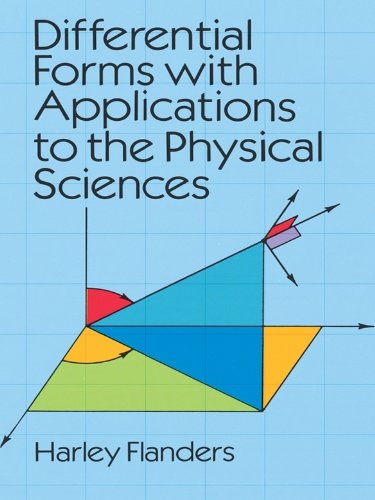
To the reader who wishes to obtain a bird’s-eye view of the theory of differential forms with applications to other branches of pure mathematics, applied mathematic and physics, I can recommend no better book. — T. J. Willmore, London Mathematical Society Journal.This excellent text introduces the use of exterior differential forms as a powerful tool in the analysis of a variety of mathematical problems in the physical and engineering sciences. Requiring familiarity with several variable calculus and some knowledge of linear algebra and set theory, it is directed primarily to engineers and physical scientists, but it has also been used successfully to introduce modern differential geometry to students in mathematics.Chapter I introduces exterior differential forms and their comparisons with tensors. The next three chapters take up exterior algebra, the exterior derivative and their applications. Chapter V discusses manifolds and integration, and Chapter VI covers applications in Euclidean space. The last three chapters explore applications to differential equations, differential geometry, and group theory.”The book is very readable, indeed, enjoyable — and, although addressed to engineers and scientists, should be not at all inaccessible to or inappropriate for … first year graduate students and bright undergraduates.” — F. E. J. Linton, Wesleyan University, American Mathematical Monthly.
User’s Reviews
Reviews from Amazon users which were colected at the time this book was published on the website:
⭐The good news is there’s a lot to like about this book. The bad news is there are at least a few things to really not like about this book.If you are a physics graduate student, I would recommend you put this book on your reading list. But I would also recommend you postpone this book until you have developed a reasonable degree of comfort with the typical tensor calculus based approach to differential geometry along the lines of
⭐.To get a better feeling for this book, let’s take a look at the contents, starting with the back of the book. The back of the book says “Requiring familiarity with several variable calculus and some knowledge of linear algebra and set theory.” So to me that sounds like a background of a third or maybe even second year undergrad. But I feel completely safe in saying that anyone with precisely this level of background will be COMPLETELY blown away by this book.The back of the book ends with a nice quote from the American Mathematical Monthly telling us that this book is “very readable – indeed, enjoyable.” And this is the first problem with this book: it is in fact quite a challenging book masquerading as an easy one.Inside, we will skip directly to the “Preface to the First Edition”. Weighing in at less than two pages, this preface actually provides a valuable high level overview of the book. We are told we are faced with ten chapters. The first chapter in an introduction; chapters 2, 3, and 5 provide the theoretical development; chapters 4, 6, 8, and 9 are applications to differential geometry; chapter 7 contains applications to differential equations; and chapter 10 applications to physics.In the second paragraph we find the statement “Probably on first reading…” This statement is a powerful omen. You should absolutely expect to read this book at least twice. The particular piece of advice here encourages us to merely try to develop “some intuition for the subject” on our first read rather than working through things in detail. That’s good advice.So, on to chapter 1. Chapter 1 is only four pages. The first two pages motivate differential forms via the change of variables theorem for multiple integrals. That’s nice. It’s also probably the most concrete part of the book. The last two pages launch into a discussion of the differences between differential forms and tensor methods. That’s funny because this book repeatedly emphasizes that the reader doesn’t need to know anything about tensors to read this book, but then it can’t seem to stop talking about them. Again, make no mistake: if you aren’t already pretty comfortable with tensors, you will probably not get much out of this book.Also, in the midst of this two page discussion we are greeted by a host of undefined terms and concepts. Trust me, this discussion will make much more sense to you on your second trip through the book.Chapter 2 is a fourteen page whirlwind on exterior algebra. The first thing that struck me about this chapter was the level of abstraction: surprisingly high considering its intended audience of scientists and engineers. This is a very compressed treatment, and nowhere is the level of compression more evident than in the discussion of the Hodge star operator. Yes, everything you need to know to compute the star operator in an arbitrary finite dimensional inner product space is actually in this two page treatment, but wringing it out is pretty challenging.With algebra out of the way, it’s time for some calculus in chapter 3. Section 3.1 defines differential forms on Euclidean space, and section 3.2 introduces the exterior derivative. Section 3.3 discusses mappings and introduces what is usually called the “pullback” of a differential form. It goes on show how pullbacks relate to the previously introduced notions of exterior multiplication and exterior differentiation: quite nicely, thank you. Section 3.4 and 3.5 are very short sections on changes of variables and a theorem from theoretical mechanics that arises in the transition from Lagrangian mechanics to Hamiltonian mechanics. Section 3.6 is a comparatively long section (2 1/2 pages) that proves the converse of the Poincare lemma. The proof is good, but unenlightening. Section 3.7 provides an example for the converse of the Poincare lemma, and section 3.8 is a brief comment on partial differential equations, and how differential forms often expose them to be simpler than they at first appear. Section 3.9 is a set of problems.This entire chapter spans only 13 pages!So with all that out of the way by page 32, we’re now ready for some applications in chapter 4. Section 4.1 introduces the important idea of a “moving frame”. For anyone with the strongly recommended background in classical differential geometry, this may well be a new idea, and its importance will be one of your key takeaways from this book. Section 4.2 discusses the relationship between orthogonal and skew-symmetric matrices. Section 4.3 introduces the six dimensional frame space. Section 4.4 discusses the Laplacian in curvilinear coordinates via differential forms. Section 4.5 digs into the differential geometry of two dimensional surfaces in three space from the perspective of differential forms. Although this treatment might initially seem somewhat cryptic, the elegance of differential geometry using differential forms starts to become apparent quickly. Section 4.6 is a brief section on the differential form formulation of Maxwell’s equations, and 4.7 is a problem set.Chapter 5 is our last chapter on theory, and it centers around Stokes’ Theorem. So far this book has restricted its treatment of differential forms to Euclidean space. The first section in this book is a very short blurb to motivate the move to manifolds which section 5.2 introduces properly. The author provides a stripped down approach to manifolds common in applied math books, and I thought it was well done. Section 5.3 and 5.4 introduce tangent spaces and differential forms on manifolds respectively. Section 5.5 introduces Euclidean simplices as we move toward integration. I found this treatment to be particularly clear. Section 5.6 introduces us to chains and boundaries on manifolds, and section 5.7 defines the integral of a differential p-form over a p-chain. And it is in this section that we encounter one of the truly infamous passages in this book. “As an exercise, one could check that each of the standard tricks used to evaluate surface integrals, etc. fits into the above scheme of things. It hardly seems worth our time here.”Hardly seems worth “our” time? This is the only book I have ever read where the author just directly came out and told me that he didn’t think explaining something to me was worth his time. Nice.Section 5.8 covers Stokes’ theorem. And I found this treatment unusually clear. Section 5.9 discusses periods of forms and De Rahm’s theorems which are stated and discussed but not proven. Section 5.10 gives some examples of the applications of De Rahm’s theorems to surfaces. Section 5.11 is about mappings of chains and the behavior of integrals with respect to pullback. Section 5.12 is a problem set.Chapter 6 is titled “Applications to Euclidean Space” and is a short grab bag of topics. Section 6.1 deals with volumes and areas of spheres in n dimensions, and the differential form treatment of such. Section 6.2 is on winding numbers and degrees of mapping. Section 6.3 is on the Hopf Invariant for mappings between certain high dimensional spheres. It’s less than a page long, so obviously there are not a lot of details, but what is given is quite clear. Section 6.4 is titled “Linking Numbers, The Gauss Integral, and Ampere’s Law”, and again is very short. There are no exercises for this chapter.Chapter 7 is “Application to Differential Equations”. Weighing in at 30 pages, this is one of the beefiest chapters in the book. Section 7.1 is devoted to the study of harmonic functions in E^n. All of the results in this section are the standard, elementary results in harmonic function theory, but all of these results are now proven relying heavily on differential forms. Results proven include Green’s Formula, Green’s Symmetric Formula, Gauss’ Mean Value Theorem, Maximum/Minimum Principle, and the Uniqueness Principle for the Boundary Value Problem. The idea of the Green’s function for an arbitrary domain is introduced, and the Poisson Integral Formula for E^n is determined. The section concludes with a proof of Liouville’s Theorem. All of these results will be immediately familiar to anyone with an introductory course in complex analysis, but again, these results are demonstrated for E^n rather than just E^2. And again, the elegance of the differential form approach is readily apparent.Section 7.2 is a short section on the Heat Equation. Essentially all that is demonstrated here is uniqueness of solutions for the boundary value problem.Section 7.3 is on the Frobenius Integration Theorem. This is a central result about the existence of integrating factors for linearly independent differential one forms. This section is ten pages, and provides a detailed proof of the Frobenius Theorem. It begins with some motivation, and then proves the result for a single form before stating and proving the general result. The reader will need to be comfortable with the theory of ordinary differential equations to follow this section. Section 7.4 follows this up with three applications of the Frobenius Integration Theorem, thus demonstrating its importance.Section 7.5 is a short section on systems of ordinary differential equations, and Section 7.6 is on the Third Lie Theorem, which is fundamental in the study of Lie groups. This result is proven in detail. There are no exercises for this chapter.Chapter 8 is on applications to differential geometry. At almost 40 pages, it is the longest chapter in the book. In section 8.1 it picks up where 4.5 left off with surface theory. Section 8.2 extends this treatment to hypersurfaces in E^n in preparation for the abandonment of the embedding space. Several crucial constructs appear in this section including curvature forms and the Riemann curvature tensor.Section 8.3 takes the plunge into Riemannian geometry, and introduces more key elements of differential geometry including the Christoffel symbols. The section ends with four pages discussing the relationships between the differential form treatment of differential geometry and the more usual tensor treatment. Again, this is very helpful if you are familiar with the tensor treatment. If not…Section 8.4 is a six page survey of Hodge theory. It states the fundamental result, but only proves uniqueness of the forms asserted to exist. I thought this section was excellent. Also excellent, is section 8.5 on Affine Connections. In particular, the definition of an Affine Connection in the differential form treatment will be quite eye opening to anyone with the traditional tensor background. It was enough to single-handedly sell me on the utility of the differential form treatment of differential geometry. Unfortunately, this section is also home to one of the most painful moments in the book. On the very first page the author mentions the dual basis of one-forms. This will be a readily familiar concept to anyone with a background in differential geometry, which this book claims you don’t need. The only problem is, he had never defined this concept. So I checked the index to see if I missed it, but it wasn’t even in the index.We finally encounter the necessary definition in the problem set at the end of chapter 10. Better late than never? I didn’t really think so, and this book lost serious points for this egregious organizational error. If I hadn’t already known what he was talking about, I would have been baffled.Section 8.6 is a problem set.Chapter 9 is a short chapter on applications to group theory. Section 9.1 contains the pertinent definitions of Lie group, structure constants, and so on. 9.2 provides some examples of Lie groups, while 9.3 and 9.4 cover matrix groups. 9.5 discusses bi-invariant forms, and section 9.6 is a problem set.Chapter 10 is Applications to Physics. The bulk of this fairly lengthy chapter is dedicated to classical mechanics, and is alone worth the price of buying and the trouble of reading this book. After seeing a wide variety of ham-fisted treatments of differential forms by classical mechanics books, I found this chapter extremely clarifying. However, the reader must already know Hamiltonian mechanics to get much of anything out of this chapter. Section 10.1 is a short introduction to phase and state spaces. Section 10.2 is on Hamiltonian systems. Section 10.3 covers integral invariants. And it covers them very well. Section 10.4 is dedicated to brackets: Poisson, Lagrange, and Lie. Section 10.5 is on Contact Transformations. Then we get a short section on fluid mechanics in 10.5, and a problem set in 10.6 to wind things up.Overall impressions: While the exposition is generally good, there are times when the author makes non-trivial assertions either in derivations or in proofs. I found this a bit exasperating, as just a little bit more text could have provided considerably more clarity in these situations. The notation is overly sparse. In particular, sigma’s for sums are NEVER indexed. In all cases it is left to the reader to determine exactly what is being summed over. And this frequently changes even from one step to the next during derivations. The book is filled with numerous, helpful figures, and while they say a picture is worth a thousand words, a book that is this short, covers this much territory, and has a bunch of picture in it, well you can pretty much figure that the exposition is going to have to be pretty terse. And it is. Sometime overly so.In addition, the index is almost, but not quite, completely worthless. And the bibliography has far too high a proportion of books in languages other than English.To wrap up this far too long review, I had my doubts about this book. In fact, I had them for quite a while. It was the last chapter, and the second reading that really sold me on it. It definitely has its flaws, but it also really shines in certain spots. Recommended, but make sure you bring the background it requires or you will be left in the dust.
⭐Very logical and thorough, but requires a good background in abstract algebra.
⭐ok
⭐A classic in differential geometry and mathematical physics. There is something for everyone, from the young mathematical wanting to learn coordinate free differential geometry via moving frames or a physicist wanted to expand his/her toolbox.
⭐A difficult book to review. This was a book acquired many years ago, based upon words written in that mammoth text Gravitation (Misner, Thorne, Wheeler): “relatively easy with many applications.” (page 90). Let me say I do not consider Flanders to be “relatively easy,” although it does have “many applications.” The preface states: “a well-trained undergraduate should find the book quite accessible.” Let me add that I do not find Flanders to be “quite accessible.” Now, I do not intend to be too negative, as there is much here that is useful. Even so, the best parts of the book appear later in the book (applications). Now, I offer some advice: be sure to first complete the book Advanced Calculus (1956, Buck) or part one of the book, Linear Algebra and Analysis (1967, Lichnerowicz). Flanders has given an exposition of nearly two-hundred pages. Twelve pages here consists of an exposition of exterior algebra, ten pages of exterior derivative, therefore you need to remain on guard ! First assimilate, in its entirety, the ‘Glossary of Notations’ before opening to page one (glossary, pages 199-200). Second, be sure to know how to disentangle the meaning of commutative diagrams (for instance, see pages: 23, 26, 56, 62 & 72). One complaint: fluid mechanics is given too much hand-waving for my tastes (that is, section #10.6, pages 188-193). The positive attributes of this monograph are found in the applications (also, the exercises):(1) Flanders: “What we shall do is express everything in sight in terms of the right-handed orthonormal frame, apply the derivative operator to these relations to derive further ones, and continue until we obtain no further results.” (page 32). That sentence describes almost all manipulations in chapter four, moving frames. It is a well-written, until you reach the section of Maxwell’s equations (pages 44-47), where we find again too much hand-waving for my tastes.(2) A highlight, chapter five: manifolds and integration. You learn the boundary of a boundary is zero (page 58 and 63). You learn a bit about simplices, orientation and chains. An exercise asks you to show that Projective n-Space is a manifold (exercise #4, page 73). I did not appreciate this: “in applications, one does not bother to spell out in detail how a given geometrical region may be considered as a chain, but rather relies on the usual combination of experience and intuition.” (page 64). However, that ‘experience and intuition’ is hardly part and parcel for undergraduates.(3) Convexity, will be heavily utilized for chapter eight (differential geometry). Regarding convexity, I am uncertain that undergraduates are significantly exposed to that concept. Certain it is, many engineers and physicists are deficient in that concept. Also, learn: “the spherical harmonics are eigenfunctions for the generalized Laplacian on the two-sphere.” (page 142). A nice exercise: “Let us be given a closed, convex, surface with constant mean curvature, prove that that surface is a sphere.” (exercise #1, page 148). Flanders sneaks-in the definition of “dual” basis vectors (page 127).(4) An interesting chapter, nine, provides a glimpse into group theory (Lie Groups). However, learn basics of group theory before tackling this chapter (Birkhoff and Mac Lane, A brief Survey of Modern Algebra). Most computations are easy to follow (for instance, see bottom of page 157 and continuation page 158).(5) Let me conclude with a few observations: As with texts of this ilk (mixing physics with mathematics), something always gets slighted. In my opinion, Harley Flanders should have spent more elaboration on the fundamentals at the beginning of the book. The applications (differential equations and differential geometry) are well done, but the algebraic preliminaries early-on are presented at too brisk a pace for beginners. You need already be aware of vector spaces, linear functionals (page 14), linear independence, cartesian product notation (page 27) and determinants (page 10). These are exactly the topics that might already get short-shrift in the usual undergraduate course !(6) This text is referenced in other books: Gravitation by Misner, Thorne and Wheeler (1973, the textbook that got me started), Elementary Differential Geometry (Barrett O’Neill ,1966) and Second Year Calculus (Bressoud,1991). By all means study Bressoud before studying Flanders (Advanced Calculus by Buck is also prerequisite). Then, return to Harley Flanders, because the applications he presents are of continuing efficacy for advanced work.
⭐excellent
⭐I was searching for a good source discussing the differential forms “from the ground up”,while passing a course on GR. My motivation in studying this book was Weinberg’s mentioning af it as “An extremely readable book” on the topic,in his book on GR.I belive that this is a good book if you have enough time and motivation to study differential forms from basic and without much hurry to use them operationally , but (at least in my opinion) it lacks that degree of clarity that one requires from a book on mathematical physics.To truly understand some parts (even at the early definitions)you may need to spend much more time that you could imagine at the first sight.Some basic ideas are expressed too concise.If you want to learn about differential forms in physics, this book would be some good, but not(I think) during a semester on something else (like GR), beacuse the way of presenting the material is not so stright , nor is operational enough.You may find the books by Lovelock & Rund or by Goldberg & Bishop more useful.
⭐I love the style of this book, it’s actually written for you the reader not just to impress the author’s peers as so many books of this type seem to be. It’s very comprehensive, with plenty of examples, but I am finding the mathematics quite a struggle. The book has a very small typeface and it’s all very compact on the pages, which doesn’t help when there are so many subscripts and different symbols. Nevertheless, it is my go-to book on this subject.
⭐I keep coming back to this book. It brings together Exterior Algebra, Differential geometry and Physics. If you like the way Elie Cartan does Differential Geometry you will love this book.
⭐Firstly, let me say that there are many advantages to learning differential forms, and it’s worth making the effort. That said, I often read mathematics for “physicists” or “engineers”, since I get easily lost in mathematical abstractions, which is what happened to me here despite the title. As an introduction, I might suggest Bressoud’s advanced calculus text, which introduces differential forms in the study of calculus, electrodynamics, and relativity and provides a foundation for more abstract treatments.
⭐Muito bom. Já estou no fim do capítulo 2 ao escrever esta resenha. Aparentemente é um misto de muita teoria matemática pura adaptada para físicos, embora a notação pudesse ser melhor e com mais exercícios.Minha nota não foi baseada no conteúdo, que é bem pesado, condensando mas palpável, e sim no tamanho da letra que é bem pequena num livro já pequeno. Poderia ter mais páginas e a fonte ser aumentada um pouco.This book is a well text for students who want to learn differentiable forms. The book contains details on exteror algebra this book is very recomended for math and physic students.
Keywords
Free Download Differential Forms with Applications to the Physical Sciences (Dover Books on Mathematics) in PDF format
Differential Forms with Applications to the Physical Sciences (Dover Books on Mathematics) PDF Free Download
Download Differential Forms with Applications to the Physical Sciences (Dover Books on Mathematics) 2012 PDF Free
Differential Forms with Applications to the Physical Sciences (Dover Books on Mathematics) 2012 PDF Free Download
Download Differential Forms with Applications to the Physical Sciences (Dover Books on Mathematics) PDF
Free Download Ebook Differential Forms with Applications to the Physical Sciences (Dover Books on Mathematics)