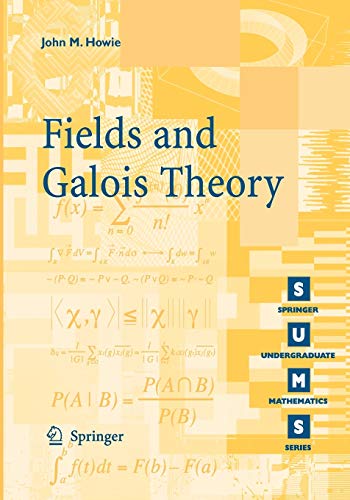
Ebook Info
- Published: 2005
- Number of pages: 236 pages
- Format: PDF
- File Size: 1.60 MB
- Authors: John M. Howie
Description
A modern and student-friendly introduction to this popular subject: it takes a more “natural” approach and develops the theory at a gentle pace with an emphasis on clear explanations Features plenty of worked examples and exercises, complete with full solutions, to encourage independent studyPrevious books by Howie in the SUMS series have attracted excellent reviews
User’s Reviews
Editorial Reviews: Review From the reviews:“This is a short but very good introductory book on abstract algebra, with emphasis on Galois Theory. Very little background in mathematics is required, so that the potential audience for this book range from undergraduate and graduate students, researchers, computer professionals, and the math enthusiasts.” (Philosophy, Religion and Science Book Reviews, bookinspections.wordpress.com, July, 2013)”The author wrote this book to provide the reader with a treatment of classical Galois theory. … The book is well written. It contains many examples and over 100 exercises with solutions in the back of the book. Sprinkled throughout the book are interesting commentaries and historical comments. The book is suitable as a textbook for upper level undergraduate or beginning graduate students.” (John N. Mordeson, Zentralblatt MATH, Vol. 1103 (5), 2007)”To write such a book on a widely known but genuinely non-trivial topic is a challenge. … J. M. Howie did exactly what it takes. And he did it with such vigour and skill that the outcome is indeed absorbing and astounding. … Every paragraph has been scheduled with utmost care and the proofs are crystal clear. … the reader will never feel forlorn amidst brilliant theorems, which makes the book such a good read.” (J. Lang, Internationale Mathematische Nachrichten, Issue 206, 2007)”Howie’s book … provides a rigorous and thorough introduction to Galois theory. … this book would be an excellent choice for anyone with at least some backgound in abstract algebra who seeks an introduction to the study of Galois theory. Summing Up: Highly recommended. Upper-division undergraduates; graduate students.” (D. S. Larson, CHOICE, Vol. 43 (10), June, 2006)”The latest addition to Springer’s Undergraduate Mathematics Series is John Howie’s Fields and Galois Theory. … Howie is a fine writer, and the book is very self-contained. … I know that many of my students would appreciate Howie’s approach much more as it is not as overwhelming. This book also has a large number of good exercises, all of which have solutions in the back of the book. All in all, Howie has done a fine job writing a book on field theory … .” (Darren Glass, MathDL, February, 2006)”The book can serve as a useful introduction to the theory of fields and their extensions. The relevant background material on groups and rings is covered. The text is interspersed with many worked examples, as well as more than 100 exercises, for which solutions are provided at the end.” (Chandan Singh Dalawat, Mathematical Reviews, Issue 2006 g) From the Back Cover The pioneering work of Abel and Galois in the early nineteenth century demonstrated that the long-standing quest for a solution of quintic equations by radicals was fruitless: no formula can be found. The techniques they used were, in the end, more important than the resolution of a somewhat esoteric problem, for they were the genesis of modern abstract algebra.This book provides a gentle introduction to Galois theory suitable for third- and fourth-year undergraduates and beginning graduates. The approach is unashamedly unhistorical: it uses the language and techniques of abstract algebra to express complex arguments in contemporary terms. Thus the insolubility of the quintic by radicals is linked to the fact that the alternating group of degree 5 is simple – which is assuredly not the way Galois would have expressed the connection. Topics covered include: rings and fields integral domains and polynomials field extensions and splitting fields applications to geometry finite fields the Galois group equations Group theory features in many of the arguments, and is fully explained in the text. Clear and careful explanations are backed up with worked examples and more than 100 exercises, for which full solutions are provided.
Reviews from Amazon users which were colected at the time this book was published on the website:
⭐Have you ever wondered why there are no general formulas for the roots of quintic or higher-degree polynomials with rational coefficients which involve only addition, subtraction, multiplication, division, and taking roots of the coefficents? Who hasn’t? What, you say you haven’t? Well, if you remember back to high-school algebra and the good old quadratic equation ax^2 + bx + c = 0, there is a solution x = -b plus or minus square root of b^2 minus 4ac, all over 2a. Turns out there is also a formula, albeit more complicated, for the cubic equation ax^3 + bx^2 + cx + d = 0, and an even more complicated one for the quartic equation ax^4 + bx^3 + cx^2 + dx + e = 0. But there’s no such general formula for the roots of quintic (x^5) or higher polynomials with rational coefficients. The two mathematicians who proved this were both doomed to die at an early age: Niels Abel, a Norwegian who died of tuberculosis at age 27, and Evariste Galois, a Frenchman who died of a bullet in the gut received in a duel at age 20. (Ironically, no one remembers who or what they were fighting over. I hope it was worth it!)If you’d like to know why this is so, this book will get you there. I’ve had a fair amount of exposure to higher math, so I’m not sure I can accurately determine whether someone with only high-school algebra could follow this book, but I think the answer would be a qualified “yes”, assuming there was sufficient motivation and persistence. In addition to high-school algebra, the only other background someone would need is a minimum acquaintance with basic set theory, the barest minimum about complex numbers, and the beautiful Euler formula. The book explains almost everything beyond this that one would need to know, but does occasionally use technical terms which are not explicitly defined. Also, the glossary is good but not great, and the index is lacking some key terms. Also at times the author could be more clear in stating how one knows something (i.e., by citing where in a previous chapter it was introduced) instead of assuming that one’s recall of the previous chapters is perfect.These relatively minor cavils aside, I think the book is great. In addition to explaining why there are no general formulas for solving by algebraic means polynomials in rational coefficients of fifth degree and higher, it also explains why one can’t square the circle, and why only certain polygons are constructible by ruler and compass, classic conundrums. It does this through the use of abstract algebra, i.e., fields, field extensions, and groups. If you stick with the line of argument, you will be impressed by the power and logic of higher mathematics, and the ability of seemingly abstruse and ethereal concepts to solve concrete problems.So anyway, the answer to why the quintic polynomial with rational coefficients is not in general solvable is found in chapter 10, section 1. I.e., you will need to plow through 8 chapters to understand it (not 9 chapters, because chapter 4 is a digression into why the circle can’t be squared). By Theorem 10.4, the Galois group of a monic irreducible polynomial of prime degree p (e.g., a quintic) with exactly 2 non-real complex roots is the Sp symmetry group (i.e., in the case of the quintic, the S5 symmetry group). In Chapter 9 it was shown that the Sn group for n greater than or equal to 5 is not soluble. Therefore the Galois group of a quintic such as x^5 – 8x + 2, which has exactly two non-real complex roots, being the S5 symmetry group, is nonsoluble. Therefore the roots of this polynomial cannot be calculated from its coefficients (1, -8, and 2) by any combination of addition, subtraction, multiplication, division, and taking of roots (any degree root, such as square root, cube root, eleventh root, you name it). This doesn’t mean that there aren’t some quintics where this can be done, but by creating even a single counterexample, we’ve proven that there is no general formula applicable to all quintics.Now for a polynomial of any degree n higher than five one can always create an example of an insoluble polynomial by multiplying an insoluble quintic by another polynomial of degree n-5 as a factor (e.g., an insoluble sixth-degree polynomial can be created from the product of an insoluble quintic and (x-2), an insoluble seventh-degree polynomial can be created from the product of an insoluble qunitic and (x^2-1), etc.), so having an insoluble factor it is also insoluble. Thus there is no general formula for any polynomial of degree higher than 5, either.If you’re like me it will take you about 2 months working about an hour a day to get to this point. Is it worth it? Ask Galois.Update November 2013: I’ve been through this book several more times and each time found it more interesting with more to learn. Or put differently, each time I found how much I hadn’t really understood from the last time.Here are some notes which may prove helpful:Chapter One:p. 5 Exercise 1.2 should be axiom R8, not R7p. 9 right after Corollary 1.7: a mapping is one to one if wheneverf(a)=f(b), a=b. IOW, for each s belonging to S there is only one r belonging to R such that f(r)=s. A mapping is onto if f(R)=S. One to one is synonymous with injective, onto synonymous with surjective, one to one AND onto synonynmous with bijective.p. 9 second to last paragraph phi is a monomorphism from Z to S, not Z to R. Then S (not R) contains Z up to homomorphism. This means S contains Z or a homomorphism of Z.p. 13 first paragraph of section 1.3: P is called the Cartesian product of D and D{0}. (a,b) is called an ordered pair. The Cartesian product of two sets is the set of all ordered pairs (a,b) where a is from the first set and b from the second set.p. 17 (1.19) should be m1K/n1K, not m1K/n1fp. 19 (1.21) should be x^p-r y^r, not x^n-r y^rp. 21 second paragraph: the “division algorithm” is on p. 25p. 21 fourth paragraph “every left coset OF U (my addition) has the same number of elements as U”.p. 22 first line “it follows immediately” BECAUSE is a subset of G.p. 22 line 8 should be U is a normal subgroup of G, not a is a normal subgroup of bp. 22 line 9 a^-1 U a = U allows for different elements of U to be on the left hand side and the right hand side of this equationp. 22 line 17 the quotient group G/U requires U to be a normal subgroup of Gp. 22 last line: “suitable” normal subgroup means the kernel of the mappingp. 23 line one: homomorphism from G onto H means the mapping is onto, i.e., H is the homomorphic image of Gp. 23 proof of theorem 1.20:1. well defined: alpha maps Na to phi(a)2. one to one: ker phi(a) = ker phi(b) implies ab^-1 member of ker phi which implies phi(ab^-1) = e subH which impliesphi(a) phi(b^-1) = e subH which implies phi(a)=(phi(b^-1)^-1which equals phi(b). therefore if a=b, phi(a)=phi(b) which is definition of one-to-one3. onto: alpha is onto since phi is onto4. homomorphism: alpha(Na)alpha(Nb)=alpha(NaNb)=alpha(Nab)=phi(ab)=phi(a)phi(b). This fulfills definition of homomorphism p. 22Chapter 2:p. 25: first paragraph “integral domains OF A PARTICULAR KIND” means Euclidean domains (by theorem 2.14)p. 26 end of first paragraph: “another important example” refers to a polynomial ring over a field (theorem 2.14)p. 26 end of second to last paragraph should be Theorem 1.5 ii not Theorem 1.5 iiip. 30 second paragraph: see p. 10, and p. 2 property R10p. 33 Exercise 2.6 (ii) phi(u) greater than or equal to 3, not greater than 3p. 39 theorem 2.15 (iv) K[X]/ where S are the generators and R the relations of the groupp. 147 exercise 8.9: should be X^6+3, not X^6 – 3Chapter 9p. 150 Lemma 9.1: mb=0. o(d)=1 implies d=0p. 151 line 13: “then” by theorem 1.19 and top of p. 22. Theorem 9.4: a p-group is a group of order p^m where p is a prime number and m is a positive integerp. 155 first paragraph of section 9.2: see p. 121. Proof: see p. 22. H is a normal subgroup of G.p. 156 first 3 lines: we can draw a diagram like that on p. 23 but replacing G with G/N, H with G/H, and G/N with (G/N)/(H/N).p. 156 Proof: V and M are normal subgroups of A since they are subgroups of an abelian group. MV/M = MV/V, latter isomorphic toV/intersection M and Vp. 158 theorem 9.12 is Sylow’s theorem; “G has at least one subgroup of order p^l”: i.e., at least one Sylow subgroup.p. 160 theorem 9.16: disjoint cycles are cycles which affect different elements of set, i.e., share no element in common.p. 161 proof line 6: “contradiction”: i.e., j-1 not greater than j.Later, (sigma sub k)^k = identity permutationp. 162 8 lines up from bottom: alternating group is a normal subgroup of Sn because if pi even, pi^-1 An pi = even even even= even, thus a member of An; if pi odd, pi^-1 An pi = odd even odd = even, again a member of An.p. 163 proof of theorem 9.20: second line: “group of order 2”: i.e., set of cosets of A4 which is {A4, A4(x1,x2)}. Line 6 second pair should be (1 3)(2 4) not (1 3)(4 4)p. 164 line 5 of proof of theorem 9.22: alpha sends a to x, b to y, and c to z. In general one can write a cycle of length n by two rows of elements between parentheses, the top row being the elements the cycle acts on, and the bottom row being what element the cycle sends each element to, placed underneath the respective element acted upon.p. 167 proof line 6: “it follows”: K subi+1 is a subgroup ofG subi+1, and G subi is a normal subgroup of G subi+1, therefore the intersection of G subi and K subi+1 (which equals K subi) is a normal subgroup of K subi+1p. 168 last line “being simple”, i.e., having no proper normal subgroupsChapter 10p. 169 theorem 10.1: see p. 94, 132, 154. Proof: E is both normal and separable (p. 133), therefore if E contains one root omega of X^m – 1, it contains all m roots. E=K(omega) where omega is a primitive mth root of unity (see proof of theorem 8.13)p. 170 line 16: “it follows”: prior sentence proved that M is a radical extension of E. Since E=K(omega) where omega is a root of X^m – 1 irreducible in K[X], M is also a radical extension of K. Therefore L, a splitting field for f, is contained in a radical extension of K.p. 170 4 lines up from bottom: “we have to be careful”: otherwise by the fundamental theorem, the subgroups of G will not be normal. The definition of a radical extension does not require that M subi+1 be a normal extension of M subi.p. 171 line 16 separable because char K =0 (corollary 7.23). 9 lines up from bottom: P is a normal extension of M because it is a splitting field for a polynomial in M[X]. 3 lines up from bottom: “so” by theorem 7.13. Next line “thus” by fundamental theorem.p. 172 line 7 “the proof proceeds by induction”: see p. 182. Line 11 M(alpha1) should be M sub 1(alpha1). Line 8 Gamma(M(alpha1)) should be Gamma(M sub 1(alpha1)) and M sub 1(alpha) should be M sub 1(alpha1). My comment following line 13: Gal(P:M1)/Gal(P:M1(alpha1)) is isomorphic to Gal(M1(alpha1):M1). Line 15 LHS should be Gal(P:M sub 1(alpha1)).p. 172 Theorem 10.3: combines theorem 10.1 which proves that if Gal(f) soluble, f is soluble by radicals, and theorem 10.2 which proves that if f is soluble by radicals, Gal(f) is soluble.p. 173 section 10.1: these insoluble quintics are NOT general polynomials of degree 5 since the coefficients of the quintics discussed in this section, being in Q, are not algebraically independent over Q.p. 173 Proof: line 1 sentence 1: by fundamental theorem of algebra. Line 7 Corollary 9.13, not theorem 9.12.p. 174 section 10.2: a general polynomial has no algebraic connection among its coefficients.p. 175 line 2 “only if f=0” i.e only if all coefficients are zero. Lines 8 and 13 Exercise 10.3 not 8.16. Proof first line “then”: by theorem 3.12. Following lines, see theorem 3.11.p. 177 general comment Autn is a subgroup of Gal(L:K). Line 3 “fixed field” is the elements which do not change under the mapping. 8 lines up from bottom “Hence” by Theorem 3.6(iia). Next line “Consequently”: df is n, therefore if m divides f, dm less than or equal to df.p. 178 first line of proof “since”: by theorem 3.12.p. 178 second to last line: zeroes of g in M are algebraically independent over K, but converse is not necessarily true: e.g. all irreducible polynomials in Q split completely over C and complex conjugates a+bi and a-bi are algebraically independent over Q, but the resultant S subi belonging to Q are not.p. 179 line 1 “finite by Theorem 5.1”: i.e., less than or equal to n!Line 2 “the same”: By theorem 3.12 every finite extension is algebraic. Line 11 see corollary 9.25, theorem 10.3.Chapter 11p. 189 13 lines up from bottom “by Corollary 8.14”: Gal(Q(omega):Q) is cyclic and cyclic groups are abelian (p. 21). 10 lines up from bottom: “hence”: Q(omega) is a splitting field for X^2 – 2 zeta x +1 belonging to K[X], therefore is a normal extension of K by theorem 7.13, also separable by corollary 7.23, therefore Q(omega) is a Galois extension of K, so by corollary 7.29 the order ofGal(Q(omega):K) = [Q(omega):K]. 6 lines up from bottom: [Q(omega):Q]=[Q(omega):K][K:Q].p. 190 (11.2) omega equals exp(2 pi i /q)Solutionsp. 190 1.20 theorem 1.13 not theorem 1.3p. 199 2.6 i, ii, iii should be ii, iii, iv. In i, last line, phi(u) should be greater than or equal to 3, not greater than 2.
⭐This text presents an introduction to rings and fields at an undergraduate level and corresponds to that portion of a course on abstract algebra that covers rings and fields. As with other titles in the S.U.M. series, this text has a nice selection of exercises accompanied by worked solutions, making the text helpful for unguided study.The Kindle edition is presented using the mobi flowable text format rather than the print replica format and the result is quite disappointing as is too often the case with attempts to present mathematical material in eReader formats. The typesetting suffers from bad line wraps on inline formulae, orphaned headings for theorems, incorrect indenting of material and so on. All of these conspire to convert what is a nicely typeset work in physical print to an annoying and irritating eBook experience.
⭐good
⭐It s ok
⭐I used this book in a second semester undergrad course in Abstract Algebra and I am not a fan of the organization of topics. Explanations of steps in between proofs and computations are sparse resulting in a hard book to follow.
⭐I needed a book with examples of normal extensions. This one was very helpful.
⭐I used this as a supplementary text while taking a graduate course in Algebra. We used Hungerford’s book, of course, which was generally excellent except that it lacked examples and simple explanations of Galois Theory. Since I was new to this subject, I went digging for other sources. This book was wonderful, and I doubt I would have passed the qualifying exam without it.
⭐This is a short but very good introductory book on abstract algebra, with emphasis on Galois Theory. Very little background in mathematics is required, so that the potential audience for this book range from undergraduate and graduate students, researchers, computer professionals, and the math enthusiasts.
⭐This is an excellent introduction to fields in general, and to the fairly difficult topic of Galois theory. However, it is not for everyone. It approaches Galois theory from the perspective of the contemporary theory of fields, and if your interests are with how the subject developed historically this is not the right book. The necessary group theory is all explained, but rather concisely, and some previous study of abstract algebra is desirable. (Most readers will find the field theory itself to be demanding enough. You don’t want to struggle with other new topics at the same time.)The back cover states that the book was written for “third and fourth year undergraduates and beginning graduates”, and that is reflected in its style. Some degree of mathematical maturity is assumed, and there is less “hand holding” than you would find in a first text on abstract algebra.
⭐IntroductionThis book is part of ‘SUMS’ (Springer Undergraduate Mathematics Series) to help students to grasp real topics and levels of difficulty at a student – compatible price. Having spent an amount of time on this book and others of the sums series, I agree this is both time and money well spent.Basic ideaThe topics bridge ‘theory of equations’ to ‘abstract algebra’. These are clearly explained, so this shows a gifted tutor has designed the explanations for the reader. There are many worked answers in the back which is really helpful to check with.Main TopicsIf your reading this review, its possible you may recall the quadratic formula to find the roots of a quadratic equation? This book builds upon algebra to find an equivalent minimal polynomial / irreducible – linear roots of unity to cubic and quartic equations. Also the inability of solving quintics with radicals. (this means by usage of powers and roots.) This is using a more modern approach than available in the time of Galois.Part of this is by handling answers with finite – sub / fields in Cayley tables. The best part is instead of laboriously working out Cayley table elements in turn, this book allows the diligent reader to recognise ‘tell-tale’ patterns in the data as presented to them, and hence rapidly answer accurately.Parts of the book clearly edge into ‘Graph theory’ stuff, which is in its self a great display of related sets and answers.In ConclusionI have bought other books of the series, and this book has also been a genuine pleasure to study and has helped my comprehension in preparation in studying Galois theory Introduction.
⭐Il manque (défaut d’impression ) 1 à 3 lignes sur de nombreuses pages ; ouvrage peu exploitable. Même pas envie de le renvoyer !
⭐
Keywords
Free Download Fields and Galois Theory (Springer Undergraduate Mathematics Series) in PDF format
Fields and Galois Theory (Springer Undergraduate Mathematics Series) PDF Free Download
Download Fields and Galois Theory (Springer Undergraduate Mathematics Series) 2005 PDF Free
Fields and Galois Theory (Springer Undergraduate Mathematics Series) 2005 PDF Free Download
Download Fields and Galois Theory (Springer Undergraduate Mathematics Series) PDF
Free Download Ebook Fields and Galois Theory (Springer Undergraduate Mathematics Series)