Ebook Info
- Published: 2010
- Number of pages: 352 pages
- Format: PDF
- File Size: 4.85 MB
- Authors: Tom M. Apostol
Description
This book is the first volume of a two-volume textbook for undergraduates and is indeed the crystallization of a course offered by the author at the California Institute of Technology to undergraduates without any previous knowledge of number theory. For this reason, the book starts with the most elementary properties of the natural integers. Nevertheless, the text succeeds in presenting an enormous amount of material in little more than 300 pages.-―MATHEMATICAL REVIEWS
User’s Reviews
Editorial Reviews: Review From the reviews:T.M. ApostolIntroduction to Analytic Number Theory”This book is the first volume of a two-volume textbook for undergraduates and is indeed the crystallization of a course offered by the author at the California Institute of Technology to undergraduates without any previous knowledge of number theory. For this reason, the book starts with the most elementary properties of the natural integers. Nevertheless, the text succeeds in presenting an enormous amount of material in little more than 300 pages. The presentation is invariably lucid and the book is a real pleasure to read.”―MATHEMATICAL REVIEWS“After reading Introduction to Analytic Number Theory one is left with the impression that the author, Tom M. Apostal, has pulled off some magic trick. … I must admit that I love this book. The selection of topics is excellent, the exposition is fluid, the proofs are clear and nicely structured, and every chapter contains its own set of … exercises. … this book is very readable and approachable, and it would work very nicely as a text for a second course in number theory.” (Álvaro Lozano-Robledo, The Mathematical Association of America, December, 2011)
Reviews from Amazon users which were colected at the time this book was published on the website:
⭐I have just used this book, which for me culminated in studying Riemann’s Famous Paper (printed in Edward’s Riemann Zeta Function, you will need this or a similar book to get help through this paper). We went through every chapter in detail, and it really is an excellent book on Anaytic Number Theory, and generally as a math book.It carefully borders the line between handholding (not too much) and terseness (just more than enough required detail) to allow the student to work at understanding the material, without feeling the books is leaving you behind (or has left out detail).The examples are good, though I do admit that in some cases there could be a few more, and the range of difficulty in the exercises is excellent. Though I have many other books on the subject material, I rarely, if ever, needed them to help me with the material from Apostal’s book.I have one caveat, that is: I would recommend you have a book dedicated to Elementary Number Theory (I mainly used G.A.Jones, lots of exercise with solutions), for the standard err ‘Elementary’ stuff. Apostal coverage is good but cursory. But of course that’s not what this book is about, and even though he states that a motivated and presumable talented, high schooler could do most of the book, it does require some mathematical maturity, a good understanding proofs and the really fun stuff requires an understanding of Complex Variables.High recommendedNote: Elementary proofs of the Prime Number Theorem (of which there is an outline of one in this book) are not ‘elementary’, as in easy, they are usually more difficult than the analytic proofs, assuming of course you have studied Complex Analysis!
⭐The delivery was as promised and prior communication was very detailed
⭐I must say that the printing quality does not meet my expectation. Although it is an old book (originally written in 1976), there are several references during 1980~, which indicates that the author has taken the reprint opportunity to revise the book. The printing quality should also be up to the standard of 2000, not 1976. However, the outcome is kind of disappointing, especially considering the price. Springer should pay more attention on this issue.
⭐Professor Dr. Apostol wrote a landmark Calculus text that consistently teaches logical proofs. A reference book and a great text. This book represents his great loves of number theory and teaching. He takes you by the hand and teaches you how to ride that bicycle, drive that car, fly that plane and think for yourself. You will not believe that you can and are doing math at this level when you finish these two number theory texts of his. Two of the most lovely books in math.
⭐I recommend the book “Introduction to analytic number theory” by Tom M Apostol. It is very accessible to undergraduate students because it does not require a very sophisticated view of complex valued functions while also offering a very good introduction to the subject. In addition, the book uses a few elementary properties in order to present the analytic continuation of the Riemann Zeta function. This was my reason to purchase the volume. Besides this issue, I particularly enjoyed the chapter on concepts of group theory. Furthermore, for fans of demonstrations, the book offers rigorous proofs of every theorem presented in the text. The first five chapters should be of interest to high school students who plan to pursue a career in mathematics.
⭐This text begins with basic number theory that does not require analysis, but is at a level that requires some mathematical maturity. Later chapters cover more advanced topics, and assume some background in analysis. Students with limited background in abstract mathematics and proofs will likely find the text heavy going from the beginning and might prefer a more elementary text. However, all of the basic material is there, and the material is accessible with reasonable effort. For students with some prior exposure to proof-intensive courses, the text is very readable.The exercises are well chosen and range from easy to rather difficult.
⭐This book “Introduction to Analytic Number Theory” written by Tom Apostol, formerly from California Institute of Technology, is the best mathematical book ever written on Number Theory. Rigorous, comprehensive, elegant, well organized, it is a masterpiece that every undergraduate or graduate in mathematics should possess!
⭐Tom Apostol just can’t write anything less than an ideal mathematics text. Here is a perfect balance between historical narrative, introductory material and more rigorous content towards the end. I will eventually buy everything he wrote.
⭐I understand that the book is reasonably authoritative in its subject area and is the set text for some university under and post graduate courses. Whilst the subject matter is very interesting, I find reading the book to be very heavy going. Although I haven’t yet found a book in this area that is easy to read, I have seen some online presentations by subject matter experts of some parts of the text which convey the underlying concepts in a clearer and much easier to understand way, although they may not be as comprehensive in the detailed proofs included in this book. As a reference, it is good, but it is very heavy going as a text to read and understand the subject – maybe not exactly the right analogy but akin to reading a dictionary or encyclopedia.
⭐As with almost all Maths textbooks I have ever had to use, this is no exception. It follows the rather dated and in my view completely discredited Bourbaki approach of “definition, theorem, proof, definition, theorem, proof…” with little else by way of explanation or putting the theorems in to any sort of context as to why they may be important or useful. As a reference book to look up details that may have just slipped your mind, it would serve that purpose well. But as a book for teaching number theory, if you know little of it already, in my view it fails abysmally.Having said that, I am not personally aware of any number theory textbook that handles the subject any better.
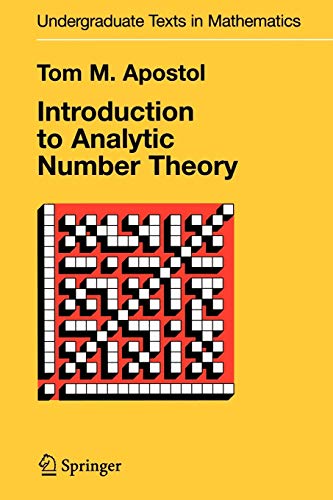
⭐This excellent textbook explains how analysis (both real and complex) may be applied to number theory, especially to the study of the prime numbers and their distribution within the naturals. There is a lot of info about Dirichlet series and the Riemann zeta function, which is one of the most fascinating functions in pure maths. Every page is a joy to read! The ideas are clearly explained in a straight-forward way. The prose style is crystal clear and perfectly phrased.The first few chapters deal with “elementary” ideas, such as arithmetic functions and congruences. There is also a look at group theory and Dirichlet characters, which are relevant to L series. The book ends with a look at the partition function and infinite products, which is a really interesting and beautiful topic!There are exercises at the end of every chapter, but unfortunately there are no answers in the back, which is a shame, because the reader cannot check if his/her work is correct.This book has been in print for about 30 years and has deservedly attained a reputation as something of a classic, in mathematical circles.By the way, it took me a while to figure out what the diagram on the front cover is supposed to be. It’s a diagram of the GCD function (greatest common divisor).
⭐This book gives a thorough grounding in those parts of number theory which involves analytic methods. Despite this a fairly complete treatment of elementary methods is also provided to develop firm basis for the analyic methods. The most significant results are Dirichlet Theorem on Primes in Arithmetic progressions and a thorough treatment of the Analytic Proof of the Prime Number Theorem. As a text book I have not found one that is as complete as this for a higher undergraduate or Masters level postgraduate course. The choice of material is well considered and given that no textbook can cover every aspect of a subject as vast as number theory, this book does an admirable job of providing a superb basis on which to progress to further more advanced treatise such as the classic books by Davenport (Multiplicative Number Theory) and Titchmarsh (The Theory of the Riemann Zeta Function) or Iwaniec ( Analytic Number Theory). It also provides sufficient preparation to pave the way for more advanced analytic methods such as Sieve Methods and exponential sums (see for example Cojocaru and Murty ‘Introduction to Sieve methods and applications’ or Harman ‘Prime-Detecting Sieves’)I found that by combining this book with Burton `Elementary Number Theory’ or Hardy and Wrights `Introduction to the theory of Numbers’ this textbook provides an excellent introduction for anyone with an interest in Analytic Number Theory.A highly recommended textbook.
⭐This version by Narosa is just a cheap reprint and a copy of the Springer Paperback Edition of the same book. It is probably reproduced without permission. Because nowhere I found the original price and when I mailed Narosa, they did not reply. It has lots of printing errors(at least my copy has). Buy the Springer Edition(Price on Amazon is around Rs. 350, MRP=Rs. 750).The book is a classic one, requiring a level of Mathematical maturity like writing proofs, Calculus(Integration, Convergences, Sequence, Limits), Induction, Binomial Theorem, divisibility, Fundamentals of Arithmetic(Trichotomy, Associative, Distributive Law..) – just basic stuffs. Remember it is ANALYTIC number theory, so it is more concerned with deriving proofs, rather than stating them for the general reader. Apostol’s exposition and writing style does half the magic.For a general book on Number Theory try Ogilvy or for basic introduction into proofs of Number Theory try GA Jones or Dudley.Attached photo of book shows the printing errors from the first chapter. I gave 4 stars for the quality of the material of the book and it is Tom M Apostol.
Keywords
Free Download Introduction to Analytic Number Theory (Undergraduate Texts in Mathematics) in PDF format
Introduction to Analytic Number Theory (Undergraduate Texts in Mathematics) PDF Free Download
Download Introduction to Analytic Number Theory (Undergraduate Texts in Mathematics) 2010 PDF Free
Introduction to Analytic Number Theory (Undergraduate Texts in Mathematics) 2010 PDF Free Download
Download Introduction to Analytic Number Theory (Undergraduate Texts in Mathematics) PDF
Free Download Ebook Introduction to Analytic Number Theory (Undergraduate Texts in Mathematics)