

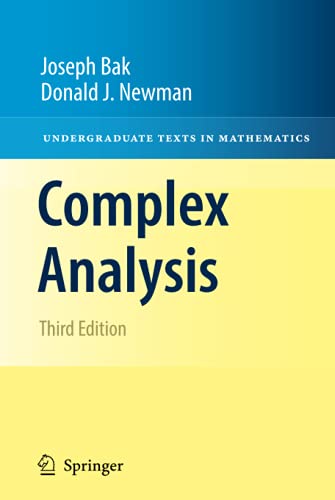
Ebook Info
- Published: 2010
- Number of pages: 340 pages
- Format: PDF
- File Size: 5.16 MB
- Authors: Bak
Description
This unusual and lively textbook offers a clear and intuitive approach to the classical and beautiful theory of complex variables. With very little dependence on advanced concepts from several-variable calculus and topology, the text focuses on the authentic complex-variable ideas and techniques. Accessible to students at their early stages of mathematical study, this full first year course in complex analysis offers new and interesting motivations for classical results and introduces related topics stressing motivation and technique. Numerous illustrations, examples, and now 300 exercises, enrich the text. Students who master this textbook will emerge with an excellent grounding in complex analysis, and a solid understanding of its wide applicability.
User’s Reviews
Editorial Reviews: Review From the reviews of the third edition:“The book of the known mathematicians J. Bak and D. Newman is an excellent introduction into the theory of analytic functions of one complex variable. The book is written on an elementary level and so it supports students in the early stages of their mathematical studies. … The book also contains many illustrations, examples and exercises, which give additional information and explanations.” (Konstantin Malyutin, Zentralblatt MATH, Vol. 1205, 2011) From the Back Cover This unusual and lively textbook offers a clear and intuitive approach to the classical and beautiful theory of complex variables. With very little dependence on advanced concepts from several-variable calculus and topology, the text focuses on the authentic complex-variable ideas and techniques. Notable additions to “Complex Analysis, Third Edition,” include: • The solution of the cubic equation and Newton’s method for approximating the zeroes of any polynomial; • Expanded treatments of the Schwarz reflection principle and of the mapping properties of analytic functions on closed domains; • An introduction to Schwarz-Christoffel transformations and to Dirichlet series; • A streamlined proof of the prime number theorem, and more. Accessible to students at their early stages of mathematical study, this full first year course in complex analysis offers new and interesting motivations for classical results and introduces related topics stressing motivation and technique. Numerous illustrations, examples, and now 300 exercises, enrich the text. Students who master this textbook will emerge with an excellent grounding in complex analysis, and a solid understanding of its wide applicability. About the Author Dr. Joseph Bak is the Assistant Chair of the Mathematics department at The City College of New York. Joseph Bak’s primary area of research is approximation theory. Dr. Donald J. Newman (July 27, 1930 – March 28, 2007) was a champion problem solver. His mathematical specialties included complex analysis, approximation theory and number theory. His career included posts as a Professor of Mathematics at MIT, Brown University, Yeshiva University, Temple University and a distinguished chair at Bar Ilan University in Israel. His publications include 150 papers and five books. Read more
Reviews from Amazon users which were colected at the time this book was published on the website:
⭐I had to use this book for my course in Complex Variables at the University of Iowa. I got an A in the course, but I did not find this book to be helpful. The book does not appear to be used often enough for there to be a solution guide online, but I was able to find these homework problems discussed in online forums and sometimes on the course websites of other universities.There are solutions to about half of the problems in the back, but only the answer is given [for example: (+/-) (1+3i)], which tells you whether or not you were correct, but it does not tell you where you went wrong in your several pages of work. If you don’t know how to solve the problem, the solution alone is not helpful.The examples given in the book are also not helpful. They always skip over many steps, and it took me at least 30 minutes to reconstruct all the missing steps in order to figure out what the book examples were trying to say. In addition, many of the examples give no explanation at all; they merely list an example problem and its solution. Without showing how to solve the problem, the book does not help you learn how to solve problems for your exams and homework.Because of these problems, I rarely used this book in my course. I completed homework problems from the book each week, but I used online sources to figure out how to solve the problems. I used this book mainly to check that my answers were correct.
⭐This is the most crystal clear book on the topic that is in print.For what it’s worth, I feel like I’m more of an algebraist.After spending many years feeling inadequate about my complex analysis skills, I bought this book.I did not feel like I had hope on my side.I used Chapters 1 – 15, plus additional topics from later chapters.For chapters that I worked through, I did every darn problem (checking solutions against those that exist in the back of the book).If you can work through one section (not chapter!) every few days, then you should have a pretty good general feel for the subject.It’s a beautiful book, and a great preparation for Lars Ahlfors’ “Complex Analysis” book.
⭐Course I took a long time ago. I guess 5 stars.
⭐It is good to read to know what complex analysis is.
⭐This is a brief text on complex analysis aimed at the traditional junior-senior course. As a text it may be a little too succinct for the average undergraduate. For example, I have no intention of teaching out of it. However, its clarity and presentation is absolutely refreshing. I think it is one of the best books written on complex analysis in the last twenty years. I recommend this book to any student of complex analysis.
⭐I have invested a lot of effort searching for the “ideal” textbook on complex variables. I found Bak/Newman to be extremely terse, with minimal detail, inadequate explanations, and unenlightening examples. The book by Brown/Churchill is a very accessible introduction, although I was surprised by the number of typos, and the use of “multivalued functions” may cause confusion. I came to the conclusion that the book by Gamelin may be the best overall in terms of clarity of explanation, rigor, and useful detail.
⭐This is a great book for Complex Analysis.
⭐Excellent book! Direct to the point and very complete for undergraduate course. The exercises are also good.
⭐All but the mathematical purist is going to like this book, since it is focusing on illustrating the simplicity of complex analysis, rather than giving the shortest possible account. This means that the closed curve theorem and Cauchy’s integral formula are proved several times over the first 100 pages, starting with the simplest possible case and ending up with the general case. The later profs goes more or less like this: “This is the same proof as for theorem XX”, and only the proof of the simple case is complete(grosely oversimplified!!). The result is a simple, easy to read, and really well structured account of the basics of complex analysis, suited for senior undergraduates(Infinite series and many other basic analytical tools are required). The book is also quite suitable for self study!
⭐It is a good book for Complex Analysis. I strongly recommend to people who are doing Complex Analysis; it give you a basic introduction and background reading about it.
⭐I read a good review of this book on the Newsletter of the European Mathematical Society, so I bought it. Frankly, I don’t like very much the method used by the authors. More than a textbook is an exercises-book. The results are not very explained and the matter is compressed in little space. Albeit the number of pages, there is not much text. This book could be useful for a teacher in preparing a lecture, because is fragmentary but well structured. For a person able to read German, I suggest “Einführung in die Funktionentheorie” by Hermann Weyl. Another good book (as introduction) is Rainer Wüst’s “Mathematik für Physiker und Mathematiker”, volume 2. A classic is Shilov’s “Elementary Real and Complex Analysis”. A gap of the book in issue is the lack of an index of the symbols and the lack of explanations of the symbols. The authors take for granted too much things from Analysis and Algebra. A trivial example: what does it mean |z|? The authors don’t give a definition of the module in the field of complex numbers. They can take for granted the REAL analysis, but not the complex analysis. The symbol for the neighbourhood is very strange and not intuitive at all. Summing up: the text is very condensed and not adapt for a newbie. Nevertheless, the great amount of exercises is very interesting.
⭐Sembra del tutto nuovo!!! Eccellente acquisto! Nessuna sottolineatura, pagine ancora profumate di stampa fresca, copertina perfettamente integra.Che altro dire?Great book!
Keywords
Free Download Complex Analysis (Undergraduate Texts in Mathematics) in PDF format
Complex Analysis (Undergraduate Texts in Mathematics) PDF Free Download
Download Complex Analysis (Undergraduate Texts in Mathematics) 2010 PDF Free
Complex Analysis (Undergraduate Texts in Mathematics) 2010 PDF Free Download
Download Complex Analysis (Undergraduate Texts in Mathematics) PDF
Free Download Ebook Complex Analysis (Undergraduate Texts in Mathematics)