Ebook Info
- Published: 2014
- Number of pages: 376 pages
- Format: PDF
- File Size: 2.10 MB
- Authors: Tim Maudlin
Description
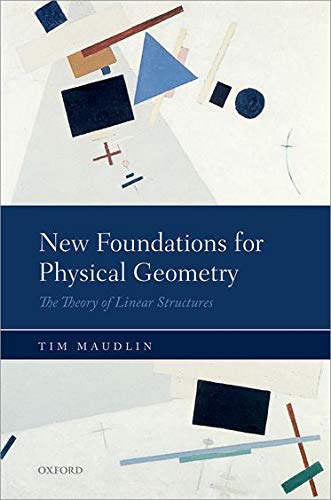
Topology is the mathematical study of the most basic geometrical structure of a space. Mathematical physics uses topological spaces as the formal means for describing physical space and time. This book proposes a completely new mathematical structure for describing geometrical notions such as continuity, connectedness, boundaries of sets, and so on, in order to provide a better mathematical tool for understanding space-time. This is the initial volume in a two-volume set, the first of which develops the mathematical structure and the second of which applies it to classical and Relativistic physics. The book begins with a brief historical review of the development of mathematics as it relates to geometry, and an overview of standard topology. The new theory, the Theory of Linear Structures, is presented and compared to standard topology. The Theory of Linear Structures replaces the foundational notion of standard topology, the open set, with the notion of a continuous line. Axioms for the Theory of Linear Structures are laid down, and definitions of other geometrical notions developed in those terms. Various novel geometrical properties, such as a space being intrinsically directed, are defined using these resources. Applications of the theory to discrete spaces (where the standard theory of open sets gets little purchase) are particularly noted. The mathematics is developed up through homotopy theory and compactness, along with ways to represent both affine (straight line) and metrical structure.
User’s Reviews
Editorial Reviews: Review “It is impressive because Maudlin develops his own, new and independent, foundational scheme for geometry. Not only does he propose new principles, he elaborates them to such a degree that a serious alternative to traditional approaches begins to take shape. I think that this result, and the enthusiasm, energy and persistence displayed in the enterprise, deserve admiration.” — Notre Dame Philosophical Reviews Online “Maudlin’s New Foundations for Physical Geometry is a fascinating and remarkable book” — Mind About the Author Tim Maudlin was born and raised in Washington DC. Having received his BA in Physics and Philosophy from Yale and his PhD in History and Philosophy of Science from the University of Pittsburgh, he was a faculty member at Rutgers University for a quarter century before joining New York University in 2011. He has been a visiting professor of philosophy at Harvard.
Reviews from Amazon users which were colected at the time this book was published on the website:
⭐This book is about a new mathematical area of study that is1) approximately (but not exactly) “equivalent” to point-set topology, and2) holds promise for being an appropriate place to hunt for models for modern physicsIt is fascinating mathematically, and also very pleasingly written, with careful, thorough explanations.
⭐I am an undergrad in physics working toward graduate studies in mathematical physics, and I found this book absolutely wonderful. Physics is only pushed forward historically by rigorous evaluation of not only the current paradigm, but the shift to such a foundation from past theories, and finally a complete reworking based on this careful analysis. Maudlin thoroughly undertakes a major step toward one such possible leap in this first volume. He lays out a mathematical theory, the theory of linearstructures, which seeks to maintain the working tools of point set topology while finding firmer ontological grounding by use of a new primitive; the line. This is far more intuitive than the alternative notion of open set, and Maudlin’s careful axiomatic undertaking deserves serious consideration. In his recent book, Now: The Physics of Time, Richard Muller points out that the next major development in physics will require physicists to no longer shy away from the issue of measurement. Maudlin is not the least bit alien to the subject of measurement, and this foray into mathematics may prove to have been a good first step. These issues of ontology are seldom concerning to mathematicians unfortunately, but Maudlin has left the work done by topologists undisturbed, while providing for what could be a more meaningful theory for modern mathematical physics. Maudlin’s solution to the classic twins paradox is one of substantial note that should earn him credibility among physicists upon their own careful verification. A text well worth the money.
Keywords
Free Download New Foundations for Physical Geometry: The Theory of Linear Structures in PDF format
New Foundations for Physical Geometry: The Theory of Linear Structures PDF Free Download
Download New Foundations for Physical Geometry: The Theory of Linear Structures 2014 PDF Free
New Foundations for Physical Geometry: The Theory of Linear Structures 2014 PDF Free Download
Download New Foundations for Physical Geometry: The Theory of Linear Structures PDF
Free Download Ebook New Foundations for Physical Geometry: The Theory of Linear Structures