

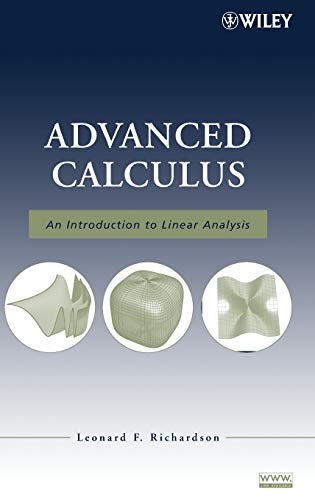
Ebook Info
- Published: 2008
- Number of pages: 416 pages
- Format: PDF
- File Size: 6.30 MB
- Authors: Leonard F. Richardson
Description
Features an introduction to advanced calculus and highlights its inherent concepts from linear algebra Advanced Calculus reflects the unifying role of linear algebra in an effort to smooth readers’ transition to advanced mathematics. The book fosters the development of complete theorem-proving skills through abundant exercises while also promoting a sound approach to the study. The traditional theorems of elementary differential and integral calculus are rigorously established, presenting the foundations of calculus in a way that reorients thinking toward modern analysis.Following an introduction dedicated to writing proofs, the book is divided into three parts:Part One explores foundational one-variable calculus topics from the viewpoint of linear spaces, norms, completeness, and linear functionals.Part Two covers Fourier series and Stieltjes integration, which are advanced one-variable topics.Part Three is dedicated to multivariable advanced calculus, including inverse and implicit function theorems and Jacobian theorems for multiple integrals.Numerous exercises guide readers through the creation of their own proofs, and they also put newly learned methods into practice. In addition, a “Test Yourself” section at the end of each chapter consists of short questions that reinforce the understanding of basic concepts and theorems. The answers to these questions and other selected exercises can be found at the end of the book along with an appendix that outlines key terms and symbols from set theory.Guiding readers from the study of the topology of the real line to the beginning theorems and concepts of graduate analysis, Advanced Calculus is an ideal text for courses in advanced calculus and introductory analysis at the upper-undergraduate and beginning-graduate levels. It also serves as a valuable reference for engineers, scientists, and mathematicians.
User’s Reviews
Editorial Reviews: Review “The book is well-suited for students who have had some basic calculus and linear algebra, as an intermediate step before beginning more advanced topics as measure theory, functional analysis, and the theory of differential equations.” (Bull Belg Math Soc, 1 July 2010)”This is an excellent book, well worth considering for a textbook for an undergraduate analysis course.” (MAA Reviews July, 2008) From the Inside Flap Features an introduction to advanced calculus and highlights its inherent concepts from linear algebraAdvanced Calculus reflects the unifying role of linear algebra in an effort to smooth readers’ transition to advanced mathematics. The book fosters the development of complete theorem-proving skills through abundant exercises while also promoting a sound approach to the study. The traditional theorems of elementary differential and integral calculus are rigorously established, presenting the foundations of calculus in a way that reorients thinking toward modern analysis.Following an introduction dedicated to writing proofs, the book is divided into three parts:Part One explores foundational one-variable calculus topics from the viewpoint of linear spaces, norms, completeness, and linear functionals.Part Two covers Fourier series and Stieltjes integration, which are advanced one-variable topics.Part Three is dedicated to multivariable advanced calculus, including inverse and implicit function theorems and Jacobian theorems for multiple integrals.Numerous exercises guide readers through the creation of their own proofs, and they also put newly learned methods into practice. In addition, a “Test Yourself” section at the end of each chapter consists of short questions that reinforce the understanding of basic concepts and theorems. The answers to these questions and other selected exercises can be found at the end of the book along with an appendix that outlines key terms and symbols from set theory.Guiding readers from the study of the topology of the real line to the beginning theorems and concepts of graduate analysis, Advanced Calculus is an ideal text for courses in advanced calculus and introductory analysis at the upper-undergraduate and beginning-graduate levels. It also serves as a valuable reference for engineers, scientists, and mathematicians. From the Back Cover Features an introduction to advanced calculus and highlights its inherent concepts from linear algebraAdvanced Calculus reflects the unifying role of linear algebra in an effort to smooth readers’ transition to advanced mathematics. The book fosters the development of complete theorem-proving skills through abundant exercises while also promoting a sound approach to the study. The traditional theorems of elementary differential and integral calculus are rigorously established, presenting the foundations of calculus in a way that reorients thinking toward modern analysis.Following an introduction dedicated to writing proofs, the book is divided into three parts:Part One explores foundational one-variable calculus topics from the viewpoint of linear spaces, norms, completeness, and linear functionals.Part Two covers Fourier series and Stieltjes integration, which are advanced one-variable topics.Part Three is dedicated to multivariable advanced calculus, including inverse and implicit function theorems and Jacobian theorems for multiple integrals.Numerous exercises guide readers through the creation of their own proofs, and they also put newly learned methods into practice. In addition, a “Test Yourself” section at the end of each chapter consists of short questions that reinforce the understanding of basic concepts and theorems. The answers to these questions and other selected exercises can be found at the end of the book along with an appendix that outlines key terms and symbols from set theory.Guiding readers from the study of the topology of the real line to the beginning theorems and concepts of graduate analysis, Advanced Calculus is an ideal text for courses in advanced calculus and introductory analysis at the upper-undergraduate and beginning-graduate levels. It also serves as a valuable reference for engineers, scientists, and mathematicians. About the Author Leonard F. Richardson, PhD, is Herbert Huey McElveen Professor and Assistant Chair of the Department of Mathematics at Louisiana State University, where he is also Director of Graduate Studies in Mathematics. Dr. Richardson’s research interests include harmonic analysis and representation theory. Read more
Reviews from Amazon users which were colected at the time this book was published on the website:
⭐I had Dr. Richardson at LSU for Adv. Cal 1,2 and 3. It was required for my major. Dr. Richardson is an amazing teacher, but I feel the book is only good if you’re being taught by the guy who wrote it. The first part of the book, yes, he does presume you know how to write proofs when, during his teachings, he preaches that you need to only have basic introductory calculus knowledge.When I was taking this class, I used his book for the homework assignments, and right alongside to further understand the material, I had Principles of Mathematical Analysis by Rudin and the way he explained the material was amazing! Nonetheless, If it wasn’t for having Len as a professor, I would not have used his book. That’s why I give this a 3 star rating.
⭐This text was chosen by professor. I don’t care for the condensed style. Classmates who like it prefer the highly abbreviated explanations. I think they use it more as a reference than for full explanations. And I don’t think less of an author for cautioning me about things he anticipates might confuse me. For me, learning math from this book is like trying to learn a new foreign language from reading a dictionary.
⭐This is another example of someone who either refuses to or simply cannot write clearly.Just to focus on 1.7, the Heine-Borel Covering Theorem which is representative. His opening is to say the least baffling to someone without at least some introduction to topology and this is made worse by the deliberate absence of meaningful examples of open and closed sets. His exposition on Theorem 1.7.1, that the union of open sets is an open set is just as baffling, as he refers the reader to a later exercise and then starts the proof in medias res. This is simply bad teaching, bad presentation. In Definition 1.7.2, he defines an open cover in as incomprehensibly a way as possible and then makes matters worse by providing no meaningful example. When he finally gets to the-Borel Covering Theorem, as he does not clearly explain what it stands for, his proof comes out as a pile of gibberish. There is simply no excuse for this.Many of the problems do not clearly follow from the exposition and there are far too many of the “give an example” type. Richardson is the professor; he should be providing the examples; he should be facilitating comprehension, not deliberately obviating it.Why Richardson and others take the byzantine approach to composing mathematics texts, as opposed to the down-to-earth approach, is beyond me. Are they fearful that too many people will grasp the subject too quickly? Are they afraid that if they write in an immediately comprehensible manner that students will simply read their books, not attend class and put them out of a job?I have no idea why Richardson even wrote this book (except for the obvious and vulgar reason)for it is no better–and in some ways, it is considerably worse–than the texts out there. This book is beyond disappointing and I resent having paid nearly $100.00 for it and gotten next to nothing out of it. Richardson should be ashamed for even writing it.
⭐I had Dr. Richardson as a professor at Louisiana State University, and this book is just amazing. It is based on his notes that he used to teach Advanced Calculus, which was by far the most useful class I’ve ever taken so far as an undergraduate. His writing is clear, and will provide a thorough understanding of the subject. In a few years this book will surely be a classic, along with Rudin and such.
⭐I got this for a class in Advanced Calculus. The book is horribly written and extremely difficult to understand. The book was so difficult to use that I had to result to online lectures to supplement it because I was unable to properly grasp the concepts as presented in the book.If you have to get this for a class keep in mind that you should attend the class and take good notes, because this book will not prove terribly useful as a learning aid.
⭐Author says, perhaps the motivation and idea of writing this book came from the class he took at Yale University from Prof. Hahn. May be this is a good book for Math students at Yale but for a Math Starter at most of the other universities, this book is the worst way to introduce the Subject of Real Analysis. I agree with the other reviewer that the author has messed up Topology in Chapter 1. His introduction of Uniform and Point wise convergence is clumsy and what his rush to introduce Banach Spaces in Chapter 2. Further there are some books that introduce Integration before differentiation and in my opinion, it may be a better idea to do the other way around like most of the books do. However, Mr. Richardson seems to be on a mission to chase away students from the subject of Advanced Calculus. He prefers to introduce Integration through the abstract notation of Riemann Integrals and then in later sections Darboux Integration criteria. Oh well .. I can go an and on… > In short in my opinion this is not the right book to introduce Advanced Calculus. For normal students, some of the better books for an introductory course in Advanced calculus are books by Abbott, or Spivak (Calculus), Bartle and Sherbert, or Stephen Lay. Among the classics, by Rudin, Apostle or Karl Stromberg.
⭐This book is pretty useless. There are very few or no examples given in each chapter. Also it doesn’t really teach how to make proofs. The author presumes that the student “already” knows how to make proofs. And its not that i have no skill. In fact I have bachelor of science in math, and even though I can understand this book, it does a poor job of explaining to student who is not proof expert
Keywords
Free Download Advanced Calculus: An Introduction to Linear Analysis 1st Edition in PDF format
Advanced Calculus: An Introduction to Linear Analysis 1st Edition PDF Free Download
Download Advanced Calculus: An Introduction to Linear Analysis 1st Edition 2008 PDF Free
Advanced Calculus: An Introduction to Linear Analysis 1st Edition 2008 PDF Free Download
Download Advanced Calculus: An Introduction to Linear Analysis 1st Edition PDF
Free Download Ebook Advanced Calculus: An Introduction to Linear Analysis 1st Edition