Ebook Info
- Published: 1995
- Number of pages: 376 pages
- Format: PDF
- File Size: 12.48 MB
- Authors: János Pach
Description
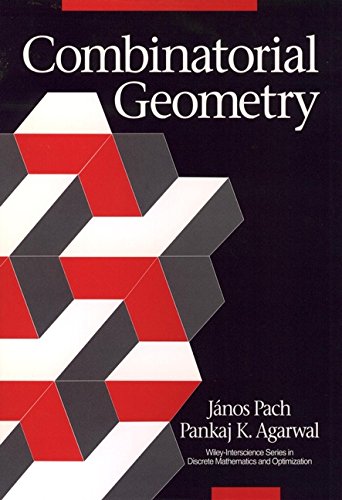
A complete, self-contained introduction to a powerful and resurging mathematical disciplineCombinatorial Geometry presents and explains with complete proofs some of the most important results and methods of this relatively young mathematical discipline, started by Minkowski, Fejes Tóth, Rogers, and Erd’s. Nearly half the results presented in this book were discovered over the past twenty years, and most have never before appeared in any monograph. Combinatorial Geometry will be of particular interest to mathematicians, computer scientists, physicists, and materials scientists interested in computational geometry, robotics, scene analysis, and computer-aided design. It is also a superb textbook, complete with end-of-chapter problems and hints to their solutions that help students clarify their understanding and test their mastery of the material. Topics covered include:Geometric number theoryPacking and covering with congruent convex disksExtremal graph and hypergraph theoryDistribution of distances among finitely many pointsEpsilon-nets and Vapnik―Chervonenkis dimensionGeometric graph theoryGeometric discrepancy theoryAnd much more
User’s Reviews
Editorial Reviews: From the Publisher A broad perspective on an area of discrete mathematics, combinatorial geometry demonstrates that important results in many areas of number theory can be established by easy geometric arguments. This book is a comprehensive overview of the field. Includes numerous exercises and solutions. From the Inside Flap How many objects of a given shape and size can be packed into a large box of fixed volume? Can one plant n trees in an orchard, not all along the same line, so that every line determined by two trees will pass through a third? These questions, raised by Hilbert and Sylvester roughly one hundred years ago, have generated a lot of interest among professional and amateur mathematicians and scientists. They have led to the birth of a new mathematical discipline with close ties to classical geometry and number theory, and with many applications in coding theory, potential theory, computational geometry, computer graphics, robotics, etc. Combinatorial Geometry offers a self-contained introduction to this rapidly developing field, where combinatorial and probabilistic (counting) methods play a crucial role. This book has grown out of the material of both undergraduate and graduate courses in mathematics and computer science given by János Pach at the Courant Institute of Mathematical Sciences, New York University. Divided into two parts― Arrangements of Convex Sets and Arrangements of Points and Lines―it presents and explains some of the most important and ingenious results in combinatorial geometry, including:Dowker’s theoremsFáry’s theoremFejes Tóth’ stheoremsMethods of Blichtfeldt and RogersMinkowski―Hlawka theoremKoebe’s representation theoremLipton―Tarjan separator theoremTheorems of Erd’s, Turán, and RamseySzemerédi’s regularity lemmaSzemerédi―Trotter theoremsMethods of Clarkson, Edelsbrunner, Guibas, Sharir, and WelzlCounterexample to Borsuk’s conjecture From the Back Cover A complete, self-contained introduction to a powerful and resurging mathematical disciplineCombinatorial Geometry presents and explains with complete proofs some of the most important results and methods of this relatively young mathematical discipline, started by Minkowski, Fejes Tóth, Rogers, and Erd’s. Nearly half the results presented in this book were discovered over the past twenty years, and most have never before appeared in any monograph. Combinatorial Geometry will be of particular interest to mathematicians, computer scientists, physicists, and materials scientists interested in computational geometry, robotics, scene analysis, and computer-aided design. It is also a superb textbook, complete with end-of-chapter problems and hints to their solutions that help students clarify their understanding and test their mastery of the material. Topics covered include:Geometric number theoryPacking and covering with congruent convex disksExtremal graph and hypergraph theoryDistribution of distances among finitely many pointsEpsilon-nets and Vapnik―Chervonenkis dimensionGeometric graph theoryGeometric discrepancy theoryAnd much more About the Author JANOS PACH is Professor of Computer Science at City College of New York and Senior Research Fellow at the Mathematical Institute of the Hungarian Academy of Sciences. He received his PhD in mathematics from Eotvos University, Budapest, in 1980 and has had visiting positions at various universities, including the University College of London, McGill University, the Courant Institute of New York University, and Tel Aviv University. He serves on the editorial boards of three mathematical and computer science journals and has been an invited speaker at many conferences. He has published more than one hundred research papers, mostly in discrete and computational geometry and in combinatorics. He received the Lester R. Ford Award in 1990 and the Renyi Prize in 1993.PANKAJ K. AGARWAL is Associate Professor in the Computer Science Department of Duke University. He received his PhD in computer science from the Courant Institute of Mathematical Sciences, New York University, in 1989. He is the author of Intersection and Decomposition Algorithms for Planar Arrangements, and a coauthor of Davenport-Schinzel Sequences and Their Geometric Applications. He has published several research papers and has given talks at many conferences. He was awarded the National Young Investigator Award in 1992. Read more
Keywords
Free Download Combinatorial Geometry 1st Edition in PDF format
Combinatorial Geometry 1st Edition PDF Free Download
Download Combinatorial Geometry 1st Edition 1995 PDF Free
Combinatorial Geometry 1st Edition 1995 PDF Free Download
Download Combinatorial Geometry 1st Edition PDF
Free Download Ebook Combinatorial Geometry 1st Edition