

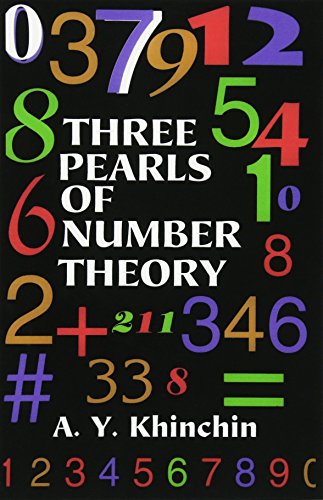
Ebook Info
- Published: 1998
- Number of pages: 64 pages
- Format: PDF
- File Size: 1.51 MB
- Authors: A. Y. Khinchin
Description
These three puzzles involve the proof of a basic law governing the world of numbers known to be correct in all tested cases — the problem is to prove that the law is always correct. Includes van der Waerden’s theorem on arithmetic progressions, the Landau-Schnirelmann hypothesis and Mann’s theorem, and a solution to Waring’s problem. Proofs and explanations of the answers included.
User’s Reviews
Reviews from Amazon users which were colected at the time this book was published on the website:
⭐This book is actually a letter from a Russian professor to a student sent off to war. It’s short, but won’t be an easy read. These are “pearls” but getting the oyster open is going to be tough. It’s also remarkable for it’s candid revelation of the mathematical process of professional practitioners at various universities in different countries. The first pearl is about a young student name van der Waerden. Yep, the guy who went on to prove so many results in Abstract Algebra and wrote the classic text on the subject influencing Artin and Noether. It’s interesting to note, van der Waerden used finite differences in his proof recounted in the first pearl, and he’s the only author I know that included finite differences in his abstract algebra text book. Both the candid historical confessions and the conversational exposition make this a great book. It’s style and methods should be widely imitated. Come on, professors, write more like this! Future archaeologist of the 20th century will be glad this document is available for it’s revelation of the habits of homo professorus mathematicus.
⭐It is truly a pearl, and pearls have permanence; — they retain their beauty, from one generation to the next. So too is the case for this little book. Measured in mathematical generations, you must count back a few;– back to the last year of the Second World War, and in what was then The Soviet Union; now Russia. The author, A. Y. Khinchin was (and is) a mathematical physicist of World Renown. He has seminal contributions to number theory, to statistics, to information theory, and to statistical physics. The book is unique in many ways; for one, I believe it is for everyone, — even if you don’t know math. But readers with math background will know that it is possible for writing in math to be both moving and beautiful. This is the case for this little classic. Both the historical background and the subject are unique. The nature of the book (64 pages in all!) is almost like a personal letter written by a loving teacher to one of his students, but it is much more than that. At the time, the War had devastated Russia, and almost everyone from the young generation, including students of the sciences was at the front. The casualties everywhere in The Soviet Union were staggering; many had lost parents and relatives during 4 long years of destruction. Khinchin’s student Seryozha was recovering (at the time of the letter) in an army hospital, and he had written his former teacher, asking for math problems to work on. We can’t begin to imagine the terrible conditions of army hospitals on the front at this time. The care Khinchin took in responding is moving. In fact Seryozha had only taken one or two beginning classes at university, before being sent to war. And even though Khinchin had only a vague recollection of Seryozha from a class, he truly wanted to send him something he could use, — something that would make him happy. Students at the front were giving their lives for the rest of the country, and we must remember that this was a war where the difference between good and evil was crystal clear. Khinchin’s students were heroes. The book opens with a moving and personal letter, full of empathy, gratitude and love. As for the mathematics, Khinchin had carefully selected problems of great beauty, problems that can be stated and appreciated with little specialized knowledge; — in modern lingo, with very few prerequisites. And at the same time, they are problems Seryozha can work on in his hospital bed. They are profound, and they can be attacked with elementary means. Naturally, since 1945, there have been a lot of advances on all three. The problems are from arithmetic (or number theory), and they go under the names: (a) van der Waerden’s theorem on arithmetic progressions, (b) Landau’s hypothesis and Mann’s theorem, and (c) an elementary solution of Waring’s problem. By now these three problems take a different form in modern math books, but none as beautiful, in my opinion as Khinchin’s in his loving letter to his student written toward the end of the war. Review by Palle Jorgensen, May 2005.
⭐A jewel. Highly recommended for students of number theory, expecilally amateurs and teachers.
⭐A Y Khinchin was one of the greatest mathematicians of the first half of the twentieth century. He was also famous as a teacher and communicator. Fortunately, several of the books he wrote are still in print in English translations, published by Dover. Like William Feller and Richard Feynman he combines a complete mastery of his subject with an ability to explain clearly without sacrificing mathematical rigour.This is a short book of three chapters: Chapter 1. Van der Waerden’s theorem on arithmetic progressions. Chapter 2. The Landau-Shnirelmann hypothesis and Mann’s theorem. Chapter 3. An elementary solution of Waring’s problem.These are all difficult problems from the theory of numbers and I think that the elementary proofs that Khinchin describes here are original. This book is a challenging but enjoyable read.I also recommend his other book on number theory: “Continued Fractions”.
⭐Great to read. A certain level of mathematical maturity is required but all interested person and querious person also can read , only it shall take some time to digest.
⭐En este libro de 65 páginas, Khinchin escribe la prueba de tres teoremas: el teorema de van der Waerden sobre progresiones aritméticas, el teorema de Mann sobre densidades de Schnirelmann para números naturales (del cual da una prueba estructuralista debida a Scherk y E. Artin) y, finalmente, una solución elemental —que no necesariamente sencilla— del problema de Waring.La claridad de exposición de Khinchin es insuperable: desmarcándose de la estructura bourbakista de los libros de texto (definición-lema-teorema-corolario) se concentra en desglosar cada una de las pruebas aludidas como si desarmara la maquinaria de un fino reloj e indicara cuál es la función de cada una de las partes del mecanismo. Más aún, enfatiza dónde hay que concentrarse para que la prueba funcione (un aspecto indispensable para los estudiantes de matemáticas que aspiran a hacer investigación) y donde Khinchin afirma que la prueba es trivial ¡es porque efectivamente lo es!Los tres teoremas y sus pruebas van creciendo en complejidad —aunque las tres pruebas pueden clasificarse de “elementales”— y, si bien la lectura del texto es relativamente rápida, el lector deberá ir acompañado de papel y lápiz para convencerse de algunos resultados que no se encuentran fácilmente en la literatura, ni se enfatizan lo suficiente; sobre todo, los “lemas fundamentales” de la solución al problema de Waring que ocupan varias páginas del presente volumen.En definitiva, dado el precio y la calidad del texto ofrecido por Dover, está obra es recomendable para todos los estudiantes de ciencias y un indispensable para los que se dedican a la teoría de números.その主張は誰にでも分かるが、証明する事が極めて難しかった数論の3つのトピックを選んで、それらの初等的で見事な証明を解説するヒンチンの定評ある古典である。選ばれた3つのトピックの初等的な証明は、何れも巧妙な数学的帰納法に拠っており、その美しさ・素晴らしさが本書の大きな魅力になっている。第1のトピックである「ファン・デル・ヴェルデンの定理」とは、「任意の2つの自然数k,lが与えられた時、ある自然数n(k,l)が存在して、その長さの連続する自然数列をどの様にk個の部分集合に分割しても、長さlの等差数列がいずれかの部分集合に含まれる」という主張である。ルコムスカヤによる証明の素晴らしさは、自然数n(k,l)が帰納的に構成可能であり、そのn(k,l)が与えられた性質を持つ事をlに関する帰納法で非常に巧妙に示している点にある。第2、第3のトピックは、0以上の整数がなす集合(Z+と書く)の部分集合(特に、0を含む単調増加数列)が持つ加法的な性質を論ずるという点で共通している。ここで(シュニレルマン)密度の概念が重要なのは、「この密度が正の数列はZ+の基になる」という性質によっている。アルティンとシャークによるマンの定理(「2つの(0を含む)Z+の数列の和の密度は、各々の数列の密度の和以上である」)の証明は鮮やかであり、「0を含むn乗数がなす数列の適当な個数の和の密度は正である」ことを示したリニクの「ウェアリング問題の解の存在証明」とともに、見事なものと言わざるを得ない。密度の概念を通して、加法的解析数論への更なる興味をかきたててくれる事が本書のもう一つの大きな魅力であると思う。本文は僅か54ページの本であるが、碩学であったヒンチンから数学愛好家に贈られた珠玉の逸品といえよう。
⭐
Keywords
Free Download Three Pearls of Number Theory (Dover Books on Mathematics) in PDF format
Three Pearls of Number Theory (Dover Books on Mathematics) PDF Free Download
Download Three Pearls of Number Theory (Dover Books on Mathematics) 1998 PDF Free
Three Pearls of Number Theory (Dover Books on Mathematics) 1998 PDF Free Download
Download Three Pearls of Number Theory (Dover Books on Mathematics) PDF
Free Download Ebook Three Pearls of Number Theory (Dover Books on Mathematics)