

Ebook Info
- Published: 1995
- Number of pages: 272 pages
- Format: PDF
- File Size: 2.33 MB
- Authors: Walt Anderson
Description
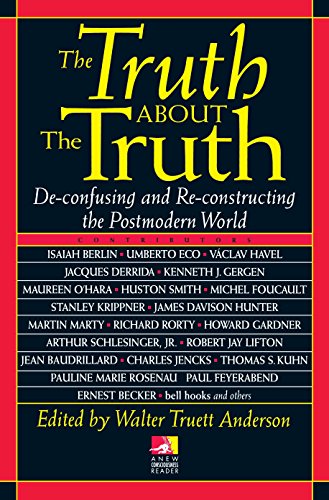
Includes essays and excerpts from the works of prominent modern thinkers such as Umberto Eco, Jacques Derrida, and Isaiah Berlin among others.
User’s Reviews
Product description From Publishers Weekly There is no longer one “truth about the truth,” observes freelance journalist Anderson (Reality Isn’t What It Used to Be), who has compiled 33 previously published short pieces by postmodern pundits grappling with problems of belief, identity and society. In an engagingly skeptical, aphoristic voice (“look at the post modern world as a kind of jailbreak from the Grand Hotel”), Anderson provides continuity between sections as diverse as “Symbols at Work and Play” (which includes a relatively lucid passage from Jacques Derrida on “the dubious relationship between a word and its referent” and Stephen Katz’s spoof on “How to Speak and Write Postmodern”) and “Science Without Scientism,” featuring passages from Thomas Kuhn and Paul Feyerabend on the instability of scientific principles. Final chapters from Arthur Schlesinger Jr. and Vaclav Havel about necessary links between politics and faith suggest where Anderson’s real sympathies lie. That Anderson has chosen some of the most accessible writings on postmodernism available is both a strength and a weakness. Academics may view this work as a remedial postmodern primer, while the larger audience for whom the volume seems intended may still be put off by considerable vocabulary barriers: a problem of readership that points up the continuing chasm between what’s on the minds of academics versus those of more regular folk. Copyright 1995 Cahners Business Information, Inc. About the Author Walt Truett Anderson’s previous books included Reality Isn’t What it Used to Be, To Govern Evolution, Rethinking Liberalism, The Upstart Spring and Open Secrets. A longtime resident of the San Francisco Bay Area, he is a fellow of the Meridian Institute, an international network of Scholars and practitioners concerned with issues of governance, earning, leadership and the future. He writes regularly for the Pacific News Service and currently serves as president of the American division of the World Academy of Art and Science.
Reviews from Amazon users which were colected at the time this book was published on the website:
⭐To many readers, postmodernism (PoMo) is a vexed subject, smacking of trendy intellectual fashion. However one views it, Anderson’s book collects a number of essays on the topic that anyone interested in the dominant ideas of the day should not be without. The entries are not lengthy and therefore persuasive depth should not be expected. Put them together, however, and a pretty complete overview of PoMo is before you. The editor has fashioned a nifty little introduction that lays out the general orientation in clear and understandable language – a not inconsiderable feat given the subject matter.One point worth noting that is not in the book. Beneath the ideas promoted by PoMo lies a sociological reality captured in that forbidding word “multi-culturalism”. There are many different cultures in the world whose customs and mores project many different kinds of worlds. This fact does seem to leave us with no common frame of reference to judge any of them as superior, a key PoMo conclusion. In that sense, postmodernism appears to be the perfect philosophical expression of an emerging multicultural reality. Nevertheless, wedging beneath the world’s many and various cultures is another emergent reality – the global consolidation of private property, as represented by trans-national corporations and international trade agreements. Beneath PoMo’s relativizing of cultural absolutes, there moves the monolithic grip of global capitalism, homogenizing all cultures in a consumerist vat. It at least deserves consideration that the former serves to conceal the latter from the view of secular intellectuals like post-modernists, and thus becomes the perfect cultural expression of a consolidating world order. Put another way, the power of Pepsi has conquered the outdated truths of reason and anyone who complains is practicing cultural imperialism. So go with the flow. Readers interested in how PoMo serves the powers-that-be should consult Terry Eagleton or Frederick Jameson.
⭐This book is a very useful entry into a difficult field, collecting short excerpts from a fascinating variety of postmodern fields and thinkers.
⭐Anderson tells us, “We are living in a new world, a world that does not know how to define itself by what it is, but only by what it has just-now ceased to be.” One of the most positive aspects of postmodernism in my view is that, because there is so much chaos of opinion today, reality is being created in plain sight. Walter Truett Anderson is one of the most lucid writers of our time and this book makes that creation of reality clear and comprehensible to anyone who will take the time to read about it. Highly recommended.
⭐Anderson’s gift for clear expression of very complicated ideas is never better exemplified than in The Truth About the Truth. In my work as a futurist working with religious clients, I have never found a more useful book.In the end, this is not a book about philosophy, it is about the dreams, worries and struggles of real people who live in the real world(s) of today. If you want to understand people and cultures of the late twentieth/early twenty-first century, this is THE book to have.
⭐(T) “p” is a true sentence if and only if pN’est ce pas?
⭐Great book that seems to follow with a common message from authors book, “Open Secrets, Guide to Tibetan Buddhism’. This is a collection of papers/articles of various authors addressing something called ‘postmodernism’. It seems to have a sociology and psychology feel to it and gives me relief that the intellect is alive and well in the world. It’s like psychology, sociology and philosophy teaming up with theoretical physics to figure out what is going on.
⭐Excellent resource about Postmodernism. Incredibly clear and interesting.
⭐I was very pleased with this transaction. The price was good and it came very quickly Everything was great. I needed this to come very quickly for a class, but I was still surprised at how fast this was.
Keywords
Free Download The Truth about the Truth: De-confusing and Re-constructing the Postmodern World in PDF format
The Truth about the Truth: De-confusing and Re-constructing the Postmodern World PDF Free Download
Download The Truth about the Truth: De-confusing and Re-constructing the Postmodern World 1995 PDF Free
The Truth about the Truth: De-confusing and Re-constructing the Postmodern World 1995 PDF Free Download
Download The Truth about the Truth: De-confusing and Re-constructing the Postmodern World PDF
Free Download Ebook The Truth about the Truth: De-confusing and Re-constructing the Postmodern World