

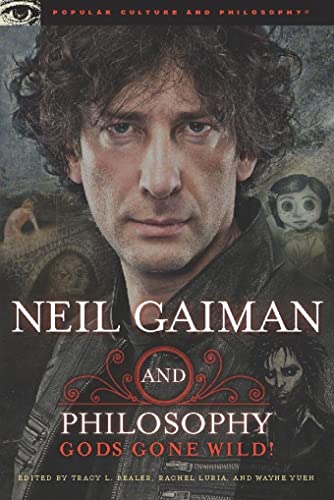
Ebook Info
- Published: 2012
- Number of pages: 288 pages
- Format: PDF
- File Size: 1.74 MB
- Authors: Tracy L. Bealer
Description
Neil Gaiman is the imaginative wizard behind the best-selling novels American Gods (soon to be an HBO series) and The Anansi Boys, the graphic series The Sandman, and popular children’s books like Coraline and The Graveyard Book. Neil Gaiman and Philosophy looks at Gaiman’s work through a philosophical lens. How does fantasy interact with reality and what can each tell us about the other? Do we each have other selves who embody different personal qualities? If the unknown influences the known, is the unknown just as real as the known? What makes people truly valuable? In Neil Gaiman and Philosophy, eighteen philosophers explore Gaiman’s best-loved and unforgettable worlds: The Graveyard Book, a macabre parallel to The Jungle Book, in which the boy Bod is raised by the supernatural inhabitants of a graveyard.Coraline, in which a girl neglected by her parents finds another world with an Other Mother who pays her a lot of attention, but then turns out to be evil and won’t let her go. Neverwhere, in which a London man discovers a magical parallel city, London Below. The Sandman, best-selling comic books in which the Lord of Dreams attempts to rebuild his kingdom after years of imprisonment.Good Omens (with Terry Pratchett) treats biblical prophecy, the Antichrist, and the End Times as a hilarious comic tale, filled with sly but good-humored twists and turns.MirrorMask, where a young circus girl finds that the pictures she has drawn have given her access to a fantastic world of light and shadow, populated with characters who have designs on her.
User’s Reviews
Editorial Reviews: About the Author Wayne Yuen teaches philosophy at Ohlone College in California.Rachel Luria is Assistant Professor of Rhetoric and Composition at Wilkes Honors College of Florida Atlantic University. She has published works of short fiction and comics in publications such as The Florida Review, Dash Literary Journal, and Yemassee Literary Journal.
Reviews from Amazon users which were colected at the time this book was published on the website:
⭐SUMMARYI didn’t know what to expect from this entry in Open Court’s “Popular Culture and Philosophy” series. The first thing that grabs the reader about “Neil Gaiman and Philosophy: Gods Gone Wild!” is the picture of Neil Gaiman on the cover. He is staring RIGHT – AT – YOU. Less Leonardo’s “Mona Lisa” and more Manet’s “Olympia”. He’s staring “into” you, with an ineffable, inscrutable expression. Is that a “come hither” look, or is that just his X-ray eyes doing what they do best? Hard to tell…The book itself is shorter than usual for an Open Court offering, clocking in at a mere 195 pages from front to back. Overall, this is a collection of mostly well-written essays, thus making it an exception to the typical Open Court offering. (Open Court stayed true to form with regards to the ever-present typos, though. Do what you do best, kiddo!) The fourteen essays are grouped into four sections, with three or four essays each. The essays do such a good job of tying in Gaiman’s works with various philosophical themes that it matters not that you have never read Gaiman before.The essays in the first section, “Gods Behaving Badly”, deal with Gaiman’s “American Gods”. The second section, “What You See”, deals with “The Sandman”, “Neverwhere”, and “Coraline”. The third section, “The Grim Teacher”, deals with “Death: The High Cost of Living”, “The Sandman: Season of Mists”, and “The Graveyard Book”. The fourth section, “Questions of Identity”, deals with “Batman: Whatever Happened to the Caped Crusader”, various works, and “The Graveyard Book”. From the “Behind the Scenes” section, which has the contributors’ bios, I note that eight (maybe nine) of the sixteen contributors are English/literature professors or are not strictly philosophy PhDs. This did not, however, detract from the quality of the contributions (although it is peculiar).The introduction, “Traveling with the Gods”, begins with the sentence “It starts with doors”, and compares Gaiman’s stories to “great travel stories”, where “heroes and [Gaiman’s] readers must mentally… map the unfamiliar spaces in order to understand the rules that govern them.” The reader is encouraged to be a traveler in Gaiman’s worlds, and thus to be transformed by his stories; to not be merely a tourist, “at a distance from their experience”. Although I have never read any of Mr. Gaiman’s works, nevertheless, the essays herein cover his major works well enough that I have come away feeling as though I had indeed been a traveler in his “worlds”, and not just a tourist. Yes, most of the essays herein are that good.SOLID ESSAYSElizabeth Swanstrom’s “Mr. Wednesday’s Game of Chance” gets the ball rolling by looking at the role of chance events in one’s life in Gaiman’s “American Gods”. We get a solid grounding in Hume and his three criteria of causation, and the idea that it is the repetition of events that gives rise to our ideas about causation.Greg Littmann’s “‘American Gods’ Is All Lies!” is a solid compare-and-contrast between Plato’s and Aristotle’s ideas on whether fiction is a good thing. Plato would have been upset over the depictions of the gods in Gaiman’s “American Gods” in a base manner, whereas Aristotle would have had no problem with fiction that served a purpose.Wade Newhouse’s “Coming of Age with the Ageless” was more of a literary analysis of Gaiman’s “The Graveyard Book” than real philosophy, although it is a very well-written essay that leverages Jean-Francois Lyotard’s ideas about our postmodern society and how metanarratives are no longer accepted at face value. This essay’s depth and insight are proven by the fact that I took almost a full page of handwritten notes as I was reading it. I rarely take more than half a page of notes for an essay.Wayne Yuen’s “The Dead Teach Us How to Live” applied Aristotle’s virtues to Gaiman’s “The Graveyard Book”. How does one respond to tragedies in one’s life? What does it mean to live a life of character? A life of authenticity? Virtues are excellences that allow a person to achieve a good life, and a virtue is relative to an individual. A solid essay. (However, Mr. Yuen’s use of the word “ghoul” on p. 140 is incorrect, I’m sure he meant “ghost” – unless Mr. Gaiman used the word “ghoul” in his book.)Tuomas W. Manninen’s “Four Bikers of the Apocalypse” is a solid essay that explores the correspondence theory of truth. That is, a claim is true if and only if it accurately represents the world. But how does one apply this idea about the truth to fictional characters? In fiction there are artifact types and tokens, and these relate to the idea that linguistic acts can change reality (think of what happens in a wedding ceremony). We get Plato, Wittgenstein and Bertrand Russell, along with contemporary philosophers David Lewis and Amie Thomasson.THE SHINING GEMBrandon Kempner’s “Forever Batman” applied Nietzsche’s “eternal recurrence” to Gaiman’s “Batman: Whatever Happened to the Caped Crusader?” Kempner refers to the teleological systems of Plato and Hegel (both are linear) and to Nietzsche’s “eternal recurrence” (which is circular). Kempner’s essay weaves his philosophical theme with the events in Gaiman’s “Batman”. It is a stellar essay because he also takes a quantum leap by applying his theme to Gaiman’s corpus in its entirety, and he shows us that the idea of “eternal recurrence” has been an ever-present theme in Gaiman’s work. Mr. Kempner’s essay in this collection is tallmanesque, as was his contribution in “The Walking Dead and Philosophy”, edited by Wayne Yuen. Mr. Kempner is the writer to watch in these “pop culture and philosophy” books. (And curiously, he’s an associate professor of English, not Philosophy!).SHADOW WORKSA few essays were disappointing. Jonas-Sebastien Beaudry’s “Apologizing to a Rat” was repetitive and meandering. It had no real philosophy or application of philosophy, rather, just social commentary. The theme was “invisibility”, and this refers to depriving an individual of one’s moral standing in the community. A solid theme, but the execution was non-existent – or should I say, “invisible”!Najwa Al-Tabaa’s “Hell Can be Good for You” was not good for me, thank you very much! It was a short essay, seven pages long, which is the only thing I enjoyed about this essay. The theme was “forgiveness”, and I think that Ms. Al-Tabaa had an interesting idea; nevertheless, I can’t forgive her for her mess.CONCLUSIONOverall, I enjoyed the essays in this book. Mostly solid and well-written, and I felt that enough of the plot and characters of the stories were referred to so that I was not lost or confused. A good mix of philosophers, both the greats and contemporary ones. Well worth the effort, only the persistent typos let me down. (Please, Open Court, puh-lease! Say “No!” to typos!) And finally, I re-iterate that it is interesting how half of the contributors specialize in English and Literature, and not in Philosophy directly. Perhaps those aspiring to become PhDs in Philosophy should…. take some writing classes, do you think? Four stars. I’ll re-read this, no doubt about it. John V. Karavitis
⭐Neil Gaiman and Philosophy
⭐EXTREMELY disappointed. I am a big fan of the entire pop culture and philosophy line, but this volume feels like a ripoff compared to almost every other volume I’ve read. The collection (such as it is) feels thrown together in a hurried attempt to cash in on Gaiman’s popularity. The book is easily half the size of every single other volume that I personally own. I am not at all happy with my purchase.
⭐Neil Gaiman’s stories are disturbing little slices of fantasy, verging almost on their own myth and lore. He takes recognizable figures and twists them according to the needs of his writing. However, there are is more going on than mere storytelling.In this anthology of essays, various authors and pundits probe the interior workings of Gaiman’s tales, showing us the intricate ways they reflect on soul, psyche, fate and self. They each make valid and thought-provoking points. However, I found that two of the essays were so esoteric and convoluted as to make little sense to the layperson. They mention Gaiman’s work then veer off into theories about mathematics and arguments by rival philosophers, theories so complex as to baffle the reader and make you wonder what Gaiman has to do with any of it.Except for these two chapters, the rest of the essays are excellent fodders for discussion and cogitation. This is a volume that will be highly appealing to Gaiman fans, since we knew all along that there’s more going on than gods behaving badly.
⭐This book contains a mix of essays, some pointed and perceptive, others struggling to find a reason to be included in the collection. I thought the essays dealing with The Graveyard Book (the last in the collection particularly) were thought-provoking, and made me want to re-read that original work.
⭐
Keywords
Free Download Neil Gaiman and Philosophy: Gods Gone Wild! (Popular Culture and Philosophy) in PDF format
Neil Gaiman and Philosophy: Gods Gone Wild! (Popular Culture and Philosophy) PDF Free Download
Download Neil Gaiman and Philosophy: Gods Gone Wild! (Popular Culture and Philosophy) 2012 PDF Free
Neil Gaiman and Philosophy: Gods Gone Wild! (Popular Culture and Philosophy) 2012 PDF Free Download
Download Neil Gaiman and Philosophy: Gods Gone Wild! (Popular Culture and Philosophy) PDF
Free Download Ebook Neil Gaiman and Philosophy: Gods Gone Wild! (Popular Culture and Philosophy)