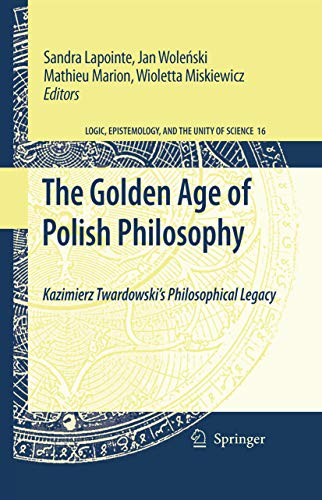
Ebook Info
- Published: 2009
- Number of pages: 264 pages
- Format: PDF
- File Size: 1.86 MB
- Authors: Sandra Lapointe
Description
Jan Wolenski ´ and Sandra Lapointe Polish philosophy goes back to the 13th century, when Witelo, famous for his works in optics and the metaphysics of light, lived and worked in Silesia. Yet, Poland’s academic life only really began after the University of Cracow was founded in 1364 – its development was interrupted by the sudden death of King Kazimierz III, but it was re-established in 1400. The main currents of classical scholastic thought like Thomism, Scottism or Ockhamism had been late – about a century – to come to Poland and they had a considerable impact on the budding Polish philosophical scene. The controversy between the via antiqua and the via moderna was hotly 1 debated. Intellectuals deliberated on the issues of concilliarism (whether the C- mon Council has priority over the Pope) and curialism (whether the Bishop of Rome has priority over the Common Council). On the whole, the situation had at least two remarkable features. Firstly, Polish philosophy was pluralistic, and remained so, since its very beginning. But it was also eclectic, which might explain why it aimed to a large extent at achieving a compromise between rival views. Secondly, given the shortcomings of the political system of the time as well as external pr- sure by an increasingly hegemonic Germany, thinkers were very much interested in political matters. Poland was a stronghold of political thought (mostly inclined towards concilliarism) and Polish political thought distinguished itself in Europe J.
User’s Reviews
Reviews from Amazon users which were colected at the time this book was published on the website:
⭐The authors cite the 1956 first edition of Alfred Tarski’s LOGIC, SEMANTICS, METAMATHEMATICS that has been out-of-print for nearly fifty years and that contains hundreds of errors since corrected by Tarski in the second edition.Tarski, A. 1956/1983. LOGIC, SEMANTICS, METAMATHEMATICS, second edition revised and corrected by Tarski with new introduction and new analytic index by J. Corcoran, Hackett Publishing Company, Indianapolis (1983). Originally published by Oxford: Oxford University Press, 1956. MR85e:01065. This book contains the complete English translation of the famous truth-definition paper “Der Wahrheitsbegriff” (The Concept of Truth in Formalized Languages).
Keywords
Free Download The Golden Age of Polish Philosophy: Kazimierz Twardowski’s Philosophical Legacy (Logic, Epistemology, and the Unity of Science Book 16) 2009th Edition in PDF format
The Golden Age of Polish Philosophy: Kazimierz Twardowski’s Philosophical Legacy (Logic, Epistemology, and the Unity of Science Book 16) 2009th Edition PDF Free Download
Download The Golden Age of Polish Philosophy: Kazimierz Twardowski’s Philosophical Legacy (Logic, Epistemology, and the Unity of Science Book 16) 2009th Edition 2009 PDF Free
The Golden Age of Polish Philosophy: Kazimierz Twardowski’s Philosophical Legacy (Logic, Epistemology, and the Unity of Science Book 16) 2009th Edition 2009 PDF Free Download
Download The Golden Age of Polish Philosophy: Kazimierz Twardowski’s Philosophical Legacy (Logic, Epistemology, and the Unity of Science Book 16) 2009th Edition PDF
Free Download Ebook The Golden Age of Polish Philosophy: Kazimierz Twardowski’s Philosophical Legacy (Logic, Epistemology, and the Unity of Science Book 16) 2009th Edition