

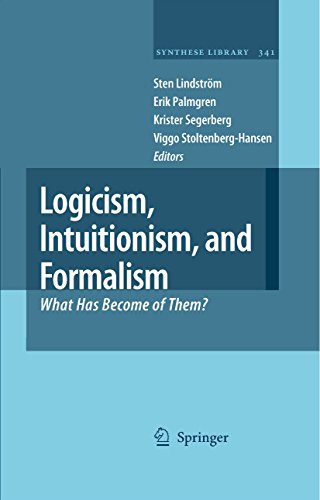
Ebook Info
- Published: 2009
- Number of pages: 524 pages
- Format: PDF
- File Size: 4.90 MB
- Authors: Sten Lindström
Description
The period in the foundations of mathematics that started in 1879 with the publication of Frege’s Begriffsschrift and ended in 1931 with Gödel’s Über formal unentscheidbare Sätze der Principia Mathematica und verwandter Systeme I can reasonably be called the classical period. It saw the development of three major foundational programmes: the logicism of Frege, Russell and Whitehead, the intuitionism of Brouwer, and Hilbert’s formalist and proof-theoretic programme. In this period, there were also lively exchanges between the various schools culminating in the famous Hilbert-Brouwer controversy in the 1920s.The purpose of this anthology is to review the programmes in the foundations of mathematics from the classical period and to assess their possible relevance for contemporary philosophy of mathematics. What can we say, in retrospect, about the various foundational programmes of the classical period and the disputes that took place between them? To what extent do the classical programmes of logicism, intuitionism and formalism represent options that are still alive today? These questions are addressed in this volume by leading mathematical logicians and philosophers of mathematics.A special section is concerned with constructive mathematics and its foundations. This active branch of mathematics is a direct legacy of Brouwer’s intutionism. Today one often views it more abstractly as mathematics based on intuitionistic logic. It can then be regarded as a generalisation of classical mathematics in that it may be given, firstly, the standard set-theoretic interpretation, secondly, algorithmic meaning, and thirdly, nonstandard interpretations in terms of variable sets (sheaves over topological spaces).The volume will be of interest primarily to researchers and graduate students of philosophy, logic, mathematics and theoretical computer science. The material will be accessible to specialists in these areas and to advanced graduate students in the respective fields.
User’s Reviews
Reviews from Amazon users which were colected at the time this book was published on the website:
⭐Benis Sinacuer cites the 1956 first edition of Alfred Tarski’s LOGIC, SEMANTICS, METAMATHEMATICS that has been out-of-print for nearly fifty years and that contains hundreds of errors since corrected by Tarski in the second edition.Tarski, A. 1956/1983. LOGIC, SEMANTICS, METAMATHEMATICS, second edition revised and corrected by Tarski with new introduction and new analytic index by J. Corcoran, Hackett Publishing Company, Indianapolis (1983). Originally published by Oxford: Oxford University Press, 1956. MR85e:01065.
⭐
Keywords
Free Download Logicism, Intuitionism, and Formalism: What Has Become of Them? (Synthese Library Book 341) 2009th Edition in PDF format
Logicism, Intuitionism, and Formalism: What Has Become of Them? (Synthese Library Book 341) 2009th Edition PDF Free Download
Download Logicism, Intuitionism, and Formalism: What Has Become of Them? (Synthese Library Book 341) 2009th Edition 2009 PDF Free
Logicism, Intuitionism, and Formalism: What Has Become of Them? (Synthese Library Book 341) 2009th Edition 2009 PDF Free Download
Download Logicism, Intuitionism, and Formalism: What Has Become of Them? (Synthese Library Book 341) 2009th Edition PDF
Free Download Ebook Logicism, Intuitionism, and Formalism: What Has Become of Them? (Synthese Library Book 341) 2009th Edition