Ebook Info
- Published: 2010
- Number of pages: 865 pages
- Format: PDF
- File Size: 6.37 MB
- Authors: Hegel
Description
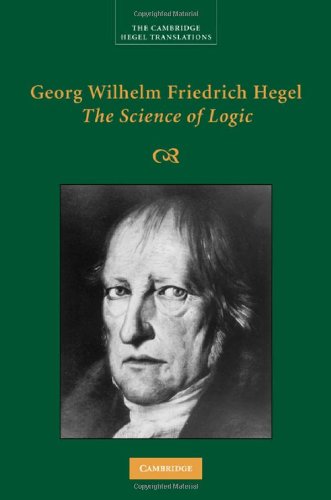
This translation of The Science of Logic (also known as ‘Greater Logic’) includes the revised Book I (1832), Book II (1813) and Book III (1816). Recent research has given us a detailed picture of the process that led Hegel to his final conception of the System and of the place of the Logic within it. We now understand how and why Hegel distanced himself from Schelling, how radical this break with his early mentor was, and to what extent it entailed a return (but with a difference) to Fichte and Kant. In the introduction to the volume, George Di Giovanni presents in synoptic form the results of recent scholarship on the subject, and, while recognizing the fault lines in Hegel’s System that allow opposite interpretations, argues that the Logic marks the end of classical metaphysics. The translation is accompanied by a full apparatus of historical and explanatory notes.
User’s Reviews
Reviews from Amazon users which were colected at the time this book was published on the website:
⭐Hegel’s Logic is the center of his philosophy, and decisive for western philosophy. To say it “marks the end of classical metaphysics” is obvious. Kant claimed to put metaphysics on the path of science, and even Hegel talks that way in the preface to the Logic — but it stops there. Marx and Mach and Freud all declare philosophy/metaphysics is done for in favor of some sense of science. Hegel’s role in provoking Kierkegaard is well known, and I agree with those who say Kierkegaaard deeply understood Hegel’s logic or ‘dialectic.’ Mach’s heirs the logical positivists specify that philosophy is to be replaced by the science of logic — not the same logic as Hegel of course, but also not the same as we call mathematical logic today.Di Giovanni’s introduction argues very well that Hegel read Kant as displacing (if not replacing) metaphysics by logic (formal and transcendental), especially logicized ontology, and Hegel completed that. I will resist the urge to offer my summary and just say di Giovanni’s argument on Kant, Fichte, and Schelling is clear, well documented, persuasive, and illuminates Hegel’s logic. Some years ago I read the Miller translation of the Science of Logic, along with much else by Hegel and on him, and have never lost the interest — but di Giovanni’s introduction gave me a much deeper sense of this book, and continues to enrich my re-reading of it.The translation itself is probably clearer and more readable than Miller’s, but translation is not so important for Hegel as commentary. That is, Hegel himself knew what any German reader knows, that Hegel’s word choices are far less illuminating than his arguments and his use of earlier philosophers. He often explains his own word choices, because he knows the words do not speak for themselves. It is hopeless to explain Hegel’s use of, say, Bestimmtheit, by knowing what it means in ordinary German, and correspondingly a poor idea to look for a word that means the same thing in ordinary English. It is very helpful to know what Kant and Fichte and/or Schelling and/or Schiller meant by various terms Hegel uses, and di Giovanni is very good on that.Hegel translators try too hard to choose words that will explain Hegel’s meaning by themselves. They do this at the expense of losing most or all of Hegel’s wordplays, including ones that Hegel himelf comments on when he discusses his choice of words, and they produce a slower more labored language than Hegel wrote. (Okay, I have not read all Hegel translators. I have read Baillie, Kauffman, Miller, Wallace, Behler, di Giovanni, and Pinkard.) Hegel’s German is brisker, wittier, and more challenging than the translations, and puts more burden on the reader to work out the meaning.The important thing in deciding whether to get this book, is that the explanations of Hegel’s terminology in this book are far better than Miller could give, benefitting from decades of valuable Hegel scholarship. That is more important than choosing translations for the words.
⭐I’ve read the AV Miller translation of the Phenomenology three times now. The critical commentary of this translation–especially Pinkard– kept me away from his translation of the Logic. Di Giovanna’s (see, that means “from Giovanna”) introduction is a refreshing take on themes you’ve read from the Logic for years. To get into the book, I started with Houlgate’s commentary that helped make the first 2/27th comprehensible. The problem is that’s where Houlgate’s commentary ends so I’m waiting for him to finish his commentary on the other 25/27th of the Logic. I’ve also listened to Winfield’s lecture’s on the Logic and am impressed that other people can make sense of it. Book I is easy enough until you get to infinity. There are some parts of the Book II that make some sense, but I don’t understand what Hegel was doing in the Doctrine of the Notion.I prefer the Cambridge editions when I have a choice with these less-read philosophy texts. The translation is welcome–and you’ll appreciate Di Giovanna’s notes–but Hegel’s thoughts behind it are obscure. It does make one wonder why the Logic in the first place. After years of amateur Hegel reading I wonder if there is a bottom to him. If you suffer from the same condition, this book is essential to your library. I’ve heard the binding is trouble on the AVM translation. This lovely paperback is robust–concrete. It will sit half read, binding intact, and mostly opaque on your shelf for years to come.
⭐Insightful book. I have used quotations from here.
⭐An important book for understanding the science of Hegel’s logic. In the literature the translation of Dr. Giovanni into English is considered one of the best, I am very satisfied with the product purchased
⭐I bought this for my son who is in graduate school. I have no idea of its value and have zero interest in reading it.
⭐Great translation of a very difficult book. Well packaged as a paperback, considering its length, by Cambridge University Press.
⭐Hegel’s work and Di Giovanni’s translation thereof are excellent. My negative review has to do rather with the trash binding Cambridge has elected to put this great content out in.Once upon a time, when you ordered a hardcover academic book, this meant you were getting a sturdy, signature-bound volume that would sustain years of wear and tear from being laid flat, underlined, noted, &c. It meant you were paying double or triple the paperback price in order to get something whose quality justified the price. Some publishers like Harvard University Press still put out good signature-bound hardcovers—not Cambridge, however. For this book, you will pay around $200 for a piece of glue-bound, image-wrapped crap that is of no better quality than a high school textbook—a paperback with cardboard wrapped around it.Get the paperback. It will be the same quality and 1/3rd the price.
⭐An important work for a transition into mature Hegelian philosophy.
⭐Excellent !
⭐The book arrived with a defect (see photo) which looks like misregistration but it is only black ink so I don’t know why there would be two impressions. I sent it back and Amazon sent a replacement but the replacement has the same defect so it must be throughout the print run. Every sixth page has this double print which has the effect of vibration. Too irritating for a book of this depth and length. Will be returning it and will have to purchase a different translation since the hardcover print is three times the price. Unfortunate because this is the best translation.
⭐I paid CDN$ 71.95 and get a book with a broken spine. It’s a Xmas gift so no time to return. Not good. I guess it’s off to a local book store now…..
⭐great book
Keywords
Free Download Georg Wilhelm Friedrich Hegel: The Science of Logic (Cambridge Hegel Translations) in PDF format
Georg Wilhelm Friedrich Hegel: The Science of Logic (Cambridge Hegel Translations) PDF Free Download
Download Georg Wilhelm Friedrich Hegel: The Science of Logic (Cambridge Hegel Translations) 2010 PDF Free
Georg Wilhelm Friedrich Hegel: The Science of Logic (Cambridge Hegel Translations) 2010 PDF Free Download
Download Georg Wilhelm Friedrich Hegel: The Science of Logic (Cambridge Hegel Translations) PDF
Free Download Ebook Georg Wilhelm Friedrich Hegel: The Science of Logic (Cambridge Hegel Translations)