

Ebook Info
- Published: 2092
- Number of pages: 334 pages
- Format: PDF
- File Size: 43.12 MB
- Authors: Michael Baur
Description
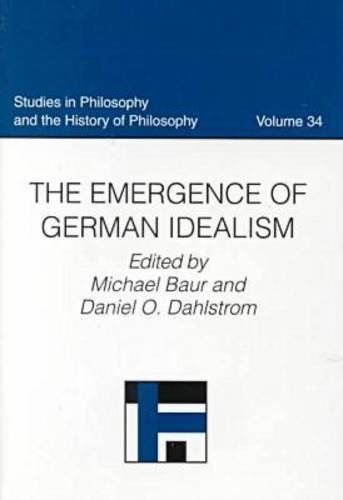
Immanuel Kant’s “critical philosophy” is rightly renowned for its criticism of the metaphysical pretensions of reason unaided by experience. It therefore seems ironic that, within a single generation, some of Kant’s most important followers argued that the critical philosophy could be made fully critical only by recourse to the very metaphysical themes that Kant had apparently criticized. The story of the emergence of German Idealism (from its beginnings in Kant to its apparent consummation in Hegel) has never been fully told. The story is full of tensions, contradictions, and reversals, all of which seemingly conspire to render a meaningful and unified account impossible.While defying any simple or simplistic explanation, the various and sometimes conflicting impulses that led to the emergence of German Idealism together constitute an intelligible and rich line of development. In this volume, an international group of leading scholars shows how the various aspirations at work in the emergence of German Idealism―moral, religious, aesthetic, political, and epistemological―can be understood as both consummating and overcoming Kant’s critical philosophy. The volume also includes a chronology of the major works in the development of German Idealism, as well as a new translation of the seminal and still-controversial essay, “The Earliest System Programme of German Idealism.” ABOUT THE EDITORS:Michael Baur is assistant professor of philosophy at Fordham University. Daniel O. Dahlstrom is professor of philosophy at Boston University.PRAISE FOR THE BOOK:”The historically brief, but complex logical bridge linking Kant and Hegel, which joins that known as ‘pre-Kantianism’ to ‘modernism,’ has often been traced. In this volume, a number of well-known scholars have focused upon various aspects of this philosophic bridge. These perceptive studies serve not only to illustrate the importance of that bridge, but to clarify the meaning of the now popular, yet still obscure term, ‘modernism.'”―Lawrence S. Stepelevich, Past President, The Hegel Society of America
User’s Reviews
Editorial Reviews: Review “The historically brief, but complex logical bridge linking Kant and Hegel, which joins that known as ‘pre-Kantianism’ to ‘modernism,’ has often been traced. In this volume, a number of well-known scholars have focused upon various aspects of this philosophic bridge. These perceptive studies serve not only to illustrate the importance of that bridge, but to clarify the meaning of the now popular, yet still obscure term, ‘modernism.'” — -Lawrence S. Stepelevich, Past President, The Hegel Society of America About the Author Michael Baur is assistant professor of philosophy at Fordham University. Daniel O. Dahlstrom is professor of philosophy at Boston University.
Reviews from Amazon users which were colected at the time this book was published on the website:
⭐
⭐
Keywords
Free Download The Emergence of German Idealism (Studies in Philosophy and the History of Philosophy) in PDF format
The Emergence of German Idealism (Studies in Philosophy and the History of Philosophy) PDF Free Download
Download The Emergence of German Idealism (Studies in Philosophy and the History of Philosophy) 2092 PDF Free
The Emergence of German Idealism (Studies in Philosophy and the History of Philosophy) 2092 PDF Free Download
Download The Emergence of German Idealism (Studies in Philosophy and the History of Philosophy) PDF
Free Download Ebook The Emergence of German Idealism (Studies in Philosophy and the History of Philosophy)