Ebook Info
- Published: 1995
- Number of pages: 296 pages
- Format: PDF
- File Size: 1.76 MB
- Authors: John Lachs
Description
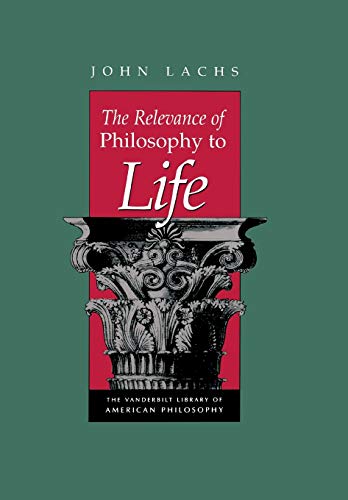
With The Relevance of Philosophy to Life, eminent American philosopher John Lachs reminds us that philosophy is not merely a remote subject of academic research and discourse, but an ever-changing field which can help us navigate through some of the chaos of late twentieth-century living. It provides a clear-eyed look at important philosophical issues–the primacy of values, rationality and irrationality, society and its discontents, life and death, and the traits of human nature–as related to the human condition in the modern world.
User’s Reviews
Product description From the Back Cover The primary purpose of philosophy is to help us better understand the critical issues in life. Sadly, in this modern world we often relegate philosophy to the ivory tower and to dusty tomes forgotten on the library shelf. With The Relevance of Philosophy to Life, eminent American philosopher John Lachs reminds us that philosophy is not merely a remote subject of academic research and discourse, but an ever-changing field which can help us navigate through some of the chaos of late twentieth-century living. Utilizing an American pragmatism grounded in the works of Dewey, James, and Santayana, Lachs insists on both the personal and the social significance of philosophy. Tackling controversial topics such as dogmatism, the relativity of values, resuscitation, euthanasia, the right to die, violence, education, technological advancement and dominance, and individual integrity in bureaucratic structures, Lachs argues that value is relative to human nature and that human nature is not one but many “human natures”. He sheds light on complicated issues in a way that informs the most sophisticated reader while also making the issues, his reasoning, and his solutions accessible to the general public. This important new book challenges readers to apply ethical principles and philosophical understanding more consistently in their own lives. It will be a timely addition to the libraries and reading lists of many professionals, students, and individuals seeking a fuller appreciation of philosophy’s relevance to our own times. About the Author John Lachs is Centennial Professor of Philosophy at Vanderbilt University. He is the author of several books, including I n Love with Life , published by Vanderbilt University Press.
Reviews from Amazon users which were colected at the time this book was published on the website:
⭐John Lachs is a rare breed. That is to say he is a philosopher who isn’t much for the trend of current philosophy to use big words while saying nothing important. Of course, most philosophers say they are not for this, but their writing suggests their tacit endorsement of the trend. Lachs, on the other hand, is not only erudite and refreshingly enjoyable, but he also writes about real problems in the real world in real contexts. At last: a book that can keep both the philosopher and the non-philosopher fortified.This book is a somewhat loose collection of essays about such topics as moral relativism (which Lachs unabashedly admits that he is for), the right to die, the myth of a unified and singular human nature, technology, and…(suprise suprise… the relevance of philosophy to life.Lachs comes from a quite pragmatic tradition and while there are more index cites of Dewey, he is to my eyes more at home with James. One of the big ideas in the book, in fact, is the existence of choice inclusive facts. Take the term ‘human nature’ (which is said to mean one definite thing – our essence). There are seemingly infinite traits we have, but when we are deciding what is and is not human nature, we CHOOSE which traits to emphasize and which not to. What’s more, it is doubtful that EVERYONE who is human has ALL of our suggested traits (and animals might even have some of them). Does that mean ‘human nature’ is a social construct? No. It simply means that while the laundrey list of traits we can choose from is objective and really existing, the traits we choose to recognize as part of its description is based on human convention. This is straight out of the James playbook (as James, like Lachs, was a non-essentialist who saw ‘essentials’ as simply those traits of a thing we pay attention to out of the many the thing has).This is a big idea and thrusts much of his book. When talking of morals, one of the biggest thrust of moral objectivism has been that morals are what accord with ‘human nature’ (natural law). But being that our natures are plural (we vary a great deal from eachother), there can’t be any ‘one’ human nature. When talking about the right to die, this idea also serves as a spring-board.All of the essays are worth reading. Aside from the idea above there are many meaty ones in here and as the book touches so many subjects, the reader will not be bored. The only other thing I feel needs saying about Lachs is that he is simply one of the best essay writers in philosophy that I’ve read. From the first paragraph (which is usually some intriguing hook – the technique of a novelist) to the last sentence, these essays are quie satisfying.
⭐John Lachs is a rare breed. That is to say he is a philosopher who isn’t much for the trend of current philosophy to use big words while saying nothing important. Of course, most philosophers say they are not for this, but their writing suggests their tacit endorsement of the trend. Lachs, on the other hand, is not only erudite and refreshingly enjoyable, but he also writes about real problems in the real world in real contexts. At last: a book that can keep both the philosopher and the non-philosopher fortified.This book is a somewhat loose collection of essays about such topics as moral relativism (which Lachs unabashedly admits that he is for), the right to die, the myth of a unified and singular human nature, technology, and…(suprise suprise… the relevance of philosophy to life.Lachs comes from a quite pragmatic tradition and while there are more index cites of Dewey, he is to my eyes more at home with James. One of the big ideas in the book, in fact, is the existence of choice inclusive facts. Take the term ‘human nature’ (which is said to mean one definite thing – our essence). There are seemingly infinite traits we have, but when we are deciding what is and is not human nature, we CHOOSE which traits to emphasize and which not to. What’s more, it is doubtful that EVERYONE who is human has ALL of our suggested traits (and animals might even have some of them). Does that mean ‘human nature’ is a social construct? No. It simply means that while the laundrey list of traits we can choose from is objective and really existing, the traits we choose to recognize as part of its description is based on human convention. This is straight out of the James playbook (as James, like Lachs, was a non-essentialist who saw ‘essentials’ as simply those traits of a thing we pay attention to out of the many the thing has).This is a big idea and thrusts much of his book. When talking of morals, one of the biggest thrust of moral objectivism has been that morals are what accord with ‘human nature’ (natural law). But being that our natures are plural (we vary a great deal from eachother), there can’t be any ‘one’ human nature. When talking about the right to die, this idea also serves as a spring-board.All of the essays are worth reading. Aside from the idea above there are many meaty ones in here and as the book touches so many subjects, the reader will not be bored. The only other thing I feel needs saying about Lachs is that he is simply one of the best essay writers in philosophy that I’ve read. From the first paragraph (which is usually some intriguing hook – the technique of a novelist) to the last sentence, these essays are quie satisfying.
⭐
Keywords
Free Download The Relevance of Philosophy to Life in PDF format
The Relevance of Philosophy to Life PDF Free Download
Download The Relevance of Philosophy to Life 1995 PDF Free
The Relevance of Philosophy to Life 1995 PDF Free Download
Download The Relevance of Philosophy to Life PDF
Free Download Ebook The Relevance of Philosophy to Life