Ebook Info
- Published: 2006
- Number of pages: 168 pages
- Format: PDF
- File Size: 6.57 MB
- Authors: John W. Burbidge
Description
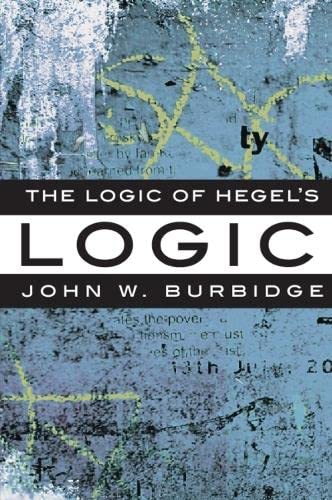
George Wilhelm Friedrich Hegel has seldom been considered a major figure in the history of logic. His two texts on logic, both called The Science of Logic, both written in Hegel’s characteristically dense and obscure language, are often considered more as works of metaphysics than logic. But in this highly readable book, John Burbidge sets out to reclaim Hegel’s Science of Logic as logic and to get right at the heart of Hegel’s thought. Burbidge examines the way Hegel moves from concept to concept through every chapter of his work, and traces the origins of Hegel’s effort to “think through the way thought thinks” to Plato, Kant, and Fichte. Having established the framework of Hegel’s logical thought, Burbidge demonstrates how Hegel organized the rest of his system, including the Philosophy of Nature, Philosophy of Spirit and his Lectures on World History, Art, Religion and Philosophy. A final section discusses English-language interpretations of Hegel’s logic from the nineteenth through twentieth centuries. Burbidge’s The Logic of Hegel’s ‘Logic’ is written with an eye to the reader of general interests, avoiding as much as possible the use of Hegel’s technical vocabulary. It is an excellent introduction to an otherwise very difficult text, and has recently appeared in an Iranian translation.
User’s Reviews
Editorial Reviews: Review “The Logic of Hegel’s ‘Logic’ is a compact, readable and largely non-technical introduction to Hegel’s logic. It will come as a pleasant surprise to readers who think that logic is precisely what Hegel’s systematic thinking lacks, or that, if it exists at all, it is a logic that lies trapped in the obscurity of Hegel’s writing. In correcting these misconceptions, John Burbidge has made a welcome contribution to our understanding of Hegel’s philosophy, and to the history of logic as well.” ― John Woods, University of British Columbia “John Burbidge has accomplished something quite incredible with this book: he has digested both the core and the details of Hegel’s Science of Logic (one of the most difficult texts to understand within the entirety of our philosophical heritage), and presented them to the reader powerfully, concisely and in simple prose, while at the same time not sacrificing accuracy. This is a feat almost without parallel in literature on Hegel. Burbidge’s Logic of Hegel’s ‘Logic’ is an excellent and extremely valuable book that I believe is capable of revolutionizing scholarly interpretations of Hegel’s philosophy.” ― John Russon, University of Guelph From the Back Cover George Wilhelm Friedrich Hegel has seldom been considered a major figure in the history of logic. His two texts on logic, both called The Science of Logic, both written in Hegel’s characteristically dense and obscure language, are often considered more as works of metaphysics than logic. But in this highly readable book, John Burbidge sets out to reclaim Hegel’s Science of Logic as logic and to get right at the heart of Hegel’s thought. Burbidge examines the way Hegel moves from concept to concept through every chapter of his work, and traces the origins of Hegel’s effort to “think through the way thought thinks” to Plato, Kant, and Fichte. Having established the framework of Hegel’s logical thought, Burbidge demonstrates how Hegel organized the rest of his system, including the Philosophy of Nature, Philosophy of Spirit and his Lectures on World History, Art, Religion and Philosophy. A final section discusses English-language interpretations of Hegel’s logic from the nineteenth through twentieth centuries. Burbidge’s The Logic of Hegel’s ‘Logic’ is written with an eye to the reader of general interests, avoiding as much as possible the use of Hegel’s technical vocabulary. It is an excellent introduction to an otherwise very difficult text, and has recently appeared in an Iranian translation. About the Author John W. Burbidge is Professor Emeritus of Philosophy, Trent University. His other books include Hegel on Logic and Religion (SUNY Press, 1992) and Hegel in His Time (Broadview Press, 1987). Read more
Reviews from Amazon users which were colected at the time this book was published on the website:
⭐John Burbidge has written not only the most accessible and compelling short introduction to Hegel’s logic, but also one of the best introductions to Hegel as a systematic thinker. Perhaps his most remarkable feat is to have found a way to write about the subject matter of the logic that addresses a number of concerns about Hegel but without getting bogged down in either apology or disputation.His basic insight is that the subject matter of the book is thinking as it attends to the process of thinking. What it discovers is that the process of thinking always consists of the dynamic of an immediate positing, challenged by an opposition that is then discovered to be essential to the positing, calling for a new position in which these differences are reconciled. This simple formulation already suggests a response to the idea that Hegel’s thinking is a closed system, inattentive to progress in science or real historical change — the challenge itself instantiates the kind of opposition that will call for a new reconciliation.Burbidge’s admirably concise and clear account of the details of this process at work — especially in his exceptionally strong sections on concepts, judgments and syllogisms — show that his approach has much to say to contemporary philosophy of logic. Moreover, while the emphasis on thought thinking itself clearly ties the logic to traditional conceptions of God and metaphysics, Burbidge’s emphasis on thinking’s dynamism and on the inescapability of difference and disruption shows that the logic can speak to some of the so-called postmodern challenges to traditional metaphysics. The effect of the book is to show, concisely and in readable English, not only that the project of Hegelian logic makes a great deal of sense, but that it is a living and still vital approach to the nature of thinking and of metaphysics that is able to achieve a kind of closure while still being open to revision and remaining attuned to the dynamism of the natural and social world.It would make an ideal companion text for courses on Hegel’s logic or even on Hegel’s philosophy generally. I definitely plan to use it next time I teach Hegel. It would also be a very good introduction for someone with some background in philosophy (at the graduate or advanced undergraduate level) who is interested in reading Hegel on their own, but has been intimidated by the difficulty of his works.
⭐
Keywords
Free Download The Logic of Hegel’s ‘Logic’: An Introduction 0th Edition in PDF format
The Logic of Hegel’s ‘Logic’: An Introduction 0th Edition PDF Free Download
Download The Logic of Hegel’s ‘Logic’: An Introduction 0th Edition 2006 PDF Free
The Logic of Hegel’s ‘Logic’: An Introduction 0th Edition 2006 PDF Free Download
Download The Logic of Hegel’s ‘Logic’: An Introduction 0th Edition PDF
Free Download Ebook The Logic of Hegel’s ‘Logic’: An Introduction 0th Edition