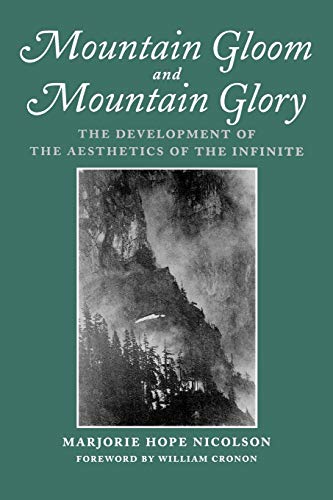
Ebook Info
- Published: 1997
- Number of pages: 432 pages
- Format: PDF
- File Size: 18.07 MB
- Authors: Marjorie Hope Nicolson
Description
To English poets and writers of the seventeenth century, as to their predecessors, mountains were ugly protuberances which disfigured nature and threatened the symmetry of earth; they were symbols God’s wrath. Yet, less than two centuries later the romantic poets sang in praise of mountain splendor, of glorious heights that stirred their souls to divine ecstasy. In this very readable and fascinating study, Marjorie Hope Nicolson considers the intellectual renaissance at the close of the seventeenth century that caused the shift from mountain gloom to mountain glory. She examines various writers from the seventeenth, eighteenth, and nineteenth centuries and traces both the causes and the process of this drastic change in perception.
User’s Reviews
Editorial Reviews: Amazon.com Review When we look at a majestic scene in nature, it is hard to believe that our appreciation of its beauty would have been completely foreign to an observer four centuries ago. In Mountain Gloom and Mountain Glory, Marjorie Hope Nicolson argues that the rise of an aesthetic appreciation of nature’s grandeur in English writing did not originate with exposure to Italian landscape painting, Orientalism, or the concept of the sublime in art, as have been postulated. Rather, Nicolson demonstrates a direct line of sentiment from Henry More, to Thomas Burnet, John Dennis, Anthony Shaftesbury, and Joseph Addison, and then to the Romantics, in which modern concepts such as infinity and regularity gradually develop into an acceptance of the magnificence of nature as a reflection of God. Originally published in 1959, this book’s reprinting demonstrates the importance of its standing in the history of aesthetic ecological thought. Review “Mountain Gloom and Mountain Glory has long been recognized by landscape historians and nature writers as a dazzling work of cultural history: fresh and original in its argument and acute in its critical intelligence. But it is also a wonderful adventure in reading, an exhilarating hike through the peaks and valleys of western modern sensibility.”―Simon Schama, author of Landscape and Memory”Mountain Gloom and Mountain Glory is a unique work of cultural history. I know of no book that provides a comparably lucid, well―documented, compelling demonstration of the far―reaching cultural consequences of changes in scientific conceptions of the universe. . . Nicolson demonstrates the power of abstract scientific thought to alter ideas, feelings, and, indeed, the very texture of human experience.”―Leo Marx, author of The Machine in the Garden: Technology and the Pastoral Ideal in America”This seminal work on nature and the sublime will remain a classic and a source of inspiration for generations to come.”―Barbara Novak, author of Nature and Culture: American Landscape and Painting, 1825–1875 From the Back Cover To English poets and writers of the seventeenth century, as to their predecessors, mountains were ugly protuberances which disfigured nature and threatened the symmetry of earth; they were symbols of God’s wrath. Yet, less than two centuries later the romantic poets sang in praise of mountain splendor, of glorious heights that stirred their souls to divine ecstasy. In this very readable and fascinating study, Marjorie Hope Nicolson considers the intellectual renaissance at the close of the seventeenth century that caused the shift from mountain gloom to mountain glory. She examines various writers from the seventeenth, eighteenth, and nineteenth centuries and traces both the causes and the process of this drastic change in perception. Read more
Reviews from Amazon users which were colected at the time this book was published on the website:
⭐I paint images of wild places where I have been. To me, they are the most beautiful and uplifting sights I have ever seen. However, visitors to my studio ofter appear ill at ease or uncomfortable in the presence of these paintings. I wanted to know why. I saw this title and bought it and read it to answer the question.This book really explained the basis and history of the common man’s feelings when confronted by mountains. Opinions and attitudes at different times in history are defined and put into the context of contemporary religious, philosophical and literary teaching. The extensive footnotes led me to other sources as well.From this, I gathered that it is the very infinity of the spaces and the feeling of helplessness that man feels in their presence that creates the Mountain Gloom and the same sublime infinity that is deemed aesthetic that creates the Mountain Glory. However, I could be misinterpreting the author. I still don’t understand my visitors’ reactions to my images, unfortunately, but I now have more clues.Beautifully documented and lush with illustrative poetry, a scholarly book to read and reread. I wish it had some visual images however.
⭐Over the past 40 years I have returned to this work again and again. I have lectured on it and referred a lifetime of students to it. To learn that there were peoples who saw mountains as hideous scars marring the face of the sacred never failed to inspire reflection upon the too easily digested metaphor.
⭐This book is my favorite book. I remember the first time that I read it. I would have to get up from my desk, walk around my apartment, and digest what I was reading. It was so exciting.Nicolson brings together Theology, History of Science and Geology, and Aesthetics in such a beautiful way. She describes what was an important change in western thinking about nature that occured at the end of the seventeenth century.Ignore, William Cranon’s introduction that ties Nicolson’s work to today’s ecocriticism. But find and read other works that study nature and culture; Clarance Glacken’s Traces on the Rhodian Shore (1967), Arthur O. Lovejoy’s The Great Chain of Being (1936), and Leo Marx’s The Machine in the Garden (1964).
⭐Die Ästhetik des Naturerlebnisses von Edmund Burke verbreitet sich im 18. Jahrhundert ebenso wie der Tourismus der Engländer. Auf seiner Grand Tour sucht der englische Reisende auf dem Rhein, in den Alpen und in Italien die Kategorien von Sublime & Beautiful und dem Pittoresken zu finden. Das Erlebnis der Landschaft wird ästhetisch normiert, am Ende dieser Entwicklung steht der Baedeker und die Ansichtskarte von der schönen Natur. Die Umwertung der Landschaft (im 17. Jahrhundert hatten Berge noch nichts Majestätisches, sondern wurden als Warzen auf dem Angesicht der Erde betrachtet) im 18. Jahrhundert ist eine der interessantesten Bewegungen der europäischen Ästhetik und Kulturgeschichte. Sowohl in der Landschaftsmalerei als auch in der Literatur. Es gibt zu diesem Thema inzwischen Literatur, die man in Metern messen kann. Aber alle Studien beziehen sich auf zwei Bücher, auf Elizabeth Wheeler Manwarings Buch aus dem Jahre 1925 und auf Marjorie Hope Nicolsons “Mountain Gloom and Mountain Glory” aus dem Jahre 1959. 400 Seiten voller Bildung, immens gut zu lesen. Wenn wir unser Verhältnis zur Natur verstehen wollen (und das gilt auch für die neue Richtung des “ecocriticism”) kommen wir an diesem Buch nicht vorbei. Auch Simon Schama in seinem großartigen “Landscape and Memory” gibt das unumwunden zu. Dank der Weyerhaeuser Foundation ist das Buch, das lange vergriffen war, seit zehn Jahren wieder erhältlich.excelente
⭐Fascinating!
⭐In mid 17th century England, mountains were denigrated as ‘deformities’, ‘warts’, ‘boils’, ‘monstrous excresences’, ‘the rubbish of the earth’, or even ‘Nature’s pudenda’. But within a century they had become the objects of the highest aesthetic admiration among literary men. Mountain Gloom had been replaced by Mountain Glory. Marjorie Hope Nicolson’s study, first published in 1959, surveys the treatment of mountain scenery in English literature and attempts to explain this reversal in attitude.It has been an influential work. Her general thesis, and many of her examples, have been recycled in later cultural histories such as Simon Schama’s Landscape and Memory and Robert Macfarlane’s Mountains of the Mind.I enjoyed the chapter documenting the often negative attitudes towards mountain scenery up to the seventeenth century, and the account of the theological problem this created (how could such ugly objects be part of God’s plan?). I also enjoyed the account of the correspondence in which Thomson offers his fellow poet Mallet advice (‘Here, if you could insert a sketch of the Deluge, what more affecting and noble?’).Yet I found myself getting increasingly frustrated by Nicolson. Her worst failing is indulgence in high flown but windy and vague rhetoric:”We have found the beginning of ‘The Aesthetics of the Infinite’. In a vastly expanded universe, men like Henry More discovered new powers in the human soul, new expansion of the imagination. Into an infinite universe, they read qualities of the Infinite who had created it, and in themselves, made in the image of the Creator, they found capacities they had not known before”There is a pervasive lack of clarity and precision. She is also addicted to the lengthy digression, commenting (usually quite inconclusively) on many scholarly debates of marginal relevance. She remarks that the author John Dennis was dubbed “Sir Tremendous Longinus”. As I struggled through the last hundred pages of Nicolson’s book, the phrase was often in my mind.Her speculations provoked an impulse to Kingsley Amis style graffiti in the margin:”Perhaps the experience of eighteenth century Englishmen was in some ways like that of C.S. Lewis’ Ransom in Out of the Silent Planet”. OR PERHAPS IT WASN’T.”Perhaps the same unconscious presupposition may have lingered in Chaucer’s mind when in the Franklin’s Tale he added to the soliloquy of Donigen theological details which sound strange upon the lips of the ‘wyf That loveth hir Housbounde as hire hertes lyf'”. OR PERHAPS IT MAY NOT HAVE.”It is amusing to consider what might have happened in the development of neoclassical landscape poetry if the young Pope had been physically able to follow the advice of George Berkeley, who urged him to travel to the continent ‘in order to store his mind with strong Images of Nature'” NO IT’S NOT.As to her explanation of the change in attitude towards mountains, the most questionable aspect is that she considers only the impact of previous literature. The idea that the change might have been in part due to improved travelling conditions is dismissed on insufficient evidence; other possible explanations such as the industrial revolution and consequent urbanisation (making wild unspoilt country seem more attractive) are not even considered.Even if one restricts attention to literary explanations for the change, there are curious blind spots. Rousseau’s novel Julie, with its Alpine setting, was deeply influential on the English Romantic poets, yet is not even mentioned.There is a strange inconsistency at the heart of her argument. On the one hand, she argues that a characteristic feature of the “Mountain Glory” poets of the eighteenth and nineteenth centuries is that they put aside literary models and looked at the mountains themselves. At the same time, she seeks literary models for their work.Another oddity is in relation to her treatment of Thomas Burnet. She argues that Burnet’s Sacred Theory of the Earth was influential in focussing the attention of educated men on geology and mountain scenery. Two chapters are devoted to Burnet and the controversies his work provoked. But then having done this, she seems to suggest that, at least for the Romantic poets, he was of marginal importance (‘except in the case of Coleridge, Burnet reminiscences among the Romantic poets are incidental’).There are good things in Mountain Gloom and Mountain Glory, but like Helvellyn in November, all too often the fog descends and you wonder if it’s worth the effort.
Keywords
Free Download Mountain Gloom and Mountain Glory: The Development of the Aesthetics of the Infinite (Weyerhaeuser Environmental Classics) in PDF format
Mountain Gloom and Mountain Glory: The Development of the Aesthetics of the Infinite (Weyerhaeuser Environmental Classics) PDF Free Download
Download Mountain Gloom and Mountain Glory: The Development of the Aesthetics of the Infinite (Weyerhaeuser Environmental Classics) 1997 PDF Free
Mountain Gloom and Mountain Glory: The Development of the Aesthetics of the Infinite (Weyerhaeuser Environmental Classics) 1997 PDF Free Download
Download Mountain Gloom and Mountain Glory: The Development of the Aesthetics of the Infinite (Weyerhaeuser Environmental Classics) PDF
Free Download Ebook Mountain Gloom and Mountain Glory: The Development of the Aesthetics of the Infinite (Weyerhaeuser Environmental Classics)