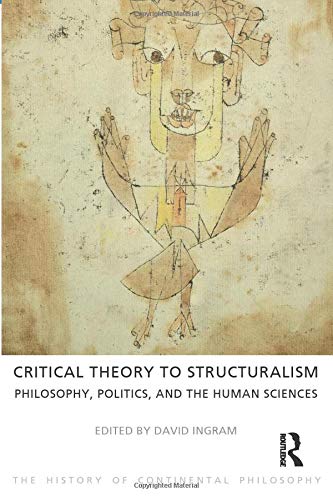
Ebook Info
- Published: 2013
- Number of pages: 360 pages
- Format: PDF
- File Size: 2.44 MB
- Authors: David Ingram
Description
Philosophy in the middle of the 20th Century, between 1920 and 1968, responded to the cataclysmic events of the time. Thinkers on the Right turned to authoritarian forms of nationalism in search of stable forms of collective identity, will, and purpose. Thinkers on the Left promoted egalitarian forms of humanism under the banner of international communism. Others saw these opposed tendencies as converging in the extinction of the individual and sought to retrieve the ideals of the Enlightenment in ways that critically acknowledged the contradictions of a liberal democracy racked by class, cultural, and racial conflict. Key figures and movements discussed in this volume include Schmitt, Adorno and the Frankfurt School, Arendt, Benjamin, Bataille, French Marxism, Black Existentialism, Saussure and Structuralism, Levi Strauss, Lacan and Late Pragmatism. These individuals and schools of thought responded to this ‘modernity crisis’ in different ways, but largely focused on what they perceived to be liberal democracy’s betrayal of its own rationalist ideals of freedom, equality, and fraternity.
User’s Reviews
Editorial Reviews: Review “Every one of the essays provides a clear and concise introduction to its subject. An invaluable work of reference and a most stimulating introduction to the way continental philosophy responded to the problems faced by liberal-capitalist societies in the early twentieth century.” –Notre Dame Philosophical Reviews About the Author David Ingram
Reviews from Amazon users which were colected at the time this book was published on the website:
⭐This is the fifth volume in the eight volume The History of Continental Philosophy published by Acumen Press in 2010 under the general editorship of Alan D. Schrift.Each volume has its own editor. For volume 5, the editor is David Ingram who is expert in the Critical Theory of the Frankfurt School (especially Habermas) and all types of social and political philosophy. Each volume in the The History Of Continental Philosophy (hereafter the HCP) shares a general methodology. The essays may be on general trends or schools, or they may focus on certain individual thinkers or they may speak to developments in related fields such as sociology or psychology. There tends to be some overlap. Both volume 1 and 2 had essays on the Young Hegelians and both 2 and 3 had essays that focused, at least, in part, on the thought of Bergson.Also the volumes may feature essays on thinkers that don’t immediately come to mind when thinking of the history of continental philosophy. In volume 2, there are essays on Dostoevsky and on Charles Pierce. In this volume the last essay (by Ingram) in on the pragmatism of Dewey and Mead as well as post-positivists such as Karl Popper..Every volume has a thinker bibliography at the end of the individual essays and a general bibliography of secondary sources at the end of the book. Each one also has a shared Chronology at the end of each book which make the temporal narrative of the history easier to follow.Finally, it should be mentioned that all volumes ( I have read six so far so I think I can make this claim) feature the writings of leading scholars.This volume is outstanding from cover to cover. Chris Thornhill starts the volume with as good an introductory essay to the thought of Carl Schmitt as I have read. This is followed a good discussion of Horkheimer, Fromm and Marcuse and good individual essays on Adorno, Benjamin, Arendt, Bataille, de Saussure, Levi-Strauss and Lacan. The essays by Peg Birmingham on Arendt and Deborah Cook on Adorno are especially good.There are subject essays on Black Existentialism and the French Marxism of the 40s through the 60s along with the previously mentioned essay by Ingram on late pragmatism and post-positivism. Of these, I found Lewis Gordon’s essay on Black Existentialism to be a useful introduction the thought of both Fanon and Césaire. For my taste, William McBride spent too much of his essay on French Marxism on Sartre and not enough on Lefebvre, Castoriadis and Lefort. Of course, any essay that covers many thinkers within a short span of pages is going to seem sketchy to those of us who have favorites.Whatever flaws I complain about are minuscule when compared with the overall achievement of the HCP. I know I am being a broken record (do you whippersnappers out there even know what that phrase means anymore?) in these reviews but reading the volumes of the HCP has been in equal parts educational and pleasurable. Non-fiction reading at its best.
Keywords
Free Download Critical Theory to Structuralism: Philosophy, Politics and the Human Sciences (The History of Continental Philosophy) 1st Edition in PDF format
Critical Theory to Structuralism: Philosophy, Politics and the Human Sciences (The History of Continental Philosophy) 1st Edition PDF Free Download
Download Critical Theory to Structuralism: Philosophy, Politics and the Human Sciences (The History of Continental Philosophy) 1st Edition 2013 PDF Free
Critical Theory to Structuralism: Philosophy, Politics and the Human Sciences (The History of Continental Philosophy) 1st Edition 2013 PDF Free Download
Download Critical Theory to Structuralism: Philosophy, Politics and the Human Sciences (The History of Continental Philosophy) 1st Edition PDF
Free Download Ebook Critical Theory to Structuralism: Philosophy, Politics and the Human Sciences (The History of Continental Philosophy) 1st Edition