

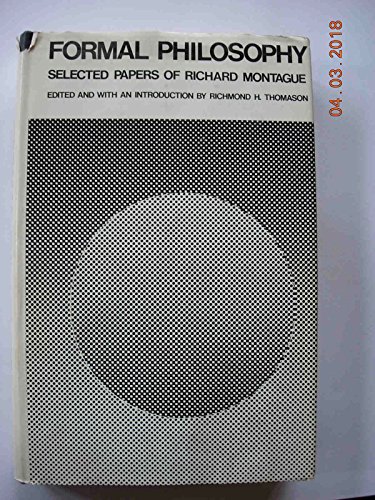
Ebook Info
- Published: 1974
- Number of pages: 369 pages
- Format: PDF
- File Size: 24.41 MB
- Authors: Richard Montague
Description
User’s Reviews
Reviews from Amazon users which were colected at the time this book was published on the website:
⭐Those interested in semantics in the context of modern computer science would I think benefit from discovering Montague, especially English as a Formal Language and Proper Treatment of Quantification. I was shocked to discover that the book was out of print.
⭐For some years “formal philosophy” has been a buzzword in analytic philosophy, as full-on symbolization of philosophical problems has become routine. Still, since the 1980s one has been unable to buy a new copy of Richard Montague’s *Formal Philosophy*, a collection of papers published a few years after his violent death in 1971. Students of linguistics will know Montague’s name from his virtual invention of formal semantics in the form of “Montague Grammar”, though fewer will be able to place any details of his particular attempt to demonstrate that any semantic distinction between logic and natural language is spurious. Montague’s most famous paper on semantics, “The Proper Treatment of Quantification in Ordinary English”, has been anthologized — in fact, a PDF of an anthology reprinting is the first search result for the paper. Unfortunately someone kitted out with a PDF of “PTQ” is really in no position to understand it; even if Montague had been a master of perspicacity, his innovations in applying “intensional logic” to the semantics of complicated English locutions would be unintelligible to the uninitiated.There are several introductions to Montague Grammar on the market, but for a hardy and enterprising linguist or philosopher looking at *Formal Philosophy* itself would be far from pointless. The majority of Montague’s uncollected publications were work in set theory and pure logic along the lines of the work of his teacher Alfred Tarski, and a few of the papers in *Formal Philosophy* center on results in pure logic which are obsolete or stratospherically complicated, but essays 3-8 of the 11 in the book form a “core” of writing on formal semantics in which Montague *gradually* explains the strategies employed in PTQ (essay 8). Essays 3 and 4, “Pragmatics” and “Pragmatics and Intensional Logic”, may already be known to the sophisticate from their influence on the work of David Kaplan; since Kaplan is so totally identified with the UCLA of Montague it has heretofore not occurred to people to call him a “Montagovian”, but his own work on the logic of demonstratives becomes easier to understand if you look at these (it also previously didn’t need mentioning that Hans Kamp of “Discourse Representation Theory” fame was a student of Montague).It is in these papers on pragmatics that some of the strategies for leveraging the “logic of sense and denotation” initiated by Alonzo Church and Rudolf Carnap into a fully satisfactory treatment of problems like those of sentences stating beliefs start to be explained in an *almost* adequate level of detail. Following the work on pragmatics, but preceding the three well-known articles on formal semantics proper “English as a Formal Language”, “Universal Grammar”, and PTQ is “On the Nature of Certain Philosophical Entities”, seemingly dispensable but which does more to explain Montague’s unusual strategies for modeling semantically unusual behavior like treating noun phrases as ‘generalized quantifiers’ (to get a grip on this, Montague’s inspiration was a remark by Quine that the singular but ‘vacuous’ term “Pegasus” could be replaced by a verb “pegasizes”, which might be ‘transposed into the key’ of being true of any property or action which would be exemplified by Pegasus). Additionally, in the essay’s focus on quasi-entities like events it has an interesting resonance with Donald Davidson’s contemporaneous “Logical Form of Action Sentences”. Unlike Davidson Montague makes full use of modal logic (newly equipped with models by Kripke) and intensional logic when it suits him, though in “English as a Formal Language” he attempts to provide an ‘extensionalist’ version of formal semantics (most would probably argue that EFL’s “extensions” are really “individual concepts”, though). Grasping what his use of the theory of types — including, as the CS-inclined will quickly notice, a critically important use of lambda abstraction — does for Montague Grammar is the most difficult part of grasping the theory as a whole.After spending years circling around this book I guess I will hazard that it *is* graspable, but I would stress the usefulness of picking it up in shifts by studying Richmond Thomason’s introductory chapter and all the relevant papers, even the seemingly incomprehensible “Universal Grammar”. What precipitates is only a ‘guess at the riddle’ of linguistic meaning, but the seemingly Byzantine abstraction contains ‘home truths’ within.
Keywords
Free Download Formal philosophy; selected papers of Richard Montague in PDF format
Formal philosophy; selected papers of Richard Montague PDF Free Download
Download Formal philosophy; selected papers of Richard Montague 1974 PDF Free
Formal philosophy; selected papers of Richard Montague 1974 PDF Free Download
Download Formal philosophy; selected papers of Richard Montague PDF
Free Download Ebook Formal philosophy; selected papers of Richard Montague