

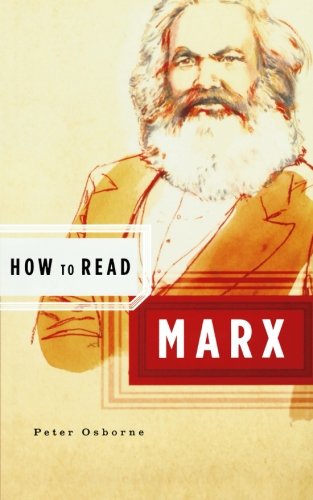
Ebook Info
- Published: 2006
- Number of pages: 146 pages
- Format: PDF
- File Size: 15.72 MB
- Authors: Peter Osborne
Description
Intent on letting the reader experience the pleasure and intellectual stimulation in reading classic authors, the How to Read series will facilitate and enrich your understanding of texts vital to the canon. Emphasizing the Romantic heritage and modernist legacy of Karl Marx’s writings, Peter Osborne presents Marx’s thought as a developing investigation into what it means, concretely, for humans to be practical historical beings. Drawing on passages from a wide range of Marx’s writings, and showing the links among them, Osborne refutes the myth of Marx as a reductively economistic thinker. What Marx meant by “materialism,” “communism,” and the “critique of political economy” was much richer and more original, philosophically, than is generally recognized. With the renewed globalization of capitalism since 1989, Osborne argues, Marx’s analyses of the consequences of commodification are more relevant today than ever before. Extracts are taken from the full breadth of Marx’s writings, including Notebooks on Epicurean Philosophy, the Economic and Philosophical Manuscripts, and The Communist Manifesto to Capital.
User’s Reviews
Editorial Reviews: About the Author Peter Osborne is Professor of Modern European Philosophy and founding Director of the Centre for Research in Modern European Philosophy (CRMEP), now at Kingston University London. He is a long-serving member of the editorial collective of the UK journal Radical Philosophy. His books include The Politics of Time, Philosophy in Cultural Theory, Conceptual Art and Marx.Simon Critchley is a best-selling author and the Hans Jonas Professor of Philosophy at the New School for Social Research. His many books include The Book of Dead Philosophers, Bowie, and Tragedy, the Greeks, and Us.
Reviews from Amazon users which were colected at the time this book was published on the website:
⭐Good theoretical introduction to Marx
⭐I thought this series was meant to make the authors understandable to the average intelligent person, i.e., cut through the jargon. There’s still too much of it in this volume. Otherwise, after struggling through the jargon, I found the book to be wise and insightful.
⭐This book was excellent for getting across some of Marx’s tougher points! It’s medium sized, and an easy read for those in classes (or for fun) trying to shift their way through Marx’s sometimes wordy articles and writings. I found it immensely helpful for the Communist Manifesto, On Freurbach, Capital, and even more of Marx writings!
⭐This is a good book if you are looking for a more challenging introduction to Marx than, say, Singer’s Marx: A Very Short Introduction. As advertised, this is a book about Marx from a philosophical perspective, but that should not scare anyone because Osborne does a nice job introducing terms from Kant and Hegel and helping the reader through the vocabulary.
⭐There are myriad little introductions to Marx on the market: as the above reviewer noted, the Peter Singer “very short introduction,” but also writings on his individual works, illustrated introductions, guides for the perplexed, Marx for Dummies, the Complete Idiot’s Guide To…, etc.For my money, the best introduction to Marx will always be the Communist Manifesto, but looking at my own notes from high school, it is clear that, unless you are willing to read hundreds of pages of Marx thereafter, and return repeatedly TO the Manifesto, there probably should be an “introduction to the introduction.”The difficulties in reading Marx on on several levels: 1) those adopted from the Hegelian line of German Idealism, 2) extremely complicated and foreign-seeming economic analysis, and 3) the integration of these within a PRAXIS and also an -ism, a tradition which would be variously elaborated by later “Marxists.”Now, after the Communist Manifesto, the best place to see this at work is in Engels’ “Socialism Utopian and Scientific” and Rosa Luxemburg’s “Reform or Revolution.” What is important in all these works is their COMMUNIST orientation–they are not merely “theoretical” introductions.So, those recommendations aside, this introduction is superior to many on the market because of its close analysis of the Marxist TEXT. There are ten close-readings of passages from Marx’s career, which solves many of the problems for the reader approaching Marx: preconceptions and the inherent difficulties of the work. Preconceptions are rendered false problems by diving straight into questions that have NO relation to bogus bourgeois ideas of, say, the Soviet Union’s collapse. And the difficult passages and concepts are excellently illuminated by Peter Osborne.Marx is his own best introduction, but since he is ALSO the most misread author in history (after Nietzsche), perhaps The Communist Manifesto should be supplemented by this superb book. I also suggest the entries in this series for Lacan and Sartre.
⭐This book is excellent. Yes, there is some jargon, yes, it is still dense in places, but this is about as basic as Marx could get while still maintaining appropriate historical and linguistic context. The author gives enough background for philosophers on whom Marx heavily relied to understand Marx’s context and arguments, and does a phenomenal job of unpacking the original meaning behind Marx’s writing, rather than much of the more modern, politicized discourse.
⭐I am a reasonably intelligent individual, but I found this work to be difficult and ponderous. I read and reread the chapter on commodity fetishism, and still don’t know what it is. I would recommend an intro university course in Philosophy, or at least a decent knowledge of philosophy, particularly German idealism, to get the most from this work. The subject matter is inherently difficult, and that was the problem. I was looking for a general, simple introduction to Marx, and particularly Das Kapital, and I have yet to find one.
⭐A very illuminating reading.
⭐If you want a basic introduction to Marx, then this is not really the right book. Peter Osbourne displays a real depth of knowledge, but that knowledge is not rendered accessible. That said, the book (while heavy going) is valuable and interesting.
Keywords
Free Download How to Read Marx in PDF format
How to Read Marx PDF Free Download
Download How to Read Marx 2006 PDF Free
How to Read Marx 2006 PDF Free Download
Download How to Read Marx PDF
Free Download Ebook How to Read Marx