Ebook Info
- Published: 2016
- Number of pages: 128 pages
- Format: PDF
- File Size: 24.64 MB
- Authors: Jacques Derrida
Description
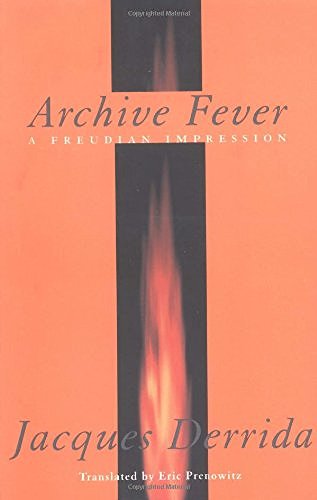
In this work, Jacques Derrida guides the reader through an extended meditation on remembrance, religion, time, and technology – all occasioned by a deconstructive analysis of the notion of archiving. The archival concept has played a pivotal role in numerous critical debates – a place of origin, yet of perpetuity, a place of stasis and order, yet of discovery, the notion of archive houses a complex of diverse, and often disparate, meanings. As a depository of civic record and social history whose very name derives from the Greek word for town hall, the archive would seem to be a public entity, yet it is stocked with the personal, even intimate, artifacts of private lives. This inherent tension between public and private inaugurates, argues Derrida, an inquiry into the human impulse to preserve, through technology as well as tradition, both a historical and a psychic past.
User’s Reviews
Reviews from Amazon users which were colected at the time this book was published on the website:
⭐This is definitive Derrida “behind the Venetian blinds” as he himself would have said in his later years. It is a transcript of a very important lecture Derrida gave in June of 1994 entitled The Concept of the Archive: a Freudian Impression. Derrida begins the exposition by giving a deconstructive exegetic analysis of the word “archive” as an etonym of the Greek “Arkhe” which originally meant “commencement” or “commandment” in the ancient Greek dialect. From here we follow Derrida into an understanding of the topology of this commencement, where history commences or comes together at the location of the archive — a place where the hidden is kept and where the documents of history are preserved by archivists (the governing body of the archive who know how to read them.) Historiography can give little more than an orthographic understanding of a text’s intended meaning and this is not to say the least of works demanding the specific rigour of the eclectic writings of the father of psychoanalysis. Deconstruction is neither historiography nor orthography as any Derrida reader knows that the aesthetics of grammar can only be an aesthetics of truth if it is taken in a holistic form to encompass all interpretations.In Archive Fever we are taken on an exhibition of the Freud archives by one who knows the rarity of gaining access to the works of (psycho)analysis. By a legitimate hermeneutic authority, the archivists or archons (guardians of it’s contents) live and work each day with the documents. They alone secure both to protect and to give authoritative readings (what the author would have intended us to eventually uncover.) As Derrida say’s the archons secure and are accorded the place of hermeneutic authority and competence, they have the power to interpret what is held in the archive (i.e., to command or posit what is deposited in the archive.) To authorize who can enter as well as who can give proper interpretation of the archive and it’s contents. Derrida and Ricoeur have both independently pointed out the embodied archaeology within psychoanalysis. Ricoeur has said in the Conflict of Interpretations that “the second phase of the philosophical interpretation I propose is characterized by the dialectic between archaeology and teleology. This advance in reflection indeed represents something new, a polarity between the reflective Arche and Telos. I reach this stage by a reappropriation of the temporal aspects of Freudianism…”Perhaps only quantum mechanics can compare as the one true science of physical nature alongside the one known as psychoanalysis, the science of mental nature, in that very few professionals can claim to understand either method esp. in the programs offered by the Anglo-American university. As any good analyst today knows: psychoanalysis does not pretend to be psychology nor attempts to be understood as such and Freud himself is not any other psychologist but the father of modern psychology. Aside from perhaps Lacan, Ricoeur, and Derrida popular interpretations of Freud cannot be situated within the tradition and lineage that began between Freud’s students and his predecessors within the Vienna Circle. Before he came into discovering psychoanalysis Freud was a student of the Austrian psychologist Franz Brentano whom Freud admired and having attended many of his lecture courses became an initiate in what was all the vogue at the time: the new psychology. Brentano is credited for having lifted Medieval 18th century psychological practice from arcane materialism and speculative medicine onto the level of Kantian metaphysics (rational psychology.) Brentano’s metaphysics of the psyche i.e., metapsychology or rational-empirical psychology provided the metaphysical foundations for Freud’s psycho-organic interpretation of the mind. In Freud’s formative years Brentano was lecturing on the new psychology that Meinong and himself had worked out through an idealist model of Aristotelian metaphysics. Once Brentano had gained immense support for his theoretical investigations empirical psychology would become metapsychology as represented by his student Sigmund Freud. Traditional metapsychology does not build itself up from Platonic or Hegelian idealism but takes directly from Kant’s rationalism as governing the logic of Aristotle’s soul/mind/matter/spirit principles. In an 1889 letter to Wilhelm Fliess, Freud writes (with regards to his Brentano courses) “I am continually occupied by psychology – it is really metapsychology”.Following the first section on the meaning of the archive, Derrida continues to excoriate the archive from within deconstruction as it is the reservoir or storage (the unconscious.) With the Freud archive/museum as his place of inquiry (Freud’s residence as the topos of this deposited content) Derrida allows us to discover that the true meaning of psychoanalysis is echoed in the impression it gives off, the phantasm, the dream image i.e., a symbolization of what is re-pressed and then revealed in it’s impression. Quintessential Derrida poetizes the art of deconstructing the impressions left in us by massive print culture when he is reconstituting the economic aesthetic or the portfolio of individual works of history that are meant to give the gift of ‘impress’; to present what could not otherwise be presented without giving away it’s secret and destroying the truth of it’s historical development.The psyche, according to 19th century philosophy of mind, is generated by this individualizing process of the developmental ego at the moment reason (another mode of impression) is able to make sense of the world. Freud’s apparent distant relationship with his father makes room for hidden emotions as the young genius growing up in a moderately conservative Jewish household has found a perfect residence for his inquisitive mind in the secret language of mythology and dreams. Derrida speaks of the illusion of distant emotion that is given symbolic depth in the form of the gift; the gift of love that Derrida captures in his biographical telling of the gift presented to Sigmund by his father on the occasion his 35th birthday (a newly re-bound copy of Freud’s childhood Bible.)What Derrida has attempted to do in this very ‘impressive’ expose is to prove that psychoanalysis is “a Jewish science”, and perhaps if we had access to the complete lecture series we would know exactly why psychoanalysis is given this designation. As a boy young Sigmund was preoccupied with a personal study of myths and not limited to the myths within the Old Testament that he would later write about in his memoires. It was not merely his Tauric-sensualistic foci on the sexual that lead Freud to such discontent with society over the rise of psychic epidemics at the turn of the century. There were much deeper religious and political problems for the socially oppressed Austrian Jews at that time as the Habsburg Empire was climaxing towards it’s immediate decline and it’s Jewish population was yearning for a return to the true Austrian cultural “homeland” they had helped build before the Habsburg’s had absorbed their culture during the late Victorian era.Why has Derrida become convinced that psychoanalysis is a Jewish science and how does he interpret psychoanalysis as Jewish? In the context of modernity after Freud we would say that Judaism is the source, the fountainhead of the religion of reason. The Jews created the religion of reason. The other religions that dominate the Occident are either altogether inadequate, or they are derivative of Judaism. It is true that Judaism was not always in every respect the religion of reason. It needed the aid of Kantian philosophy to free itself completely from it’s mythical and logico-mythical irrelevancies i.e., from ancient to modern Jewish thought. But this aid merely enabled Judaism to actualize fully what it meant to be from the beginning and what it fundamentally was at all times. Why psychoanalysis is a Jewish science and why the gentile psyche has difficulty gaining access to it, and this is the key to why resistance to self-analysis and the resistance to analyst-patient engagement in psychology has always been prevalent. Modern gentility represents something different from it’s ancient and Medieval definition after Freud, it represents the pre-rational or preanalytical psyche that struggles with itself to grasp absolute reason following the Greco-Roman mythos of the Christian era. (From the complexity of myth and the logic that is derived from myth.) Myth, in its primitive form, is the sediment of primal logic. Freud was the first speculative anthropologist who looked at the relationship of the human psyche to primitive symbolism and their association to drives and representational emotions expressed symbolically to protect the id and superego. Derrida argues that to truly practice analysis, analysis itself must pass through the dialectical analysis that is at once a generative hermeneutic analysis of Freud’s own development and the development of psychoanalysis. To understand Freud’s place in modern science one should be required to study European intellectual history as a totality and not as separate historical events of progress. Analyst’s who wish to gain a deeper understanding of their practice should start with Derrida, deconstruct method and work their way back from our postmodern condition/problem, as exemplified by Derrida, to sufficiently access the instance and place of modernity that was the psychoanalytic revolution of Sigmund Freud.
⭐What can be said about this work that hasn’t already been written? Derrida provides an interesting challenge to the role of archives and public memory, and does so in his signature style. Whether that makes you want to read this or not, the work is nothing if not a seminal take on archives.
⭐I sort of have a love/hate relationship with Derrida, but this book begins with acknowledging the gatekeepers of knowledge, so this book falls in the love category.
⭐I bought this book for a Philosophy-ish course I took while in college. I hated reading every page of it. Although the writer has some interesting ideas to present, his dense language alone made it particularly difficult to get through even a few sentences without asking yourself “What the heck is he trying to say?”If you’re interested in pompous, complex, theoretical ramblings, then you’d love this book. Otherwise, stay clear.
⭐Purchased for Grad School. Good Edition!
⭐Deep. Heady. and very theoretical.
⭐awesome!
⭐Not a review of the content but of the Kindle edition: The pages have been scanned in both out of focus and upside down. There are four pages per screen, so each has to be zoomed into to read anything. A frustrating waste of money as the text is nearly unusable, and I do need this book for class.
⭐I bought this after being introduced to Derrida, but whilst studying psychoanalytic theory- very interesting take. I felt like it provided a further dimension and a different perspective on how we understand and process things as people- nice to broaden things out a bit
⭐Do not buy this edition. Its not a proper kindle edition, just a photocopied book!!!
⭐Daughter enjoying it (Intern archivist)
⭐Gut und pünktlich geliefert, bin sehr zDer Artikel wurde gut und pünktlich geliefert und der Zustand ist wie bestellt. Ich bin mit dem Einkauf sehr zufrieden.ufrieden.デリダは初期のころからフロイトの著作に言及しているが、本書は20年近く前にロンドンのフロイト研究所に委託でフロイトとアーカイヴズの関係を哲学的に論究することを目的に執筆されたものである。哲学者とアーカイヴズというテーマだと誰しもフーコーの「知の考古学」における<アルシーヴ>への言及を想起する。だが生憎、フーコーのアーカイヴズへの言及内実は、デリダの今回の議論ほど具体的な内容を含んでいないし、体系性にも乏しい。フーコーも学位論文執筆時にカント・アルヒーフでカントの生原稿を参照しており、アーカイヴズがいかなる意義を学術的に持ち得ているかを熟知している。その成果が「カントの人間学」である。また、デリダもデビュー作「幾何学の起源」を現わしたもとの作業はルーヴァン大学にあるフッセル・アルヒーフでの現象学の創始者フッサールの遺稿を精読してまとめ上げた著作であり、両者ともにアーカイヴズが学術にいかなる影響を与えるかを熟知している。 このようにアーカイヴズは、ともすると歴史学者や歴史的研究に関わる人の十八番であるということを超えて学術の証左(エヴィデンス)の起源であることを哲学の立場に立ちながら実証した重厚な議論が本書である。 デリダの歴史学者を超えて、アーカイヴズに精通した立場で、アーカイヴズ、精神分析、歴史、記憶、印刷物との関係性を柔軟に読解し、脱構築的な視点に導き出す。その視点こそアーカイヴズが内在させる二律背反的な存在理由であり、アーカイヴズの病と名付けうるフロイトとは不可分の学術的な起源を共有することになる。実に興味深い議論である。 デリダ没後、ちょうど10年である。
⭐
Keywords
Free Download Archive Fever: A Freudian Impression in PDF format
Archive Fever: A Freudian Impression PDF Free Download
Download Archive Fever: A Freudian Impression 2016 PDF Free
Archive Fever: A Freudian Impression 2016 PDF Free Download
Download Archive Fever: A Freudian Impression PDF
Free Download Ebook Archive Fever: A Freudian Impression