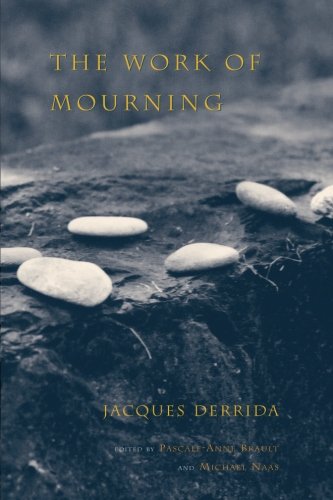
Ebook Info
- Published: 2003
- Number of pages: 272 pages
- Format: PDF
- File Size: 33.12 MB
- Authors: Jacques Derrida
Description
Jacques Derrida is, in the words of the New York Times, “perhaps the world’s most famous philosopher—if not the only famous philosopher.” He often provokes controversy as soon as his name is mentioned. But he also inspires the respect that comes from an illustrious career, and, among many who were his colleagues and peers, he inspired friendship. The Work of Mourning is a collection that honors those friendships in the wake of passing.Gathered here are texts—letters of condolence, memorial essays, eulogies, funeral orations—written after the deaths of well-known figures: Roland Barthes, Paul de Man, Michel Foucault, Louis Althusser, Edmond Jabès, Louis Marin, Sarah Kofman, Gilles Deleuze, Emmanuel Levinas, Jean-François Lyotard, Max Loreau, Jean-Marie Benoist, Joseph Riddel, and Michel Servière.With his words, Derrida bears witness to the singularity of a friendship and to the absolute uniqueness of each relationship. In each case, he is acutely aware of the questions of tact, taste, and ethical responsibility involved in speaking of the dead—the risks of using the occasion for one’s own purposes, political calculation, personal vendetta, and the expiation of guilt. More than a collection of memorial addresses, this volume sheds light not only on Derrida’s relation to some of the most prominent French thinkers of the past quarter century but also on some of the most important themes of Derrida’s entire oeuvre-mourning, the “gift of death,” time, memory, and friendship itself.”In his rapt attention to his subjects’ work and their influence upon him, the book also offers a hesitant and tangential retelling of Derrida’s own life in French philosophical history. There are illuminating and playful anecdotes—how Lyotard led Derrida to begin using a word-processor; how Paul de Man talked knowledgeably of jazz with Derrida’s son. Anyone who still thinks that Derrida is a facetious punster will find such resentful prejudice unable to survive a reading of this beautiful work.”—Steven Poole, Guardian”Strikingly simpa meditations on friendship, on shared vocations and avocations and on philosophy and history.”—Publishers Weekly
User’s Reviews
Editorial Reviews: From the Inside Flap Jacques Derrida is, in the words of the New York Times, “perhaps the world’s most famous philosopher—if not the only famous philosopher.” He often provokes controversy as soon as his name is mentioned. But he also inspires the respect that comes from an illustrious career, and, among many who were his colleagues and peers, he inspired friendship. The Work of Mourning is a collection that honors those friendships in the wake of passing.Gathered here are texts—letters of condolence, memorial essays, eulogies, funeral orations—written after the deaths of well-known figures: Roland Barthes, Paul de Man, Michel Foucault, Louis Althusser, Edmond Jabès, Louis Marin, Sarah Kofman, Gilles Deleuze, Emmanuel Levinas, Jean-François Lyotard, Max Loreau, Jean-Marie Benoist, Joseph Riddel, and Michel Servière.With his words, Derrida bears witness to the singularity of a friendship and to the absolute uniqueness of each relationship. In each case, he is acutely aware of the questions of tact, taste, and ethical responsibility involved in speaking of the dead—the risks of using the occasion for one’s own purposes, political calculation, personal vendetta, and the expiation of guilt. More than a collection of memorial addresses, this volume sheds light not only on Derrida’s relation to some of the most prominent French thinkers of the past quarter century but also on some of the most important themes of Derrida’s entire oeuvre-mourning, the “gift of death,” time, memory, and friendship itself.”In his rapt attention to his subjects’ work and their influence upon him, the book also offers a hesitant and tangential retelling of Derrida’s own life in French philosophical history. There are illuminating and playful anecdotes—how Lyotard led Derrida to begin using a word-processor; how Paul de Man talked knowledgeably of jazz with Derrida’s son. Anyone who still thinks that Derrida is a facetious punster will find such resentful prejudice unable to survive a reading of this beautiful work.”—Steven Poole, Guardian”Strikingly simpa meditations on friendship, on shared vocations and avocations and on philosophy and history.”—Publishers Weekly About the Author Jacques Derrida is the director of studies at the Ecole des Hautes Etudes en Sciences Sociales, Paris, and professor of humanities at the University of California, Irvine. He is the author of many books including The Gift of Death and Archive Fever, both published by the University of Chicago Press. Pascale-Anne Brault is an associate professor of French at DePaul University. Michael Naas is a professor of philosophy at DePaul University. Together they have translated several works by Derrida, including Memoirs of the Blind, published by the University of Chicago Press, and Adieu.
Reviews from Amazon users which were colected at the time this book was published on the website:
⭐Jacques,The morning after, after the morning, the morning that is in itself (an sich) not morning (in itself that is). The indefinite dyad at the service of the One, the measure of all things great and small, marks (as trace) the before and after of morning itself, viz as thing itself, qua being, as an indeterminacy that begs transgression. I will return “There” shortly. When does our morning begin and end? When does it become a pile or stack, not of mornings of course, but perhaps of grains of sand, the very measure of time, and our time together? How do we measure this morning as loss? As a never-was? How do we retain it in our self (if it cannot render itself)? For the dawn of morning returns to the crepuscule. …. and to Death itself. It is now (even more so) the morning after, a pill so hard to swallow in the work of morning; as it inevitably brings death onto itself… the death of those we loved and lost, and the loss of Love, that filial loss. Morning lies there in that infinitesimal (yet infinite) space between Eros and Thanatos.If you recall the time we met (but never truly met, never shared a “this place here” or occasion, that is to say a “There” in the Heideggerian, rather than Ginsbergian sense, a limitation (as fundamental characteristics of the There, I believe is the quote). The field, that open-ness, where the Heideggerian peasant (yes we “Jacques”) soils himself in the work, in the labor. No, no boundary condition, no perimeter, or plane, but rather an intersection of two independent trajectories, coming to a point, indefinite, immeasurable… if that is the (physis of the) point.It was Irvine circa late `80s. But what is the date? If I have your permission, and take your leave, to repeat, in your own words, at the time, you said “It is necessary that in the date the unrepeatable (das unweiderholbar) repeat itself, effacing in itself the irreducible singularity that it denotes. It is necessary that, in a certain manner, the unrepeatable divide itself in repeating itself, and in the same stroke encipher or encrypt itself. Like physis, a date loves to encrypt itself. (Sovereignties in Question: The Poetics of Paul Celan 2005: 15). It was this very love of the encrypted that drew me to you, and the comfort received in apparent endless/timeless repetition (granted across divergent registers). Discursive strategy practiced by all good rhetors (theologians included), where the repetition, reiteration, recursion, and eventual regression lead to solace and tranquility (ataraxia): precursor to eudemonia. And you were in good spirits.If I remember correctly the “occasion” was a seminar on Heidegger, or more correctly on the “Heidegger Question,” more specifically on the punctuation (punctum) of Spirit (Geist) in the Heideggerian corpus. You admitted a surprise–I believe, it was long ago–at the avoidance or reluctance on the part of Heidegger to engage with that essentially Hegelian idiom. You said, “Saisi par l’idiome allemand, Geist donnerait à penser plutôt, plus tôt, la flame.” Sooner (plus tôt) rather (plutôt) than later we all come to ashes (dust to dust), and to the work of morning.For all these memories, Jacques, thank you: J’en-saigne pour tous ceux qui veulent bien me voir écouler!Jacques.
⭐Sacred groves of ancient gatherings were destroyed by conversions threatening genocide for heathens who refused to be converted to official unity religions. People who were stumped by how believing in their need to be like everybody else might sympathize with suicides by experts in Nietzsche who checked out for die at the right time. I was not familiar with many of the first ten names in the contents on page v, but items 11 and 12 Sarah Kofman (1934-1994) and Gilles Deleuze (1925-95) were my favorite suicides. Heavy thinkers Levinas and Lyotard are the other two names on page vi.Chapter 12 starts with a summary on pages 189-191 which mentions a pulmonary condition that he suffered from badly in 1993 after many years in which Deleuze felt the literary world setting up a restricted space, “artificial, and crippling” (p. 194). I am impressed by his titles on the cover of a book of 600 pages by Deleuze and Guattari:a thousand plateauscapitalism and schizophrenia
⭐This volume is a compendium of obituaries by Jacques Derrida on several key figures of continental philosophy who have since passed in recent years. The book, gathered as a whole, essentially marks the end of an important era in the history of Western philosophy, it was the era of existentialism, phenomenology, structuralism, post-structuralism, Marxist theory, and deconstruction.Derrida writes elegant and respectful essays about literary theorist Roland Barthes, Paul DeMan, philosopher Michel Foucault, Max Loreau, Jean-Marie Benoist, Marxist theorist Louis Althusser, Edmond Jabes, Joseph Riddel, Michel Serviere, Louis Marin, feminist Sarah Kofman, Gilles Deleuze, Emmanuel Levinas, and Jean-Francois Lyotard.Although this text is far from a major work of philosophy on behalf of Derrida, I am positive it will be an important resource for future students, and an elegant work of preservation for a by-gone era.
⭐It was interesting to read Derrida’s eulogy/poersonal view on several eminent modern thinkers whom he had known well- for instance Paul Mann, Lyotard, Foucault. The translation was adequate. Not a classic but a useful addition
⭐Amazon said it was delivered 28 February 2020. It arrived months afterward. It’s a beautiful book but I wouldn’t buy it thru’ Amazon again.
⭐
Keywords
Free Download The Work of Mourning in PDF format
The Work of Mourning PDF Free Download
Download The Work of Mourning 2003 PDF Free
The Work of Mourning 2003 PDF Free Download
Download The Work of Mourning PDF
Free Download Ebook The Work of Mourning