Ebook Info
- Published: 1987
- Number of pages: 552 pages
- Format: PDF
- File Size: 42.24 MB
- Authors: Jacques Derrida
Description
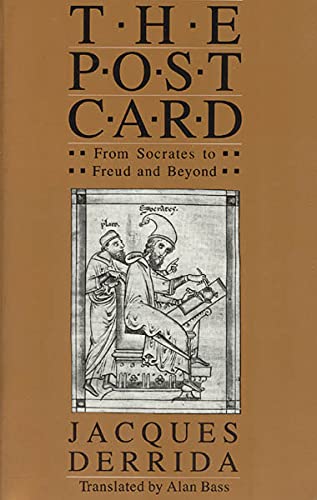
17 November 1979You were reading a somewhat retro loveletter, the last in history. But you have not yet received it. Yes, its lack or excess of address prepares it to fall into all hands: a post card, an open letter in which the secret appears, but indecipherably. What does a post card want to say to you? On what conditions is it possible? Its destination traverses you, you no longer know who you are. At the very instant when from its address it interpellates, you, uniquely you, instead of reaching you it divides you or sets you aside, occasionally overlooks you. And you love and you do not love, it makes of you what you wish, it takes you, it leaves you, it gives you. On the other side of the card, look, a proposition is made to you, S and p, Socrates and plato. For once the former seems to write, and with his other hand he is even scratching. But what is Plato doing with his outstretched finger in his back? While you occupy yourself with turning it around in every direction, it is the picture that turns you around like a letter, in advance it deciphers you, it preoccupies space, it procures your words and gestures, all the bodies that you believe you invent in order to determine its outline. You find yourself, you, yourself, on its path. The thick support of the card, a book heavy and light, is also the specter of this scene, the analysis between Socrates and Plato, on the program of several others. Like the soothsayer, a “fortune-telling book” watches over and speculates on that-which-must-happen, on what it indeed might mean to happen, to arrive, to have to happen or arrive, to let or to make happen or arrive, to destine, to address, to send, to legate, to inherit, etc., if it all still signifies, between here and there, the near and the far, da und fort, the one or the other. You situate the subject of the book: between the posts and the analytic movement, the pleasure principle and the history of telecommunications, the post card and the purloined letter, in a word the transference from Socrates to Freud, and beyond. This satire of epistolary literature had to be farci, stuffed with addresses, postal codes, crypted missives, anonymous letters, all of it confided to so many modes, genres, and tones. In it I also abuse dates, signatures, titles or references, language itself.J. D.”With The Post Card, as with Glas, Derrida appears more as writer than as philosopher. Or we could say that here, in what is in part a mock epistolary novel (the long section is called “Envois,” roughly, “dispatches” ), he stages his writing more overtly than in the scholarly works. . . . The Post Card also contains a series of self-reflective essays, largely focused on Freud, in which Derrida is beautifully lucid and direct.”—Alexander Gelley, Library Journal
User’s Reviews
Editorial Reviews: From the Back Cover You were reading a somewhat retro loveletter, the last in history. But you have not yet received it. Yes, its lack or excess of address prepares it to fall into all hands: a post card, an open letter in which the secret appears, but indecipherably. You can take it or pass it off, for example, as a message from Socrates to Freud. About the Author Jacques Derrida (1930–2004) was director of studies at the École des hautes études en sciences sociales, Paris, and professor of humanities at the University of California, Irvine. Several of his books have been published in their English translation by the University of Chicago Press.
Reviews from Amazon users which were colected at the time this book was published on the website:
⭐Contrary to the reviews thus far reported in regards to this “work in the traditions of Finnegans Wake,” i would reccomend reading this book to all who are interested in Derrida’s philosophy of ethics. Herein we may find ephemerally expounded glimpses at Postmodernism’s notions of continuity and of the legacy of ideas: a gift which we neccessarely both receive and reinscribe – “What is tragic is not the possibility but the neccessity of repetition” (Writing and Difference). Many Derrida readers have shied away from this text because of its disparate and fragmented stuttering…Don’t if you have patience to listen read this treasure. It is a pastiche, a montage and a rebus. An exquisite rendition on tradition and inheritance, on presence and absence. A reminder to never stop giving and giving and giving because the most ethical one can be is through the dissemination of ideas, the transformation of the recurring within which each becomes a relative of all and none. Finnegans Wake approximates the same themes with Vico’s philosophy of history as an addendum. By the way Vico was an avid reader of the Cabbala…Only Walter Benjamin can better inspire the re-visions that we need for a tragic becoming tragic. This book is extremely personal and one of Richard Rorty’s favorites I might add…he was not very fond of the early Derrida…Rorty understands Derrida as only Caputo and Bennington have…This is our modern day Novalis, we may dream of dreaming our dreams!
⭐It took me a long time to crack the Derrida nut. But when I did, I did it with this book. Thus it will always be my favorite philosophical novel by Derrida. When I finished this book I picked up Badiou’s book on Deleuze and he said I got everything right, only he said it better than I would have.So far, all the other readers seem to have missed the point. First, this book is not about anything so feminine and smacking of vulgar Christianity as love and cushy feelings. Derrida says it’s a poison pen letter. It’s about hate. It may be “between lovers,” but it’s published for the whole world to admire and appraise, a radically different context than the relationship of husband and wife. Which the careful Derrida-phile will note was handled very carefully, almost cynically, in the Derrida “documentary.” (Has there ever been a greater and more hilarious take on oral sex?)One wag commented that the book is only good for beach-reading. But that misses the serious side of Derrida, which is also the point. Rhetoric can be philosophy. Derrida is one hundred percent hilarious. But he’s always pushing the philosophical envelope with his puns. To resort to a distinction that has a pragmatic value even though it utterly lacks any philosophical foundation, the use-mention distinction, when Derrida uses the word ‘this,’ he also means _that_. (Why does the use-mention distinction make no sense? Because when you say ‘horse,’ a _horse_ comes out of your mouth. As per Wittgenstein and the Stoics.) It’s up to us lesser mortals to tease out the strands and levels until we can produce something as thoroughly competent. And simultaneously beautiful and ugly. Like orgasm.Which brings us to Lacan. Some say he’s a charlatan. And you have to be suspicious of anyone who declares that they’re not interested in truth, but falsity. But when the postmodernists say this what they mean is that the truth, which can potentially be known, is in being aware that you actually don’t know. The idea goes back to Plato and his early Socratic dialogues. Stated like that, it isn’t too far from Kant, who also believed that we can’t actually know much, other than that there are stars above and some sort of moral rules within. (Nobody has ever agreed with him on his rules, including his great heir John Rawls.) Derrida doesn’t differ much from Lacan. He abandons Oedipus for the same reasons as Deleuze (it’s a self-fulfilling prophecy and alienated from real life). But the argument on the postal system only looks different from Lacan’s account because Derrida says it is. That he got Lacan to agree with him says something about Derrida’s prestige, so there must be something there. (Though Lacan’s submission looks suspiciously like he doesn’t submit–republishing the Ecrits in an edited down version where the offensive passages have been actively forgotten.) But when Lacan says that a letter always gets to its destination he means that it always misses its destination, because the person it’s intended for is going to sometime pass away. (“The living is a species of the dead.” Nietzsche.) Which is also Derrida’s point. I haven’t read Derrida’s latest writings on Lacan but apparently there’s a whole lot of a rapprochement. In his interviews with Roudinescu, A Quoi Demain, he considers his style to be Lacanian and a lot of his conclusions to be similarly disposed.Here’s hoping the most consistently amusing of the post-Heideggerians remains a liberal individualist. Though it’s probably going to be tough for him, given that the Straussists of the Whitehouse talk a similar talk and walk a similar walk. (“Jewgreek is Greekjew.”) I believe the fact that Derrida is explicitly against the death penalty is the deciding difference. QED.
⭐Contrary to the reviews thus far reported in regards to this “work in the traditions of Finnegans Wake,” i would reccomend reading this book to all who are interested in Derrida’s philosophy of ethics. Herein we may find ephemerally expounded glimpses at Postmodernism’s notions of continuity and of the legacy of ideas: a gift which we neccessarely both receive and reinscribe – “What is tragic is not the possibility but the neccessity of repetition” (Writing and Difference). Many Derrida readers have shied away from this text because of its disparate and fragmented stuttering…Don’t if you have patience to listen read this treasure. It is a pastiche, a montage and a rebus. An exquisite rendition on tradition and inheritance, on presence and absence. A reminder to never stop giving and giving and giving because the most ethical one can be is through the dissemination of ideas, the transformation of the recurring within which each becomes a relative of all and none. Finnegans Wake approximates the same themes with Vico’s philosophy of history as an addendum. By the way Vico was an avid reader of the Cabbala…Only Walter Benjamin can better inspire the re-visions that we need for a tragic becoming tragic. This book is extremely personal and one of Richard Rorty’s favorites I might add…he was not very fond of the early Derrida…Rorty understands Derrida as only Caputo and Bennington have…This is our modern day Novalis, we may dream of dreaming our dreams!
Keywords
Free Download The Post Card: From Socrates to Freud and Beyond in PDF format
The Post Card: From Socrates to Freud and Beyond PDF Free Download
Download The Post Card: From Socrates to Freud and Beyond 1987 PDF Free
The Post Card: From Socrates to Freud and Beyond 1987 PDF Free Download
Download The Post Card: From Socrates to Freud and Beyond PDF
Free Download Ebook The Post Card: From Socrates to Freud and Beyond