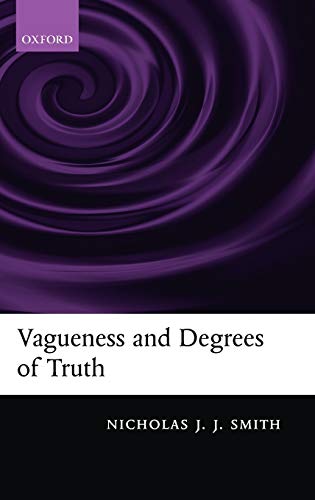
Ebook Info
- Published: 2009
- Number of pages: 272 pages
- Format: PDF
- File Size: 4.28 MB
- Authors: Nicholas J. J. Smith
Description
Nicholas J. J. Smith argues that an adequate account of vagueness must involve degrees of truth. The basic idea of degrees of truth is that while some sentences are true and some are false, others possess intermediate truth values: they are truer than the false sentences, but not as true as the true ones. This idea is immediately appealing in the context of vagueness–yet it has fallen on hard times in the philosophical literature, with existing degree-theoretic treatments of vagueness facing apparently insuperable objections. Smith seeks to turn the tide in favour of a degree-theoretic treatment of vagueness, by motivating and defending the basic idea that truth can come in degrees. He argues that no theory of vagueness that does not countenance degrees of truth can be correct, and develops a new degree-theoretic treatment of vagueness–fuzzy plurivaluationism–that solves the problems plaguing earlier degree theories.
User’s Reviews
Editorial Reviews: About the Author Nicholas J. J. Smith is a Senior Lecturer in Philosophy at the University of Sydney.
Reviews from Amazon users which were colected at the time this book was published on the website:
⭐Smith is that most invaluable kind of philosopher: he explicates points made decades ago more clearly and more revealingly than the original author did, while simultaneously making insightful and profound contributions of his own. Both of these achievements are particularly astounding in light of the subject matter, for the vagueness literature is as full of esoteric and difficult distinctions as it is ingenuity.The book is structured into three parts; the first is divided between a section that introduces a lot of the mathematical terminology necessary for understanding model-theoretic semantics (Smith is extremely good at this, which he evidently must be aware of, given his recently published logic book), and the necessary introduction to contemporary theories of vagueness. Smith offers old criticisms of these theories as he illustrates them, but holds back the true problem he has with them until the second part of the book.Here, he begins his positive project of offering a definition of vagueness. He motivates the need for a definition and the definition itself, showing how the telltale signs of a vague predicate, i.e., borderline cases, blurred boundaries, and the sorites paradox, can all be reduced down to “Closeness”, a concept similar to that of Wright’s tolerance, but with important differences. Smith uses his definition to bludgeon the theories of vagueness he introduced in the book’s first part; when the dust clears, the only remaining theory is the degree-theoretic account of vagueness, which successfully handles the so-called ‘jolt problem’ via a continuum of truth values.The book’s final part is divided between a brilliant defense of the degree-theorist from common complaints and an assimilation between Smith’s brand of fuzzy semantics and a view he calls plurivaluationism (Smith’s untangling of this theory from supervaluationism is of enormous benefit), which obviates a family of complaints that essentially originate out of arguments for Quinean indeterminacy. Smith masterfully clarifies conceptual confusions and touches on practically all of the issues relevant here, including truth-functionality, norms of assertion, and a fascinating new take on degrees of belief. Even if one disagrees with Smith’s final position on a topic, going through his arguments is highly rewarding.Who would benefit from this book? A lot of it would probably go over the head of someone completely new to philosophy of language; Smith notes in his first chapter that the mathematical intro is fine for people with “little to no formal background”, but I suspect readers in this camp will have to work a bit to completely grasp everything he goes over. However, Smith rewards well for doing so. As for philosophy of language oriented readers, it is a fantastic introduction to anyone who is new to the vagueness literature, and likewise for seasoned veterans. I highly recommend this marvelous book; I found it a paradigm of good philosophy.
Keywords
Free Download Vagueness and Degrees of Truth 1st Edition in PDF format
Vagueness and Degrees of Truth 1st Edition PDF Free Download
Download Vagueness and Degrees of Truth 1st Edition 2009 PDF Free
Vagueness and Degrees of Truth 1st Edition 2009 PDF Free Download
Download Vagueness and Degrees of Truth 1st Edition PDF
Free Download Ebook Vagueness and Degrees of Truth 1st Edition