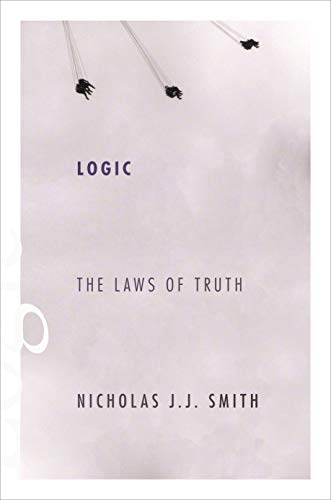
Ebook Info
- Published: 2012
- Number of pages: 545 pages
- Format: PDF
- File Size: 2.84 MB
- Authors: Nicholas J.J. Smith
Description
Logic is essential to correct reasoning and also has important theoretical applications in philosophy, computer science, linguistics, and mathematics. This book provides an exceptionally clear introduction to classical logic, with a unique approach that emphasizes both the hows and whys of logic. Here Nicholas Smith thoroughly covers the formal tools and techniques of logic while also imparting a deeper understanding of their underlying rationales and broader philosophical significance. In addition, this is the only introduction to logic available today that presents all the major forms of proof–trees, natural deduction in all its major variants, axiomatic proofs, and sequent calculus. The book also features numerous exercises, with solutions available on an accompanying website.Logic is the ideal textbook for undergraduates and graduate students seeking a comprehensive and accessible introduction to the subject.Provides an essential introduction to classical logicEmphasizes the how and why of logicCovers both formal and philosophical issuesPresents all the major forms of proof–from trees to sequent calculusFeatures numerous exercises, with solutions available at http://njjsmith.com/philosophy/lawsoftruth/The ideal textbook for undergraduates and graduate students
User’s Reviews
Reviews from Amazon users which were colected at the time this book was published on the website:
⭐By Laura B.”Logic, therefore, as the science of thought, or the science of the process of pure reason, should be capable of being constructed a priori.”-Arthur Schopenhauer, The Art of Controversy (“a priori” is defined as deduced from self-evident premises)”We ought in fairness to fight our case with no help beyond the bare facts: nothing, therefore, should matter except the proof of those facts.”-Aristotle, Rhetoric1. Nowhere in this book “Logic: The Laws of Truth” is it mentioned that premises must be supported by evidence. (Imagine that, an introductory logic text that never mentions the need for supporting evidence?? It’s almost as though the author of this book didn’t want you to have any ability to discern between a true premise and a false one.)2. Nowhere in this book is it mentioned that relevant evidence must not be suppressed. That’s right! The logical fallacy of suppressed evidence is completely omitted from this book! (Just imagine for a moment that you are going to be tried in a court that could bring charges against you that aren’t supported by evidence, and, that they can suppress relevant evidence that would exonerate you. What do you think your chances of getting a fair trial will be?)3. Nowhere in this book are the classical logical fallacies defined or even listed. Classical formal and informal logical fallacies such as the nonsequitur, the undistributed middle, argumentum ad hominem, argumenum ad verecundiam, argumentum ad populum, argumentum ad misericordiam, etc., have been used for time immemorial as tools to reveal defects in the premises and structure of arguments. They are completely omitted from “Logic: The Laws of Truth”.4. The vast majority of the book “Logic: The Laws of Truth” is symbolic logic, about which Professor Paul Kreeft offers the following in his book “Socratic Logic”, “I have never found anyone except a professional philosopher who actually used symbolic logic in an actual conversation or debate.” This replacing of Classical Logic by Symbolic Logic reminds me of a passage from arguably the greatest book about modern political science ever written:”Don’t you see that the whole aim of Newspeak is to narrow the range of thought? In the end we shall make thoughtcrime literally impossible, because there will be no words in which to express it.”-George Orwell, 1984In short, with this book “Logic: The Laws of Truth” Nicholas Smith has deliberately eviscerated Aristotelian formal logic. Why he has done so is another matter.”The province of Logic must be restricted to that portion of our knowledge which consists of inferences from truths previously known; whether those antecedent data be general propositions, or particular observations and perceptions. Logic is not the science of Belief, but the science of Proof, or Evidence. In so far as belief professes to be founded on proof, the office of Logic is to supply a test for ascertaining whether or not the belief is well grounded.”- John Stuart Mill, A System of Logic”The statements that make up an argument are divided into one or more premises and one and only one conclusion. The premises are the statements that set forth the evidence, and the conclusion is the statement that is claimed to follow from the evidence.”-Patrick Hurley, A Concise Introduction to Logic (1985)”An argument expresses an inference in a special way, in terms of one or more premises that present evidence and a conclusion that is claimed to follow from that evidence. Because the antecedent of a conditional statement is not asserted to be true, it presents no evidence; and because it presents no evidence, a conditional statement is not an argument, even though it may express an inference.”-Patrick Hurley, A Concise Introduction to Logic (1985)”The fallacy of suppressed evidence is committed when an arguer ignores evidence that would tend to undermine the premises of an otherwise good argument, causing it to be unsound or uncogent. Suppressed evidence is a fallacy of presumption and is closely related to begging the question. As such, it’s occurrence does not affect the relationship between premises and conclusion but rather the alleged truth of premises. The fallacy consists in passing off what are at best half-truths as if they were whole truths, thus making what is actually a defective argument appear to be good. The fallacy is especially common among arguers who have a vested interest in the situation to which the argument pertains.”-Patrick Hurley, A Concise Introduction to Logic (1985)”When we are told something that is startling or unpleasant we may be moved to ask our informant: ‘How do you know that?’ Usually such a question is a demand for reasons: we want to know the grounds for the statement rather than to enquire what were the processes of thought through which our informant was led to make the statement in question; we are asking for some insurance; we are not willing to accept the statement without evidence. The sort of answer that would satisfy such a questioner would take the form: ‘Because it (i.e. what was originally stated) follows from so-and-so’.The reader, it is assumed, will have no difficulty in understanding the above paragraph; he is already familiar with a notion of great importance in the study of logic, namely, the notion of evidence in support of a statement. In this book it is taken for granted that our interest in logic is, for the most part, confined to the domain of evidence.”-L.S. Stebbing, A Modern Elementary Logic (1943)”Education should aim at destroying free will, so that, after pupils have left school, they shall be incapable, throughout the rest of their lives, of thinking or acting otherwise than as their school masters would have wished.”-Bertrand Russell, quoting Johann Fichte, inventor of The Prussian School System (currently used throughout The West to educate the masses)”Proletariat: Derived originally from the Latin proletarii, the name given in the census of Servius Tullius (circa 600 B.C.) to those who were of value to the state only as rearers of offspring (proles); in other words, they were of no importance either for wealth, or position, or exceptional ability.”-Jack London, The Iron Heel”One of the great figures in the literature of freedom, Jean-Jacques Rousseau, did not fear the power of positive reinforcement. In his remarkable book Emile he gave the following advice to teachers:Let (the child) believe that he is always in control, though it is always you (the teacher) who really controls. There is no subjugation so perfect as that which keeps the appearance of freedom, for in that way one captures volition itself. The poor baby, knowing nothing, able to do nothing, having learned nothing, is he not at your mercy? Can you not arrange everything in the world which surrounds him? Can you not influence him as you wish? His work, his play, his pleasures, his pains, are not all those in your hands and without his knowing? Doubtless he ought to do only what he wants; but he ought to want to do only what you want him to do; he ought not to take a step which you have not foreseen; he ought not to open his mouth without you knowing what he will say.” – B.F. Skinner, Beyond Freedom and Dignity”If you would be a real seeker after truth, it is necessary that at least once in your life you doubt, as far as possible, all things.”-Rene Descartes”We can easily forgive a child who is afraid of the dark; The real tragedy of life is when men are afraid of the light.”-Plato9/11:Architects and Engineers for 9/11 Truth9-11 Missing LinksDr Alan Sabrosky, former Director of Studies at the US Army War CollegeThe Holocaust:Bishop Richard WilliamsonDavid McCaldenDavid ColeMark WeberGermar RudolfErnst ZundelSylvia StolzCancer:Linus PaulingG. Edward GriffinDr. Nicholas GonzalezAIDS and HIV:Dr Kary Mullis (winner of the Nobel Prize)Dr Robert Willner (author of the book “Deadly Deception the Proof that Sex and HIV Absolutely do not Cause AIDS)Dr Peter Duesberg (author of “Inventing the AIDS Virus)JFK assassination:Jim GarrisonMichael Collins PiperBenjamin FreedmanSandy Hook shootings:Wolfgang Halbig”A Funny Thing Happened on the Way to the Moon” by Bart SibrelBill KaysingAll can be found on youtube.P.S.For a more detailed explanation of the classical logical fallacies and cogent reasoning see my review of “The Trivium: The Liberal Arts of Logic, Grammar, and Rhetoric” by Sister Miriam Joseph PhD.
⭐I tutor undergraduate students from this text at a leading Australian university. The text is well organised and the key introductory concepts such as truth preservation, validity, and soundness are presented in order and manner that promotes a high degree of comprehension for beginners. There are also plenty of appropriate exercises, and explanations provided refer to selected exercises and examples in a way highly conducive to improving the student’s understanding. Smith’s treatment of propositions provides a conceptual placeholder for students that prevents confusion, while accommodating development of the concept.The terms and vocabulary of the text have an understated but consistent informational tone and informational concepts are put to good use without being distracting or obstructive. They are introduced in order to promote understanding of propositions and semantic content. The concept of referring terms and semantic content is presented using the idea of the conveyance of information about a state of affairs. This demonstrates that the scholarly underpinnings of the text are informed by the latest developments in the philosophy of information and associated developments in logic (See Luciano Floridi’s analysis of ‘the information that’ in relation to his IL or information(al) logic:
⭐). This approach is also conducive to handling the concepts associated with propositions and truth.PL and truth tables are presented before trees, and then predicate logic is introduced in a helpful stepwise manner. Explanations of quantifiers, variables and scope is clear, comprehensive, and effective. Chapter 6 provides an in depth and yet accessible explanation of the differences between natural languages and PL, and helps clarify the project and theme of the entire book (the laws of truth) which is established in the earlier chapters. The progression through monadic to general predicate logic in part II is well executed with a solid step by step development and consolidation of key concepts, and again the theme of the book is reinforced.The syntactic/semantic distinction is treated well throughout and the notation is presented systematically in a helpful manner in step with the explanatory content.I found the text excellent for my own revision, and would recommend it for that purpose and for the purpose of tutoring undergraduate students.P.S. Like most Kindle editions, this one would benefit from a mapping of page numbers to location numbers in the text, but the sections and exercises are all labelled amply with section and subsection numbers and so it is not difficult to search for the material students are interested in referring to from their hardcopy texts.
⭐The way I am completing my degree I did not have a chance to do a formal logic course (only an informal / critical thinking unit). I am using this book to fill the gap, and have to say for self-study it would be hard to go past this book. It goes beyond the basic mechanics to cover deeper philosophical issues like implicature and so on, and goes over the subjects of completeness and the like. It also includes trees, truth tables and a bit of natural deduction and other methods. I think for anyone self-studying with only one book to take them from a beginning level to a fairly good understanding to prepare for intermediate / advanced texts, this is about as good as it gets. I didn’t start as an absolute beginner so I can’t say how easy it is to start from scratch with this text but I’d say most would find it clear. Substitute with some others if you need more examples, but this has been great for my purposes.
⭐This book was purchased for a Logic and Critical Thinking class that I am taking this semester. For the type of information that this subject requires, the book is actually well-written and easy to understand. There are a number of examples and illustrations with detailed information concerning the information they are projecting for a student to learn. It’s overall a very well put together book.
⭐Provides a viable structure for a theology of truth.
⭐It worked for the college class
⭐Claro, conciso, nada aburrido. Es la obra de alguien que sabe mucho de lógica y lo sabe contar muy bien.Looks good
Keywords
Free Download Logic: The Laws of Truth in PDF format
Logic: The Laws of Truth PDF Free Download
Download Logic: The Laws of Truth 2012 PDF Free
Logic: The Laws of Truth 2012 PDF Free Download
Download Logic: The Laws of Truth PDF
Free Download Ebook Logic: The Laws of Truth