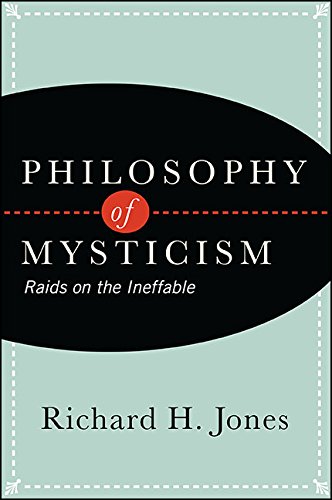
Ebook Info
- Published: 2016
- Number of pages: 440 pages
- Format: PDF
- File Size: 2.02 MB
- Authors: Richard H. Jones
Description
A comprehensive exploration of the philosophical issues raised by mysticism.This work is a comprehensive study of the philosophical issues raised by mysticism. Mystics claim to experience reality in a way not available in normal life, a claim which makes this phenomenon interesting from a philosophical perspective. Richard H. Jones’s inquiry focuses on the skeleton of beliefs and values of mysticism: knowledge claims made about the nature of reality and of human beings; value claims about what is significant and what is ethical; and mystical goals and ways of life. Jones engages language, epistemology, metaphysics, science, and the philosophy of mind. Methodological issues in the study of mysticism are also addressed. Examples of mystical experience are drawn chiefly from Buddhism and Advaita Vedanta, but also from Christianity, Judaism, Islam, and Daoism.Among his many books, Richard H. Jones is the author of Mysticism Examined: Philosophical Inquiries into Mysticism, also published by SUNY Press.
User’s Reviews
Reviews from Amazon users which were colected at the time this book was published on the website:
⭐This 2016 book offers a thorough philosophical analysis of mysticism for present times. As the author noted in the preface of his work, “A comprehensive treatment of the basic problems in [the field of mysticism] is long overdue. No major comprehensive book on the philosophy of mysticism has been published since Walter Stace’s Mysticism and Philosophy in 1960…. Since then, a number of developments and new issues have arisen – in particular, those raised by postmodernism and scientific research.”Jones deeply understands his subject matter at an intuitive level, and he thoroughly addresses contemporary matters affecting mysticism through clear and profound thinking. He is among the greatest philosophers of mysticism alive today.
⭐This book is very well written, and dense with ideas and information. It’s one of the best books I’ve read in years.
⭐Richard H. Jones’s Philosophy of Mysticism: Raids on the Ineffable is a watershed work in the tumultuous and often confusing history of scholarly raids into the question of mysticism. A philosopher by training who has authored numerous books on a variety of aspects of mystical phenomena, Jones is carrying out in this book a dispassionate, methodical, and, crucially, philosophical cross-examination of “both explicit claims and implicit claims entailed by practices” of mystical traditions and individual mystics. And he does it in a comprehensive as well as critical way that, to my mind, renders out-of-date much if not all of what has been done in this regard until now (or at least implicitly reveals them as being either woefully incomplete or else far less significant than they may have appeared). “Philosophers ask questions that mystics may find irrelevant to how they lead their lives. . . . The philosophical approach leads to basic questions. Do mystics in fact have unique experiences? How do their experiences relate to their claims? Are these experiences cognitive? That is, do mystics gain insights into the nature of reality, or are mystics delusional in some way? Does the scientific study of meditation invalidates mystical claims or in fact validate them? Do the experiences justify belief in transcendent realities? Is only one particular view of alleged transcendent realities justified? Can mystics express what they experience? Are mystics irrational in their discourse and arguments? Do their experiences have any necessary consequences for values and morality?” The range of Jones’s inquiry is remarkable, in addition to possessing essential critical depth and creative insight; it is long overdue indeed. Engaged are “all the major areas of philosophy”: epistemology, metaphysics, philosophy of language, ethics, philosophy of science, and so on. Perhaps what stands out most significantly for this reviewer—apart from the thoroughness and distinctiveness with which the book tackles the above questions, all the while exhibiting firsthand knowledge of the matter practically on every page of this weighty book—is Jones’s ability, as well as courage, to identify gaps in our scholarly apparatus with its customary knowledge systems that can easily confound and prejudice one’s research into things mystical. He formulates and offers his own—suddenly seen as being quite necessary—new perspectives and their related terms. “Mystical knowledge,” he states in a notable example of such original construction of meaning, “if valid, is a third type of knowledge not recognized by modern philosophy: a receptive knowledge by participation or knowledge by identity where there is no object separated from the knower. It is a direct knowledge in the way that knowledge of a distinct object is not: one has become what is experienced.” The book’s objective investigation results in an ostensibly “negative” finale: “If mystical experiences are genuine [they are for Jones], mystics are aware of aspects of reality that nonmystics miss, but the experiences still give less knowledge and fewer values than mystics typically believe. Mysticism gives an experiential sense that there is more to reality than we previously supposed, but philosophy reveals that we know less than we supposed” (emphasis added). Some readers might challenge such a categorical stance apropos that which goes by the name of “mysticism,” an umbrella term for a vast range of manifestations, after all. What is crucial, however, in terms of what will concern the would-be reader of this momentous book, is that he or she has a valuable opportunity to carefully examine, jointly with this profound and original author, some of the most fundamental philosophical questions pertaining to the ever-mystifying domain of mystical phenomena.
⭐Caveat Emptor*Professor! What is ‘Oneness’? Oneness, is a synonym for a mystic experience. A mystic experience is one that cannot be described in words. It is ineffable.Professor! As you refer to the original and very informative Mysticism and Philosophy by W.T. Stace, 1960, What is ‘Brahman’? Brahman, is a synonym for a mystic experience. A mystic experience is one that cannot be described in words. It is ineffable.420 pages that does nothing more than paraphrase ‘ineffable’ – like it’s stuck in a mental loop.Want to learn more about the tunnel experience, the OBE and such?These are not in our professors’ vocabulary.Moreover we are to understand that: “Both the experience and what is experienced are ineffable (i.e., cannot be adequately expressed in any words or symbols); Oh, and that will be $29.99, please!Taff, R & D person, Information Technology, Rtd.*What we have here is akin to to used car salesman speak, with the addition that he doesn’t actually have any cars at all!There is a a very effable Anglo-Saxon word that is most applicable here.What kind of market do these publishers operate in?
Keywords
Free Download Philosophy of Mysticism: Raids on the Ineffable in PDF format
Philosophy of Mysticism: Raids on the Ineffable PDF Free Download
Download Philosophy of Mysticism: Raids on the Ineffable 2016 PDF Free
Philosophy of Mysticism: Raids on the Ineffable 2016 PDF Free Download
Download Philosophy of Mysticism: Raids on the Ineffable PDF
Free Download Ebook Philosophy of Mysticism: Raids on the Ineffable