Ebook Info
- Published: 2009
- Number of pages: 680 pages
- Format: PDF
- File Size: 3.95 MB
- Authors: Jaekwon Kim
Description
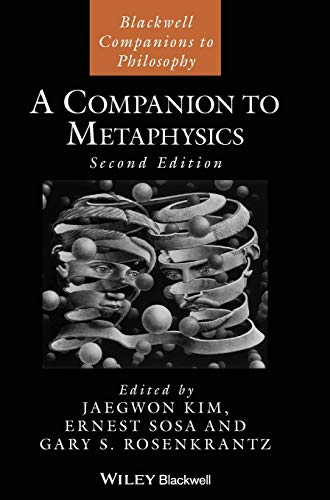
Fully extended and revised, A Companion to Metaphysics 2nd Edition includes a section of detailed review essays from renowned metaphysicians, and the addition of more than 30 new encyclopedic entries, taking the number of entries to over 300. Includes revisions to existing encyclopedic entriesFeatures more than 30 all-new “A to Z” entriesOffers a section of in-depth, essays from renowned metaphysiciansProvides the most complete and up-to-date reference guide for students and professionals alike
User’s Reviews
Editorial Reviews: Review ?This is a resource no metaphysician in the Anglo-American tradition will want to do without. Summing Up: Essential.? (CHOICE, October 2009) Review Almost since it first came into print, I have used the first edition of Metaphysics: An Anthology in upper level undergraduate metaphysics courses. I also use it whenever I teach a graduate survey of metaphysics. The second edition is not just new, but new and improved. And I intend to use it in future metaphysics courses. -Trenton Merricks, University of Virginia A thorough compilation of essential readings. Anyone seriously interested in contemporary analytic metaphysics needs to know these pieces. The nicely updated second edition adds papers foundational to the next generation of metaphysical research. -Mark Heller, Syracuse University The second edition of Metaphysics: An Anthology is a splendid update of the already-excellent first edition. Thirty new articles by well-known younger philosophers join recent classics to bring this comprehensive collection right up to the moment. -Lynne Rudder Baker, University of Massachusetts – Amherst An outstanding collection of classic to contemporary essays on some of the most interesting topics in metaphysics. It would provide a great basis for an upper-level undergraduate or graduate course in metaphysics. -Amie Thommasson, University of Miami From the Inside Flap From the Back Cover Blackwell Companions to PhilosophyThis outstanding student reference series offers a comprehensive and authoritative survey of philosophy as a whole. Written by today’s leading philosophers, each volume provides lucid and engaging coverage of the key figures, terms, topics, and problems of the field. Taken together, the volumes provide the ideal basis for course use, representing an unparalleled work of reference for students and specialists alike. A Companion to Metaphysics, Second Edition Edited by Jaegwon Kim, Ernest Sosa, and Gary S. RosenkrantzSince its first publication, A Companion to Metaphysics has established itself as the leading one-volume reference resource in the field. This extended and revised new edition brings the Companion up to date. A new section of longer review essays focuses on the major topics that continue to have an abiding centrality for the field and which have seen significant developments in recent years, including Fictional Entities, Individuation, Persistence, Realism & Anti-realism about Abstract Entities, as well as Causation, Free Will, the Mind/Body Problem, Modality, Space & Time, and Substance. In addition the central A-Z section, consisting of nearly three hundred entries, has been extended with new entries on emerging topics and major metaphysicians, and the existing entries have been brought up to date where necessary. Written by leading figures in the field and offering comprehensive coverage of both historical and contemporary metaphysics and from analytic and continental traditions, the entries in this extensively cross-referenced volume combine to form a complete and up-to-date reference guide for students and professionals alike. About the Author The EditorsJaegwon Kim is William Perry Faunce Professor of Philosophy at Brown University. His publications include a number of influential papers in metaphysics and philosophy of mind, and the books Supervenience and Mind (1993), Mind in a Physical World (1998), Physicalism, or Something Near Enough (2005), and Philosophy of Mind, 2nd edn. (2006). He is co-editor of Blackwell’s Epistemology: An Anthology, 2nd edn. (2008). Ernest Sosa is Board of Governors Professor of Philosophy at Rutgers University. With Jonathan Dancy he is also co-editor of another volume in the Blackwell Companions to Philosophy Series: A Companion to Epistemology (1993); and, with Laurence BonJour, of Epistemic Justification (2003), a volume in the Blackwell Great Debates in Philosophy series. His other publications include Knowledge in Perspective (1991), A Virtue Epistemology (2007), and Reflective Knowledge (2009). Gary S. Rosenkrantz is Professor and Head, Department of Philosophy at the University of North Carolina at Greensboro. A practicing metaphysician for more than 30 years, Professor Rosenkrantz’s published books include Haecceity: An Ontological Essay (1993), and three works co-authored with Joshua Hoffman: Substance Among Other Categories (1994), Substance: Its Nature and Existence (1996), and The Divine Attributes (2002). Read more
Reviews from Amazon users which were colected at the time this book was published on the website:
⭐One of the great controversies in 20th century philosophy of science concerned the role and function of metaphysics. The logical positivists and after them the logical empiricists devoted some decades to the quest for meaning or cognitive significance to be defined by some version of the verification principle. Karl Popper took a different path because he could see that the verification principle was never going to do the work that was demanded of it. In Logik der Forschung (1935) he offered an alternative program which accepted the role of metaphysics while insisting on the need for testability and attempted falsification to maintain high standards of criticism in scientific practice.In addition to the “negative” role of eliminating errors, criticism (not just empirical testing) has a positive role to play by locating problems which are the growing point of science. Problems can be seen as ecological niches that can be colonised by new ideas (attempted solutions).Popper’s program developed in later years to include a theory of metaphysical research programs which exert a constant influence on the activities of scientists, whether they are aware of this or not. Popper’s point was to maintain a critical watch on the role of metaphysical programs with the hope of improving them. This aspect of Popper’s work should be a matter of great interest to everyone working on metaphysics but the Popper entry in this volume does not mention it.JJE Gracia contributed a one-page entry referring to The Logic of Scientific Discovery, the 1959 English translation of Logid der Forschung. He wrote that Popper and the logical positivists shared the framework assumption that first-order logic is a legitimate tool to capture the structure of science.”If logical positivists tried to build scientific structure on singular factual sentences that could be verified, Popper tried to build scientific structure on universal sentences that could be falsified: logical positivists had trouble figuring out how universal statements could be verified while Popper had trouble figuring out how singular sentences representing data points that could falsify scientific generalizations could themselves be scientific”.That is a very limited gloss on Popper’s ideas about testing theories and the function of his demarcation criterion. He confused Popper’s criterion for scientific statements (formulated to provide an alternative program to the positivists) with the whole domain of scientific discussion and investigation where the formulation of statements occurs. The statements under discussion in that domain, or in the scientific community, or indeed in the community at large, may or may not be “scientific” in the limited and technical sense defined by the demarcation criterion. For that reason it was not a problem for Popper to work out how singular statements could be scientific.In the light of Popper’s theory of metaphysical research programs it is disappointing that this large volume, devoted to metaphysics, with some hundreds of entries, did not contain any hint of Popper’s contribution to the topic which was in print from 1982 in the Postscript to The Logic of Scientific Discovery, in addition to earlier references in Conjectures and Refutations (1963) and his autobiography (1974).
⭐It came perfectly.
⭐
Keywords
Free Download A Companion to Metaphysics 2nd Edition in PDF format
A Companion to Metaphysics 2nd Edition PDF Free Download
Download A Companion to Metaphysics 2nd Edition 2009 PDF Free
A Companion to Metaphysics 2nd Edition 2009 PDF Free Download
Download A Companion to Metaphysics 2nd Edition PDF
Free Download Ebook A Companion to Metaphysics 2nd Edition