

Ebook Info
- Published: 2005
- Number of pages: 160 pages
- Format: PDF
- File Size: 7.49 MB
- Authors: C. John Collins
Description
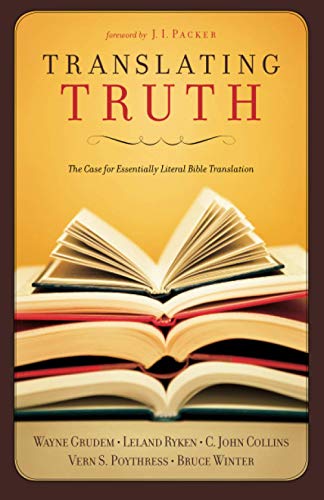
Which translation do I choose?In an age when there is a wide choice of English Bible translations, the issues involved in Bible translating are steadily gaining interest. Consumers often wonder what separates one Bible version from another.The contributors to this book argue that there are significant differences between literal translations and the alternatives. The task of those who employ an essentially literal Bible translation philosophy is to produce a translation that remains faithful to the original languages, preserving as much of the original form and meaning as possible while still communicating effectively and clearly in the receptors’ languages.Translating Truth advocates essentially literal Bible translation and in an attempt to foster an edifying dialogue concerning translation philosophy. It addresses what constitutes “good” translation, common myths about word-for-word translations, and the importance of preserving the authenticity of the Bible text. The essays in this book offer clear and enlightening insights into the foundational ideas of essentially literal Bible translation.
User’s Reviews
Editorial Reviews: About the Author C. John Collins (PhD, University of Liverpool) is professor of Old Testament at Covenant Theological Seminary in St. Louis, Missouri. He has been a research engineer, church-planter, and teacher. He was the Old Testament Chairman for the English Standard Version Bible and is author of The God of Miracles, Science and Faith: Friends or Foes?, and Genesis 1–4: A Linguistic, Literary, and Theological Commentary. He and his wife have two grown children.Wayne Grudem (PhD, University of Cambridge) is Distinguished Research Professor of Theology and Biblical Studies at Phoenix Seminary. He is a member of the Translation Oversight Committee for the English Standard Version of the Bible, the general editor of the ESV Study Bible, and the author of over twenty-five books. Vern S. Poythress (PhD, Harvard University; ThD, University of Stellenbosch) is Distinguished Professor of New Testament, Biblical Interpretation, and Systematic Theology at Westminster Theological Seminary in Philadelphia, Pennsylvania, where he has taught for four decades. In addition to earning six academic degrees, he is the author of numerous books and articles on biblical interpretation, language, and science.Leland Ryken (PhD, University of Oregon) served as professor of English at Wheaton College for nearly fifty years. He served as literary stylist for the English Standard Version Bible and has authored or edited over sixty books, including The Word of God in English and A Complete Handbook of Literary Forms in the Bible.Bruce William Winter (PhD, Macquarie University) is the director of the Institute for Early Christianity in the Graeco-Roman World. Winter was previously the warden of Tyndale House at Cambridge and is currently a part-time lecturer at Queensland Theological College in Australia.
Reviews from Amazon users which were colected at the time this book was published on the website:
⭐The 5 authors were on the team that produced the ESV. They take a position that their translation method (their term is “essentially literal”) is preferred. They show bad examples of translations from paraphrase versions like The Message and good examples from the ESV and others they see as similar. They show a mixed bag from the NIV and TNIV of both good and bad examples, but one should know that the NIV is a main competitor to the ESV. I agree with all the examples they give.They also claim that ambiguous words should be left ambiguous, which I also agree with. In some sense, this book is an extended (positive) ad for the ESV, or failing that, similar translations like NASB and a (negative) ad for the NIV and anything even less “essentially literal”.A concern I have is that they do not seem to see that even their translation involves interpretation and commentary by the understandings they have and the word choices they make. For example, they are complementarian, so do not expect any verses to use an egalitarian word choice or understanding. One needs to be aware when reading any translation that all translations involve interpretation and should be seen as the translators attempt to get you to more easily agree with their interpretation, whatever it is.They do not discuss the Concordant Literal Version, which takes their method even further than they do, perhaps because it is not very well known.
⭐I found this book extremely helpful, concise and useful. The arguments were clearly built, showing respect to those who differ in opinion. I think the book could be summarized with a sentence from pg. 76: “What is at sake [in various translation models] is whether the Bible reading public with return to the real Bible or accept a substitute for it.” The question for normal people (or 18-year-old Christians like myself) is: will we care enough to find translations that communicate God’s thoughts as “essentially literally” as possible, or will we settle for letting translators interpret/level passages to make them more easily understandable and applicable (according to the translator’s definition of understanding and applicability)? The authors conclude that a more “watered-down” and “understandable” Bible is NOT communicating the true meaning of a passage accurately and maintain that if God’s words are “watered-down” and made “understandable” at the expense of HIS WORDS, then perhaps the TRUE “meaning” of the passage is lost. Whether you agree with their position or not, I feel like this book would be extremely helpful as the case is built on what Scripture says about itself and an earnest desire to be true to the Words of God which are “living and active, sharper than any two-edged sword”, and which present the only Way, Truth and Life for all people and nations.
⭐This book, following months of translation comparison and prayer, convinced me of the need for “word for word” translation of the Bible. Yes, there may be a time and place for simpler, “thought for thought” paraphrases like the NLT and Message, but they must never take the place of reading a translation that (as much as possible in English) shows the reader the WORDS of the original languages not merely the ideas a human translator thinks are important. This book is not “KJV Only.” In fact, the authors worked on the ESV. But I think, once you consider their arguments, you will likely agree with their thoughtful conclusion that not having the actual words of scripture in front of you is depriving us of what was intended, by God and the human writers. Don’t be short-changed- read it for yourself before you settle on a favorite translation!
⭐This is worth every word on understanding why literal translations, or even “Essentially Literal” translations are worth our time. They also help in discerning some common misconceptions about the ESV and NIV that enrich our desire to learn from the Bible. It also addresses some common objections in very helpful ways in regards to Paraphrased translations. I would recommend reading this by anyone, especially those who do not care for the ESV, people who burn every bible but the KJV, and those who do not understand why literal or essentially literal translations are worth the library budget.
⭐The intro by Packer and the first three essays are particularly good. The book is definitely worth buying and reading. I’d give it 4 stars.However, in the first essay in the Kindle edition, authored by WAYNEGRUDEM (and that is just how his name appears), “A SPECTRUM OF TRANSLATIONS” is formatted very, very poorly. It’s almost unreadable. Additionally, throughout the book, where there is text in italics, there is no space between the italic word(s) and the next word. Just plain lousy formatting.The book is great. The Kindle edition is crummy. I have concluded that any book likely to have charts or graphs should not be purchased in the Kindle format. Any reference work is useless without a thorough table of contents and an excellent index. This is not the first Kindle book where I’ve encountered poor formatting. From here on, I’ll purchase only fiction in a Kindle version – charts and graphs have never been an issue there. Perhaps the iBooks or Nook version has been more carefully formatted?
⭐This polemic is written to cover the imperfections of the English Standard Version of the Bible. The authors seem to have a vested interest in the success of that translation. Attacking the translation work of other scholars is not worthy of the body of knowledge these authors possess. I gave up about halfway through the book.
⭐Good resource.
⭐This book was well written. The writer brought complicated thoughts down to a level that the masses could understand the issues. Excellent Book!
⭐This book lays out the straigh-forward facts about what Bible Translation is and ought to be, and the pros and cons of the two approaches that are now at War – these being ‘Essentially Literal’ and ‘Dynamic Equivelence’. We all know that when Bible translations are made for alien cultures that a certain degree fo ‘equivelence’ is necessary, but not when the straight translation still makes sense. Given that the Bible itself lays such emphasis on every word of God being so important, even to the minutae of differentiating between a Singular Noun ‘Abrahams SEED’ and a Plural ‘SEEDS’, and the fact that there are already excellent EL Bibles available in Good modern English e.g. the ESV, should we not be concerned that so many ‘Dumbed Down’ and inaccurate versions are now being promoted so heavily? Should we be dumbing down and altering the very words of God to pander to illiteracy, Political Correctness and worldly agendas? Surely the TRUTH cannot be altered else it is no longer the truth. This book is a collection of essays by some very wise and learned People, who make a very strong case for retaining the ‘actual’ words of God in their original text and context, and for translations into Plain English from the Greek and Henbrew to be based upon standard lexicons rather than ‘equivelent’ words. For exmaple if Jesus chose to use teh word MAN and not Men & Women, or People, shouldnt that be what we read (ESV) rather than as in the TNIV where the words are changed? Well done to these men who have fought continually on our behalfs to ensure that these constant attacks on the TRUTH of Gods word do not go unchallenged. Pray for them !
Keywords
Free Download Translating Truth in PDF format
Translating Truth PDF Free Download
Download Translating Truth 2005 PDF Free
Translating Truth 2005 PDF Free Download
Download Translating Truth PDF
Free Download Ebook Translating Truth